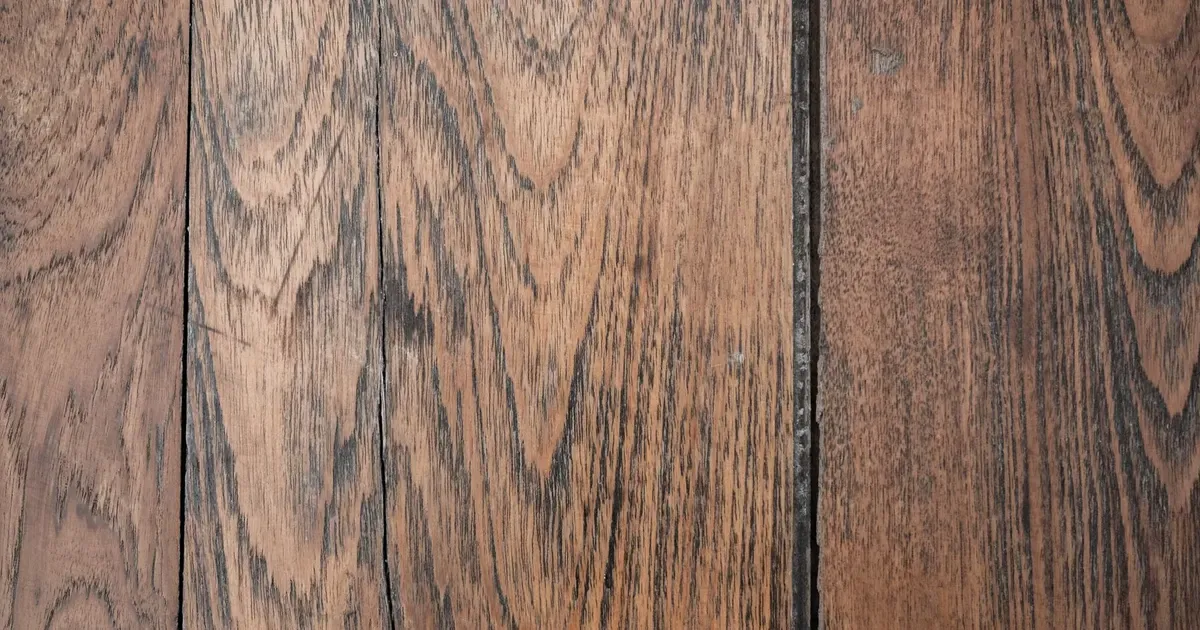
Few floor textures are asked for as often, and described as loosely, as hand scraped. Buyers send a photo of a worn farmhouse floor and write “hand scraped” in the RFQ, and the factory has to decide whether that means a person with a hand tool, a machine that imitates one, or a deep wire brush. The three give different floors, at different cost, with different risks for the wear layer. This guide explains what each one is, how a true hand scraped surface is built up, and what to put in the specification so the sample and the production lot agree.
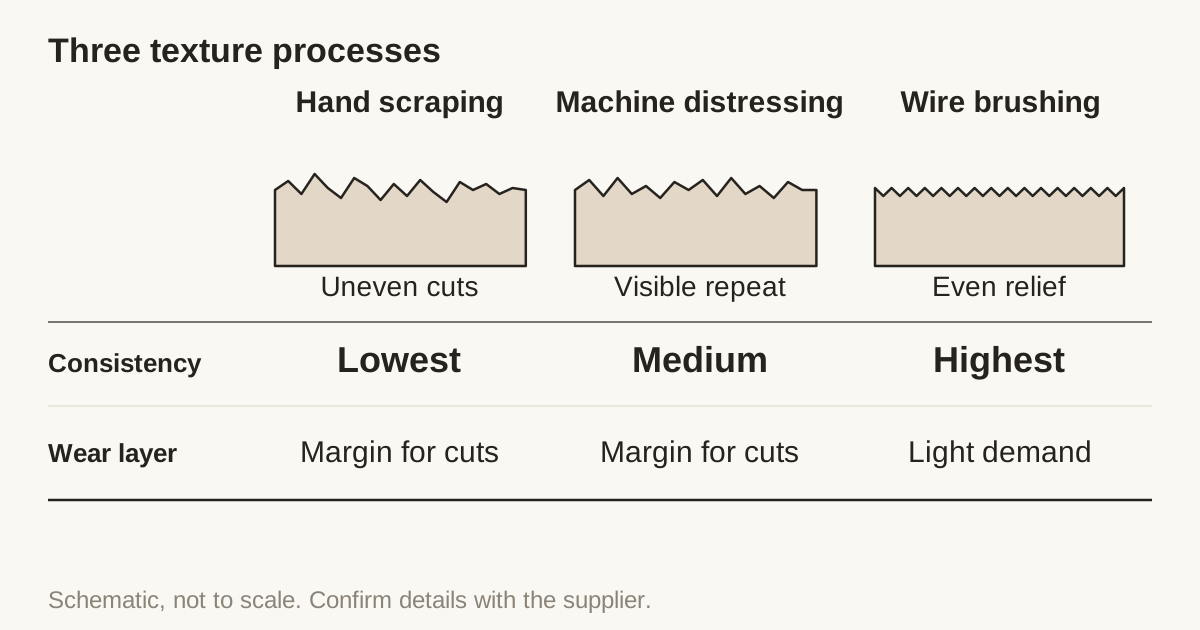
What “hand scraped” can mean
The term covers three different processes, and a specification should name which one is wanted.
- Hand scraping. A worker passes a hand tool such as a scraper, a drawknife or a plane over each board. Cuts vary in length, depth and direction because a person made them. No two boards are alike.
- Machine distressing. A machine, often a set of cutters or abrasive heads, creates an irregular surface that imitates hand work. The pattern repeats more than hand work does, but each board is closer to the next one.
- Wire brushing. Steel or abrasive brushes remove the softer earlywood and leave the harder latewood standing, so the grain opens up evenly. It is a controlled texture, not a scraped one.
| Process | How the surface is made | How it reads | Board to board consistency |
|---|---|---|---|
| Hand scraping | Hand tool on each board | Uneven cuts, soft ridges, worked edges | Lowest, by design |
| Machine distressing | Cutters or abrasive heads | Irregular, with a visible repeat over a large area | Medium |
| Wire brushing | Brushes lift softer grain | Open grain, even relief | Highest |
None is better in the abstract. A true hand scraped surface suits a lived-in interior where variation is the point. A brushed surface suits a project that needs the same look across thousands of square feet.
How a hand scraped surface is built up
The scraping itself is only one stage. The finished look comes from the sequence around it.
- Board selection. Boards with strong grain and some character show scraping best. A very clean Premium face can look empty once scraped, because there is little for the cuts to reveal.
- Scraping. The worker works the face in passes, taking more from some areas and less from others. The long edges and ends are often eased by hand so the board does not look machined.
- Light sanding. A light pass removes raised fibers and splinters without erasing the cuts.
- Color. Stain settles into the lower areas and reads darker there, which gives the worked look its depth. On a clear finish the effect is quieter.
- Topcoat. A low sheen coat protects the surface without filling the relief.
Because stain collects in the cuts, a scraped floor is more sensitive to the color system than a smooth floor is. The same stain on a scraped board and a smooth board will not look the same. Our article on how texture changes floor color covers this in more detail.
What it asks of the wear layer
Scraping removes material, and on an engineered board that material is the oak wear layer. The deeper the cuts, the less wear layer remains in those spots. This is the main technical reason to settle texture and construction together.
The wear layer options we describe on our pages are 1/16” (2mm), 1/8” (3mm), 5/32” (4mm) and 1/4” (6mm) sawn, with other thicknesses made to order. A thin wear layer leaves little margin for a deep scraped texture, while a thicker one gives the worker room and also leaves material for a future sanding. A solid board has no such limit from a core, but refinishing a heavily scraped solid floor will remove the texture, so the owner should know that before the floor is laid.
If the project calls for strong relief, say so when you ask for the construction. Our wear layer guide explains how thickness relates to sanding and to what the surface can take.
Sheen, edges and cleaning
A glossy coat picks out every dip and makes a scraped floor look busy and wet. Lower sheens keep the attention on the grain and the texture. Matte, Extra Matte and Ultra Matte are the three sheens on our Specify page, and the lower two suit worked surfaces well. See Matte, Extra Matte or Ultra Matte for how they compare.
The edge detail matters as well. A micro-bevel outlines each board and sits naturally with an irregular face, while a square edge makes the field look continuous. Our guide to square edge and micro-bevel sets out the trade-offs.
Texture holds dust. The low points of a scraped surface collect fine dirt that a smooth floor would shed, so a regular dry clean matters more. Owners who expect a very clean look in kitchens or entrances should know this before they choose it.
Grade and species behavior
Oak takes a worked surface well because the grain is open and the rays give a visible figure once the surface is cut. The grade changes how much of that shows.
- Premium and Select give a calm face. Scraping adds texture without adding much visual noise.
- Natural adds visible knots and color movement, which suits a scraped finish.
- Rustic adds larger sound knots and filled features, which can look natural under scraping but can also look crowded.
Filled features take stain differently from the surrounding wood, so they show more on a worked surface than on a smooth one. Check them on the sample, not in a photograph. The grades explained article gives the four grade descriptions.
What the Specify page offers
The texture options on our Specify page are Smooth, Light Wire Brushed, Medium Wire Brushed, Wire Brushed and Wire Brushed with Cross Marks. The last is described as brushed and then cross-worked for a more irregular, hand-worked surface. That is the closest listed option to a worked look.
A fully hand scraped surface is not one of the listed textures. If a project needs one, send the reference board and the drawing or photograph, and say that it is a request outside the listed range. What can be made, and how consistent it can be across a lot, is confirmed at quotation and agreed on an approved sample. We do not promise a result before the factory has seen what you want.
How to write it into the RFQ
Use words a factory can act on, and attach something physical.
- Name the process: hand scraped, machine distressed or wire brushed.
- Describe depth in plain terms: light, medium or heavy relief, and whether the cuts are shallow and broad or short and deep.
- State whether edges and ends should be eased.
- Give the sheen and the finish system, because both change how the texture reads.
- Send a physical board if you have one. A photograph shows the look but not the depth.
- Say how much board to board variation is acceptable. If the answer is “as much as the reference”, say that.
Ask for the sample to be made on the construction and wear layer you are ordering. A scraped surface on a thick solid board proves nothing about a thin engineered one.
Approving the sample
Variation is the point of a hand worked floor, so approval needs more than one board. Review several boards from the sample set, side by side and in the light of the room. Record what you approved: the texture description, the sheen, the color reference and the construction. That record becomes the master that production is checked against. The method is the same one described in approving flooring color on a physical sample.
A short checklist
| Question | Why it matters |
|---|---|
| Hand scraped, machine distressed or wire brushed? | The three cost and behave differently |
| What wear layer thickness? | Scraping removes it |
| Which sheen? | Gloss exaggerates texture |
| Which grade? | Knots and filled features show more |
| Edge profile? | Bevel outlines each board |
| Physical reference sent? | Photos hide depth |
| Several boards approved? | One board hides the range |
Working with Vu Uy Wood
Vu Uy Wood manufactures solid and engineered French White Oak flooring to buyer specification in Song Than 3 Industrial Park, Ho Chi Minh City, and has done so since 2006. The Specify page lists the texture, sheen and finish options, and the Colors page shows the 211-color library. If you need a worked surface outside the listed range, send the reference board with your specification. We normally reply within one working day.