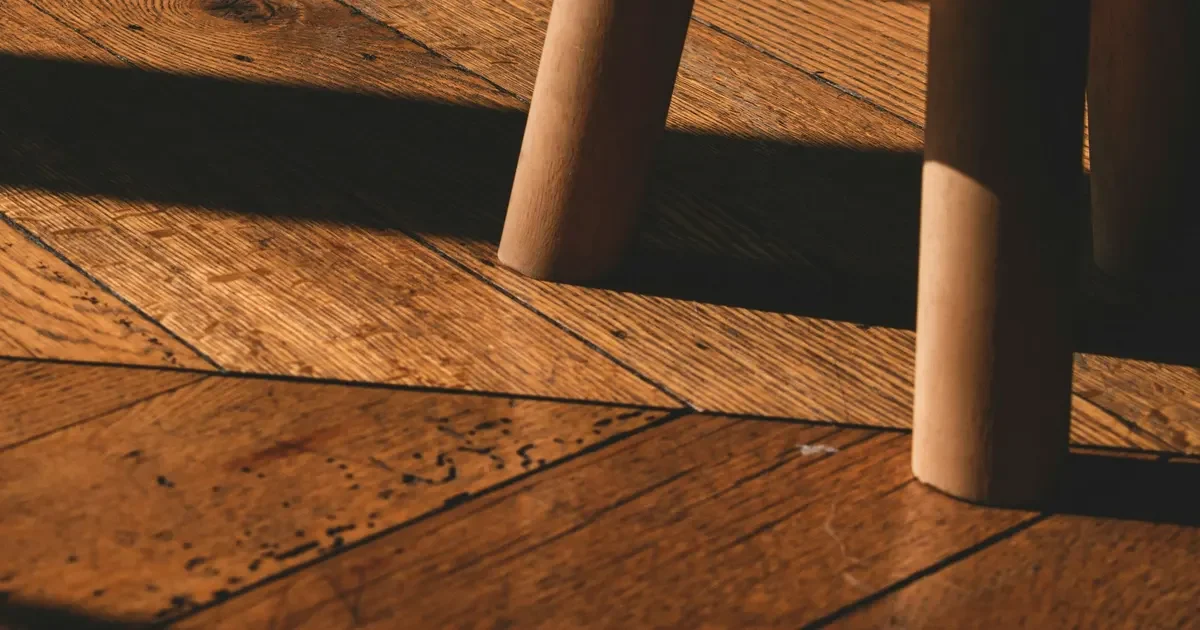
Sheen changes how a floor looks without changing its color or its wood. The same oak board, under the same stain, reads as a soft, almost raw surface at ultra matte and as a polished, reflective surface at gloss. Sheen also decides how much of everyday life shows on the floor: scratches, dust, footprints and the slight unevenness that every wood floor has. This article walks through the full sheen scale used in the flooring trade, how each level behaves in a real room, where each one suits, and which part of the scale Vu Uy Wood produces.
The sheen scale, from flattest to brightest
Flooring finishes are sold under a handful of sheen names. The order is consistent across the trade, even where the exact boundaries are not.
| Sheen name | What you see | Reflections of windows and lights |
|---|---|---|
| Ultra matte | A surface close to bare, unfinished wood | Almost none |
| Extra matte | Very low sheen, a soft and quiet surface | Faint, only at low angles |
| Matte | Low sheen with a little depth in the color | Soft and blurred at low angles |
| Satin | A gentle glow across the floor | Blurred but recognizable shapes |
| Semi-gloss | A clear shine | Visible reflections of lights and windows |
| Gloss | A mirror-like surface | Sharp reflections |
Some coating makers add their own names, such as “flat” or “dead matte”, and some split one level into two. The names are not a standard. One maker’s satin can sit closer to another maker’s matte than to its own semi-gloss. The objective way to compare is a gloss reading, covered in our article on measuring floor sheen with a gloss meter. The practical way is a physical sample.
What makes one finish duller than another
Every finish reflects some light like a mirror and scatters the rest. A gloss film is very smooth at a microscopic level, so most of the reflected light leaves the surface at one angle and you see a sharp image of the window. Lower-sheen finishes contain matting agents that give the surface of the film a fine, microscopic roughness. That roughness scatters the reflected light in many directions, so the image blurs and the surface looks soft.
Two points follow. First, sheen is a property of the topcoat, not of the oak. Second, sheen is a surface effect: the same coating family can be made at different sheens, and the sheen name does not by itself tell you how well the finish resists abrasion. Wear resistance depends on the finish system and should be asked about separately.
How sheen reads in a real room
Sheen is never seen on its own. Four things in the room change how strongly it shows.
- Viewing angle. Sheen is most visible when you look along the floor toward a light source, for example down a corridor toward a window. Seen from standing height, looking down, the levels look much closer together.
- Light. Low daylight through large windows shows sheen most. Downlights make bright spots on a glossy floor and almost none on an ultra matte one.
- Color. The eye reads sheen more strongly on dark floors than on pale ones. A dark floor at satin can look shinier than a pale floor at the same sheen.
- Texture and flatness. Brushing breaks up reflections, so a brushed floor reads lower in sheen than a smooth floor with the same topcoat. In the other direction, a glossy smooth floor shows every slight difference in height between boards, because the reflection bends wherever the surface does.
Wear, scratches and dirt at each level
Sheen does not change how much wear a floor takes. It changes how much of that wear you see.
| Sheen | Fine scratches | Dust, footprints, streaks | Long-term change in traffic paths |
|---|---|---|---|
| Ultra matte, extra matte | Least visible | Blend into the surface | Can polish up slightly where feet pass |
| Matte | Low visibility | Low visibility | Small change |
| Satin | Moderate | Moderate | Visible under low light |
| Semi-gloss, gloss | Most visible | Show clearly, including cleaner streaks | Dulls in paths, with contrast against untouched areas |
Both ends of the scale change over time, in opposite directions. A glossy floor loses sheen where people walk, and a very flat floor can gain a little sheen as the surface is burnished by foot traffic. In both cases the traffic path becomes visible because it no longer matches the rest of the room.
Cleaning products play a part too. Polishes and some cleaners leave a film that raises the sheen of a matte floor in patches. Use the cleaner recommended for the finish system.
Where each level suits
| Setting | Usually suits | Why |
|---|---|---|
| Homes with large windows | Extra matte or ultra matte | Low glare, wear less visible in raking light |
| Family homes with children and pets | Matte or extra matte | Scratches and dust stay quiet |
| Hotel corridors and retail floors | Matte or extra matte | Long sight lines show sheen, and low sheen hides traffic |
| Offices | A low sheen | Less glare on screens and from overhead light |
| Formal or period interiors | Satin or higher, if the design calls for it | A reflective floor is part of the look |
| Matching an existing floor | The existing floor’s sheen | A sheen mismatch shows as clearly as a color mismatch |
Low sheens are the common choice for oak because they keep the floor looking like wood. Higher sheens suit interiors that want a polished floor and owners who accept the extra care.
Sheen and the finish system
Sheen is set by the topcoat, so the finish system decides where and when it is set. With a factory UV finish, sheen is fixed on the finishing line and arrives on the board. With an unfinished floor, sheen is set on site by the product the installer applies. Finish families also differ in their usual range: lacquers and polyurethanes are made across the scale, while oil finishes usually sit toward the low end. Our comparison of hardwood floor finish types covers each family.
Sheen returns as a question at maintenance. A recoat sets a new sheen, and a recoat at a different sheen from the original shows wherever new meets old. See recoating and repairing lacquered and oiled floors.
What Vu Uy Wood produces
Our UV finishing line produces three sheens: Matte, Extra Matte and Ultra Matte. They are available across the three prefinished routes (Clear UV, Color UV, and Color and Effect UV) and across the five surfaces, from Smooth to Wire Brushed with Cross Marks. For the differences between those three levels, see Matte, Extra Matte or Ultra Matte.
If a project needs satin, semi-gloss or gloss, ask whether it can be produced; it is confirmed at quotation and on an approved sample. If the floor will be finished on site, order the Unfinished route and set the sheen with the installer and the finish maker.
How to choose and approve sheen
- Start with the room’s light. Think about window size, orientation and the main sight lines before choosing a name.
- Choose sheen together with color and texture. A darker color or a smooth face makes sheen more visible.
- Compare two levels side by side on samples of the same color, texture and finish system.
- Look from a low angle as well as from standing height, in daylight and under the project’s lighting.
- Write the sheen name on the approval, with finish system, color, texture and grade. The approved sample, not the name, is the reference for production.
Working with Vu Uy Wood
Vu Uy Wood manufactures made-to-order solid and engineered French White Oak flooring in Song Than 3 Industrial Park, Ho Chi Minh City, and has done so since 2006. Matte, Extra Matte and Ultra Matte are applied on our own UV finishing line, and sheen is chosen together with finish system, color and texture on the Specify page. We normally reply within one working day.