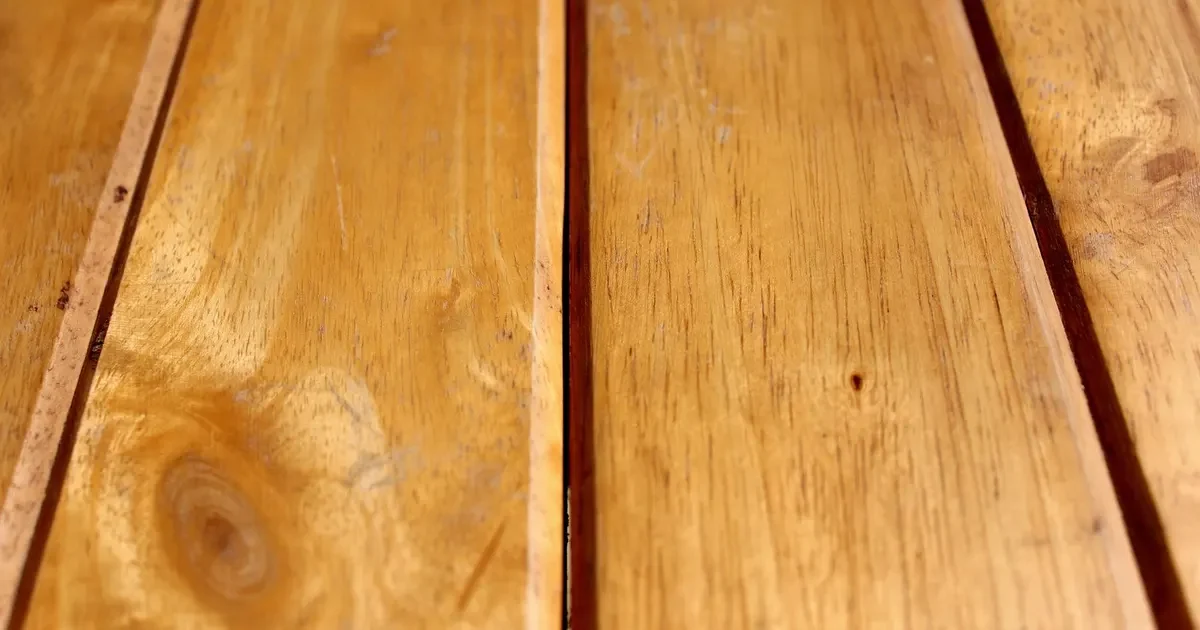
A painted bevel is a small detail that changes how a floor reads from across the room. The edge of each board is cut at an angle and then given its own color, usually darker than the face, so every plank is outlined by a fine colored line. Buyers ask for it on wide boards and light floors, where it gives the plank format a clear structure. This guide explains how the edge is made and colored, what it takes from the board, and how to describe it so the factory builds what you drew.
What a painted bevel is
Start with the bevel itself. On the face of a board, where the top surface meets the side, the sharp corner can be left square, softened with a very small chamfer or cut with a larger angle. Our article on square edge and micro-bevel covers the first two. A painted bevel is the third case with an extra step: the cut surface is colored separately from the face.
Three things distinguish it from an ordinary bevel.
- The bevel is larger. A micro-bevel is a hairline. A painted bevel needs enough width to hold a visible band of color.
- The color differs from the face. On an ordinary prefinished floor, the bevel is stained and coated along with the face and carries the same color. A painted bevel is deliberately different, which is why it reads as a line.
- The color is applied to the edge only. The face and the edge are colored in separate steps.
How the edge is colored
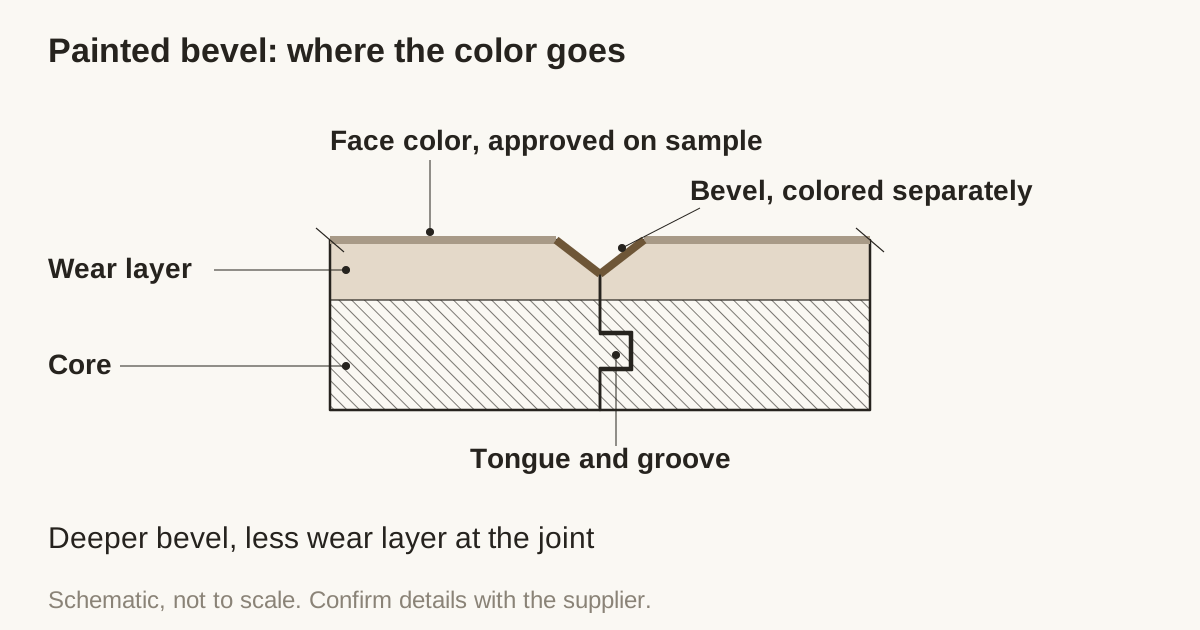
The principle is simple: the boards are profiled first, then the edge is colored, then the whole board is sealed.
- Profiling. The tongue and groove and the bevel are milled. Accuracy here decides whether the color band is the same width along the whole board.
- Face finishing. The face is stained and coated to the approved color.
- Edge coloring. Color is applied to the bevel only, by a roller, a spray head or another applicator set to the angle of the cut. Masking or precise application keeps the color off the face.
- Curing and sealing. The coating is cured, and a clear coat or the topcoat protects the edge.
The order can change with the system. In some routes the edge is colored before the face coat, so the topcoat covers both. In others the edge is colored last. What matters for the buyer is that the edge color is tied to a physical sample, because the same pigment looks different on a tight bevel than it does on a flat face.
What the bevel takes from the board
A bevel removes material at the edge of the face. On an engineered board, that material is the oak wear layer. The deeper the cut, the less wear layer is left at the joint.
| Bevel type | Typical effect | Wear layer demand |
|---|---|---|
| Square edge | Continuous face, no line | None |
| Micro-bevel | Fine outline, hides small height differences | Very small |
| Larger bevel, painted | Clear colored outline on every board | Higher, because the cut is deeper |
This is a reason to settle the bevel together with the construction. The wear layer options on our pages are 1/16” (2mm), 1/8” (3mm), 5/32” (4mm) and 1/4” (6mm) sawn, with other thicknesses made to order. A thin wear layer limits how deep a bevel can go without leaving the edge fragile. Our wear layer guide explains the relationship to sanding and wear.
A painted bevel also affects refinishing. Sanding a floor flat takes the bevel with it, so a painted bevel suits a prefinished floor that will not be sanded, not an unfinished floor that will be sanded on site. Unfinished boards usually take a square edge for exactly this reason.
How it looks and behaves in use
- Light floors with a dark edge look drawn, in the manner of a pencil line around each board. The effect is graphic and clear.
- Dark floors with a darker edge give a quiet shadow that adds depth without a strong line.
- Wide boards gain the most, because the line breaks up a large face and sets the rhythm.
- Grade. A Premium or Select face leaves the edge to lead. A Natural or Rustic face has its own movement, and the painted line can compete with it.
- Dirt. A bevel is a small groove. Fine dust and grit gather in it and show as lines, and a dark painted edge hides them better than a light one.
- Wear. The edge sees traffic from chairs, boots and vacuum heads. The coating should be cured and sealed, and an edge that chips will show raw wood or the base color below. Ask about adhesion on the sample.
Where a painted bevel suits a project
A painted bevel works best where the floor is meant to read as boards. Retail spaces, showrooms and hospitality interiors use it to give a wide plank floor a graphic structure. In homes it tends to appear in open living areas with light floors, where the line keeps a large surface from looking flat.
It is a weaker choice where the owner wants a calm, continuous surface, or where the floor will be sanded and refinished within its life. In those cases a square edge or a micro-bevel in the face color is the safer route.
Sheen and texture
Sheen changes how the line reads. A glossy coat makes the colored edge shine and look like trim. Lower sheens make it quieter and more integrated. Texture also matters, because a wire brushed face with a painted bevel has relief on both sides of the line. Our articles on choosing floor sheen and wire brushed against smooth oak explain how the two interact.
What the Specify page offers
At Vu Uy Wood, Tongue & Groove is machined on all four sides. Square edge is available on request and micro-bevel is added where specified. In both cases the edge is stained and coated along with the face, so it carries the same approved color.
A separately painted or pigmented bevel is not one of the options listed on our Specify page. If your project needs one, include it in the RFQ as a request outside the listed range and send a reference board. Whether it can be made, how wide the bevel can be on your construction and how consistent the line is across a lot are confirmed at quotation and agreed on an approved sample. We do not promise a result before we have seen the reference.
Writing the specification
Be specific, because “painted bevel” alone leaves the factory guessing.
- State the bevel: on the long edges only, or on all four sides including the ends.
- Give the width of the bevel and its angle, or send a drawing of the profile.
- Name the edge color against a physical reference, and say whether it is darker or lighter than the face.
- State the construction and wear layer thickness.
- Give the sheen and the finish system.
- Say whether the floor will be sanded after installation. If it will, a painted bevel is not suitable.
Approving the sample
Judge the line, not the board. Put several boards together and lay them as they will lie in the room, because a bevel only shows once there are joints. Look from standing height and from a low angle, and check the color of the edge against the reference in daylight and under the room lighting. Check that the line is even in width, that the color stays off the face and that the corners at the ends are clean. Record what you approved. The method is the same one described in approving flooring color on a physical sample.
Questions to ask
| Question | A clear answer covers |
|---|---|
| Long edges only, or all four sides? | Where the line runs |
| What bevel width and angle? | The profile and the color band |
| What edge color reference? | A physical standard |
| What wear layer thickness? | Margin for the cut |
| Is the floor sanded after installation? | Whether the edge survives |
| Is the sample the production construction? | A sample that predicts the lot |
Working with Vu Uy Wood
Vu Uy Wood manufactures solid and engineered French White Oak flooring to buyer specification in Song Than 3 Industrial Park, Ho Chi Minh City, and has done so since 2006. The Specify page turns your construction, width, grade, color and finish selections into a written brief, and a profile drawing can be sent with it. We normally reply within one working day.