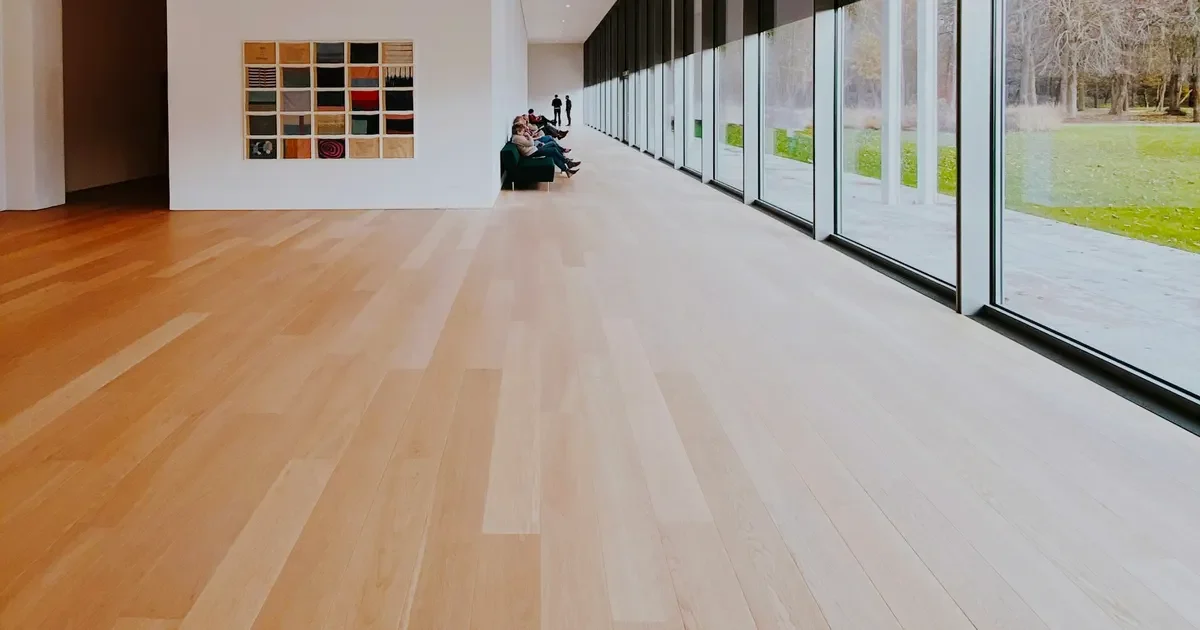
Freshly sanded oak has a look that many designers want to keep: pale, dry, slightly chalky, with the grain quiet and the color close to straw. The difficulty is that a floor cannot be left bare. It needs a finish to resist dirt and wear, and almost every finish changes that look the moment it touches the wood. A raw-look finish is the attempt to protect the floor while undoing that change. It is a narrower target than a general “natural” floor, and it needs its own approach. This guide explains why oak darkens under a clear coat, which levers restore the raw look, and how to approve the result.
Raw look is not the same as natural
“Natural” covers several looks, from oak’s own warm color under a clear coat to a light stained tone. Our article on natural oak look flooring sets out all of them. Raw look is one specific target within that range.
| Look | What the floor should resemble | Typical route |
|---|---|---|
| Oak as finished | The real tone of oak under a clear coat, with its warmth | Clear topcoat, no stain |
| Raw look | Freshly sanded oak with no visible coating | Lowest sheen plus a light tint that offsets the darkening |
| Light natural tone | A pale beige oak that reads as unstained | A light stain chosen from a library or a reference |
| Whitewash | Oak visibly lightened, with white held in the grain | A white stain or effect, clearly visible |
Writing which of these is wanted, in words, saves at least one round of samples. A raw-look request answered with a whitewash sample, or the reverse, is a common mismatch.
Why a plain clear coat darkens oak
Bare sanded wood looks pale for a physical reason. Its surface is full of tiny cut fibers and air gaps, and each one scatters light back to the eye before it can travel into the wood. That scattered light adds a whitish veil over the color.
A clear finish fills those gaps. The coating sits closer in optical behavior to the wood fibers than air does, so less light is scattered at the surface and more light enters the wood, where some of it is absorbed. The result is the “wet look”: deeper, warmer, more saturated color, much as a board darkens when wiped with a damp cloth.
Three further effects add to it:
- The coating’s own tone. Some clear coatings carry a slight yellow or amber tint, which warms the oak further.
- Sheen. A reflective surface lets the eye see deeper into the color, so higher sheens read darker and richer.
- Light over time. Oak mellows toward a warmer tone with exposure to light, with or without a coating.
So a plain clear coat on oak will not look raw. It is the right choice when the honest color of finished oak is the goal, as described in Clear UV vs Color UV, but not when the target is the sanded board.
The levers that bring the raw look back
Sheen
Sheen is the single biggest lever. A low-sheen surface scatters light, which restores part of the veil that the clear coat removed. Of our three sheens, Ultra Matte has the lowest reflection and is the closest to raw, unfinished oak. Extra Matte is a step up, and Matte shows some visible sheen at low angles. For a raw look, Ultra Matte is the usual starting point. The three are compared in Matte, Extra Matte or Ultra Matte.
A light tint that cancels the warm shift
Sheen alone rarely closes the gap. The second lever is a very light tint, applied under the topcoat, that offsets the darkening and warming the coating causes. In practice this is usually a small amount of white or neutral pigment that puts back some of the paleness, and sometimes a trace of a cooler tone to balance the yellow.
The balance is delicate:
- Too little and the floor still reads as clear-coated oak.
- Too much and it tips into whitewash, with white visible in the open grain and a flat, chalky surface.
- The wrong direction and the floor can look cold or lifeless rather than freshly sanded.
On our line, a tint of this kind is a Color UV route: a color stain beneath a protective UV topcoat, developed against the buyer’s reference and approved on a sample. How stains build color in the wood is explained in pigment vs dye stains on oak flooring.
Texture
Texture changes how the tint and the sheen read.
- Smooth gives the cleanest, most even raw look, with the grain closed.
- Light Wire Brushed adds touch underfoot and breaks up reflection a little more, with little change in color.
- Deeper brushing opens the grain. Any tint collects there, so the grain can read lighter or darker than the surface around it, which moves the floor away from a quiet raw look.
Grade
A raw-look floor hides very little. Premium and Select give a calm face. Natural and Rustic show knots and filled features, which can take the tint differently from the surrounding wood. Check them on the sample.
Clear UV or a tinted Color UV
| Point | Clear UV at Ultra Matte | Tinted Color UV at Ultra Matte |
|---|---|---|
| Color | Oak’s own finished tone, warmer than sanded wood | Adjusted toward a sanded board |
| Looks like | Finished natural oak | Untreated oak |
| Board-to-board variation | Fully visible | Slightly softened |
| Risk | Reads warmer than the reference | Can tip toward whitewash if overdone |
| Approval | On a physical sample | On a physical sample, side by side with the reference |
Both use the same UV topcoat on our finishing line. The difference is whether a light tint sits under it.
Using a sanded board as the reference
The best reference for a raw look is often a piece of the actual oak, freshly sanded and left bare. Two cautions apply.
- A bare reference changes. Sanded oak left in light and air starts to mellow and pick up dirt. Keep the reference wrapped and out of direct light, or sand a fresh face before comparing.
- Compare like with like. A bare board and a finished sample will never be identical, because one is protected and one is not. The aim is that the finished board reads as raw at normal viewing distance, not that it matches under close inspection.
If the reference is a photograph, treat it as a direction only. Screens shift color, and raw looks are easily misread in photos, so the final approval is always made on a physical sample.
Approving a raw-look floor
- Name the target in words: raw look, not whitewash and not oak as finished.
- Ask for a pair: a Clear UV board and a tinted Color UV board, both at Ultra Matte, on the same texture and grade.
- Place both next to the reference, in daylight and under the project lighting, and look from standing height and from a low angle.
- Review several boards, not one, so the natural variation of the grade is visible.
- Record everything on the approval: finish system, tint reference, sheen, texture and grade.
The approved sample then becomes the master reference, and color is checked against the approved master panel during production.
Working with Vu Uy Wood
Vu Uy Wood manufactures solid and engineered French White Oak flooring to buyer specification in Song Than 3 Industrial Park, Ho Chi Minh City, and has done so since 2006. Clear UV and Color UV are applied and cured on our own UV finishing line, in Matte, Extra Matte or Ultra Matte. Start from the lightest tones in our color library, then set finish, sheen and texture on the Specify page. We normally reply within one working day.