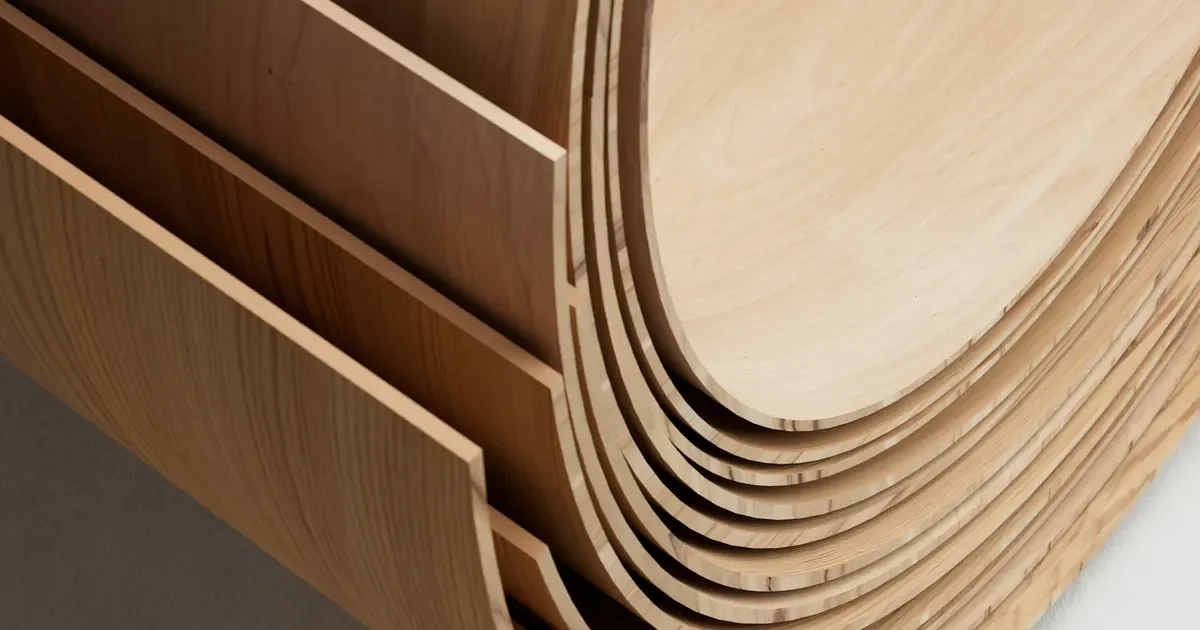
Two engineered oak boards can have the same overall thickness, the same grade and the same color, and still behave differently over the life of the floor. One reason is a detail that rarely appears on a quotation: how the oak wear layer was cut from the log. The face can be sawn, sliced with a knife or peeled off a turning log, and each method leaves its mark on the grain, the surface and the room left for future sanding. This article explains the three methods in plain terms, how to tell them apart on a sample, and what to write into the specification so there is no doubt about what is supplied.
Why the cutting method matters
The wear layer is the only oak the owner ever sees or touches. The core decides stability and floor height; the face decides whether the floor reads as real oak, how it takes a wire brush and how much oak is left for sanding.
The cutting method affects all three, and it is easy to miss, because a stained, UV-cured face does not announce how it was produced. Treat it as a line on the specification, like thickness and grade. Our wear layer guide covers thickness; this article covers the cut.
Sawn wear layers
A sawn wear layer is cut from dried oak lumber with a saw, in much the same way as a thin board. Each piece, often called a lamella, is solid oak.
What this means in use:
- Look. The face shows the same grain figure as a solid board of the same cut. Plain sawn lumber gives cathedral arches; rift and quarter lumber gives straighter lines and, on quarter sawn faces, the ray fleck white oak is known for.
- Surface. The wood fibers are cut cleanly rather than bent around a knife, so the face is free of the fine cracks that knife-cut veneers can carry on one side.
- Brushing. Wire brushing works into real growth rings and follows the grain, much as it would on solid oak.
- Sanding. A sawn layer is solid oak through its thickness, so it can be sanded like solid oak within that depth.
The cost is material. A saw blade turns part of each cut into sawdust, so sawing takes more timber per square foot of face than knife cutting, and sawn faces generally cost more.
Sliced wear layers
A sliced face is cut with a long knife rather than a saw. The log is usually cut into sections, softened with steam or hot water, and then sliced into thin sheets, one after another. Because the knife produces no sawdust, slicing yields more face from the same log.
What this means in use:
- Look. Slicing can follow the same grain directions as sawing, so a sliced face can show plain or quartered figure. Consecutive sheets from one section look very similar, which can give a consistent run of boards.
- Surface. As the knife bends each sheet away from the log, the side that faced the knife can develop fine cracks. If that side ends up on top, or if the face is thin, the cracks can show through the finish or open as the floor takes on and loses moisture.
- Color. The steaming or soaking step can shift the natural color of the oak, which matters when the color is being matched to an approved reference.
- Thickness. Slicing is generally used for thinner faces than sawing, which limits how much oak is available for future sanding.
Rotary-peeled wear layers
A rotary-peeled face is cut by turning a softened log against a fixed knife, so the veneer comes off in one continuous sheet, rather like unrolling paper. It is the most economical way to turn a log into face material, and it is the usual way the plies of plywood are produced.
What this means in use:
- Look. The knife follows the growth rings around the log, so the face shows a broad, wandering grain figure that does not resemble a sawn oak board. Many buyers recognize it as a plywood look.
- Surface. Peeled veneer bends sharply as it leaves the log, and the fine cracks this leaves on the knife side are usually more pronounced than on sliced veneer.
- Brushing and sanding. A peeled face is normally thin, which leaves little room for deep brushing and little or no room for full sanding.
Rotary-peeled faces suit lower-cost products where the owner plans to recoat rather than sand. They are a different product from a sawn face and should not be priced against it as if they were the same.
The three methods side by side
| Sawn | Sliced | Rotary-peeled | |
|---|---|---|---|
| How it is cut | Saw, from dried lumber | Knife, from softened log sections | Knife, from a turning softened log |
| Grain look | Same as a solid board of the same cut | Plain or quartered figure, consistent between sheets | Broad, wandering figure |
| Fine cracks on one side | No | Possible | Usually more pronounced |
| Timber used per face | Highest | Lower | Lowest |
| Typical face thickness | Thin to thick | Thin | Thin |
| Deep brushing | Suits it | Depends on thickness | Limited |
| Full sanding | Within the sawn depth | Limited by thickness | Little or none |
Stability and the core
The face and the core work against each other. A thicker, stiffer face pulls harder on the core as it gains and loses moisture, so the construction has to be balanced for it. That is one reason a supplier’s core and backing should be stated together with the face. In a 2-layer board, the sawn face is bonded to a stable plywood core; in a 3-layer board, the face sits over a cross-layered core with a backing layer. Our 2-layer vs 3-layer comparison explains how each construction handles that balance.
The face and the core are separate questions. Plywood plies are commonly peeled, which says nothing about the face. Ask about each one on its own.
How to check the cut on a sample
- Look at the end of the board. The wear layer is visible as a separate band above the core. Its thickness should match the specification.
- Read the grain across several boards. A sawn or sliced plain face shows arches; a quartered face shows straight lines. A broad, irregular figure that repeats across the face points to a peeled veneer.
- Check the surface in raking light. Fine cracks running along the grain can be a sign of a knife-cut face with the cracked side up.
- Compare with the specification. If the quotation says “sawn”, the sample should be consistent with a sawn face.
What to write in the specification
A useful line names the species, the cut, the method and the thickness: for example, “French White Oak, 6mm sawn wear layer, rift and quarter”. If the grain direction is open, say so. Grain direction is a separate choice, covered in our article on rift and quarter vs plain sawn oak.
Questions to put to any supplier:
- Is the wear layer sawn, sliced or peeled?
- What is its thickness, and is it a standard build or made to order?
- Is the cutting method stated on the quotation and the sample record?
- Is the brushing level suited to the face thickness? See smooth vs wire-brushed oak.
At Vu Uy Wood, wear layers run from 0.6mm to 6mm, with 3mm and 6mm as the standard builds paired with 5/8” (15mm) and 3/4” (20mm) overall. The wear layer is cut to the specified thickness and checked across the board before pressing. The cutting method for each thickness is stated on the quotation and the sample record, so the buyer knows exactly what face is being supplied.
For the other lines of the floor, see the engineered oak flooring specifications guide.
Working with Vu Uy Wood
Vu Uy Wood manufactures made-to-order solid and engineered French White Oak flooring in Song Than 3 Industrial Park, Ho Chi Minh City, and has done so since 2006. The route from lumber selection and wear layer cutting to pressing, profiling and finishing is shown on our Production page. Set construction, thickness and wear layer on the Specify page, and the specification is confirmed in writing with the quotation. We normally reply within one working day.