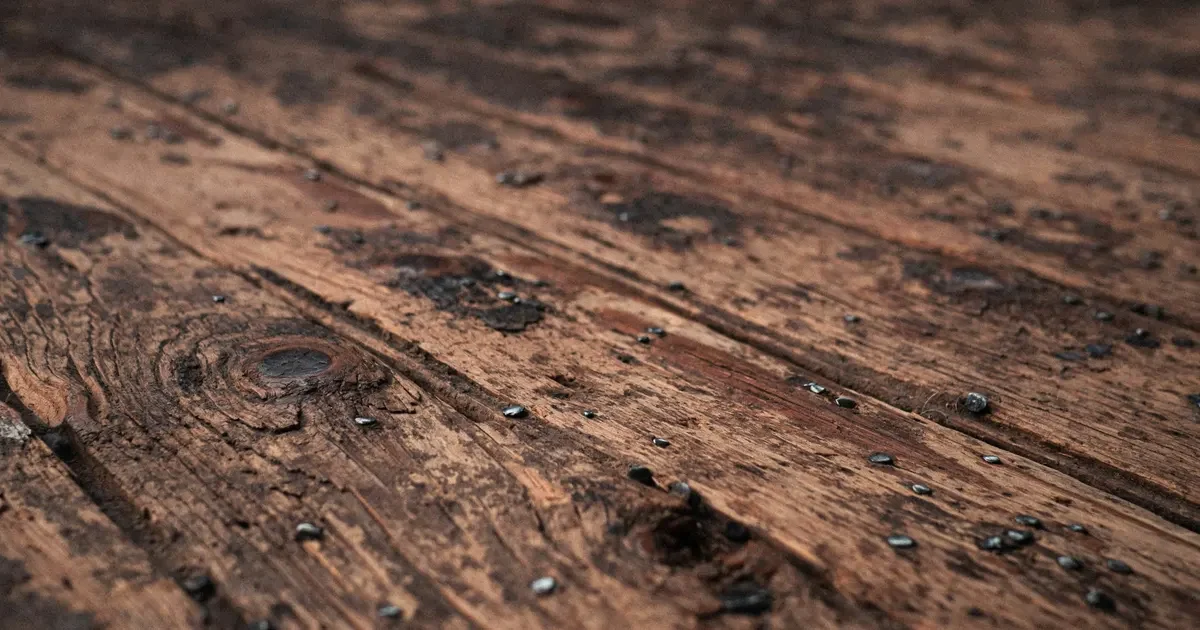
A distressed floor is a new floor made to look as if it has already lived a long life. Designers ask for it in restaurants, boutique hotels, farmhouse kitchens and homes built around reclaimed materials, usually with a photograph of an old floor attached. The difficulty is that “distressed” is not one texture. It is a family of separate effects, each made in its own way, each with its own risks, and two suppliers can read the same word very differently. This article describes the common effects one by one, where they suit, what can go wrong, and how to write a request that a factory can sample and repeat.
What “distressed” covers
Distressing is any surface treatment that imitates age, use or the marks of old working methods. It sits at the far end of the texture range, beyond brushing and beyond a plain hand-scraped face. Where wire brushing opens the grain evenly, distressing adds marks that interrupt it: ripples, holes, dents and worn edges.
Most distressed floors combine several effects. A specification that only says “distressed” leaves the factory to choose which ones, how many, how deep and how they are spread, and the sample that comes back may not be the floor the designer pictured. The fix is to name each effect separately.
The common effects
| Effect | What it imitates | What it looks like | Watch for |
|---|---|---|---|
| Chatter marks | Old planing and milling | Shallow ripples running across the width | Visible repeat over a large area |
| Nail hole marks | Reclaimed boards fixed with nails | Small dark holes, often near board ends | Too many per board looks artificial |
| Wormhole marks | Insect tracks in old timber | Small irregular holes and short channels | Holes that hold dirt and liquid |
| Worn or scraped edges | Edges rounded by years of foot traffic | Soft, uneven edges and ends | Gaps at joints read larger |
| Dents and gouges | Impacts from furniture and tools | Random hollows of different sizes | Depth against the wear layer |
| Aged color | Smoke, sun and time | Deeper, uneven tone, darker in the marks | Color drift between lots |
Chatter marks
Chatter is a rhythmic ripple across the face, made by a cutter that skips over the surface in regular steps. It imitates the marks of old hand planes and early mill machinery. Because it is regular by nature, it can look mechanical across a big room, so the spacing and how far it runs along each board are worth describing.
Nail hole and wormhole marks
These are small holes cut or punched into the face to imitate reclaimed timber. Nail holes are usually placed near the ends of boards, where an old floor would have been fixed. Wormholes are smaller and less regular. Both read as authentic only when they are sparse and irregular, so the specification should say how often they appear, not only that they are wanted.
Worn or scraped edges
The long edges and ends are rounded or worked unevenly, so the board looks as if feet have worn it down over years. This changes how the joints read: a worn edge makes the line between boards look wider and darker, which some designers want and others do not.
Dents and gouges
Impact marks of different sizes, spread across the face. They are the effect most likely to be mistaken for real damage, by the owner, by a site supervisor or by an inspector who was not told what was ordered.
Aged color
Color is what makes the physical marks read as old. Stain collects in every hole, ripple and dent, so the marks read darker than the surrounding face. Smoked, washed and two-tone effects add more depth and variation. Our article on Color and Effect UV finishes explains those looks.
Where distressed floors suit
- Hospitality interiors that want an established, lived-in character from day one.
- Homes built around reclaimed brick, beams or old furniture.
- Retail and showroom spaces where the floor is part of the brand story.
- High-traffic rooms where new marks should blend into existing ones.
They are a weaker fit for formal rooms, for minimal interiors that rely on a calm plane, and for any space where the owner may later want a clean, smooth floor, because sanding out a distressed texture takes a lot of wood.
Risks to settle in the specification
- Repetition. Machine-made effects repeat. Ask how the pattern is varied between boards and judge it over several boards laid together.
- Density. Too many marks per board looks artificial; too few looks like random damage. Describe how many you expect, in plain words, and approve it on the sample.
- Depth against the wear layer. Deep gouges remove oak from the face. Wear layer options on our pages are 1/16” (2mm), 1/8” (3mm), 5/32” (4mm) and 1/4” (6mm) sawn, with other thicknesses made to order. Deep effects need a thicker layer.
- Open holes. Holes and channels hold dust, and they can hold a spilled liquid. Say whether holes stay open or are filled, and check that the finish covers the inside of each mark.
- Expectations on site. Tell the installer, the general contractor and the owner in writing that the marks are intended. Many complaints about distressed floors are about effects that were ordered.
- Repeat orders and replacement boards. An irregular look is harder to match later. Keep the approved sample, and order spare boards from the same lot if possible.
How color and sheen change the look
Low sheens suit distressed floors. A shiny topcoat makes holes and dents look like fresh damage, while a matte surface keeps attention on the wood. Matte, Extra Matte and Ultra Matte are the three sheens on our Specify page. Grade matters too: Natural and Rustic faces carry distressing naturally, while a Premium face can look damaged rather than aged.
What we list, and how a distressed request is handled
The surfaces listed on our Specify page are Smooth, Light Wire Brushed, Medium Wire Brushed, Wire Brushed, and Wire Brushed with Cross Marks, which is brushed and then cross-worked for a more irregular, hand-worked surface. That last option, combined with a Color and Effect UV finish, is the closest listed route to an aged look.
Distressed effects such as chatter, nail holes, wormholes, dents and worn edges are not on that list. If a project needs them, ask whether they can be produced and send a reference board or clear close-up photographs. What can be made, and how consistent it can be across the lot, is confirmed at quotation and on an approved sample. For related worked surfaces, see hand-scraped oak flooring and saw mark oak flooring.
Writing it into the RFQ
- Name each effect separately, not “distressed” alone.
- Describe density and depth in plain terms: sparse or frequent, shallow or deep.
- Say whether holes are open or filled, and whether edges are worn.
- Give construction and wear layer on the same line.
- State color, sheen and finish system, because each changes how the marks read.
- Attach a physical reference if you have one, and mark photographs as reference only.
Approving the sample
Approve distressing on a set of boards laid side by side, not on one board in the hand. Look at it from standing height, in daylight and in the project’s light, and check how often the pattern repeats. Record each approved effect with color, sheen, grade and construction. That record becomes the master reference for production. Our guide to oak flooring surface treatments compares distressing with the other textures.
Working with Vu Uy Wood
Vu Uy Wood manufactures made-to-order solid and engineered French White Oak flooring in Song Than 3 Industrial Park, Ho Chi Minh City, and has done so since 2006. The listed textures and finishes are on the Specify page. For a distressed surface, send your reference and a description of each effect through the contact page; whether it can be produced is confirmed at quotation and agreed on an approved sample. We normally reply within one working day.