
An engineered floor is made of layers held together by adhesive, and then it is often fixed to a subfloor with another adhesive. The two are rarely discussed together, and buyers often mix them up when they ask about emissions. One is chosen and controlled in the factory. The other is chosen on site, by the installer, together with the adhesive maker. This guide separates the two, names the common types and sets out what a buyer can ask to see before an order is made.
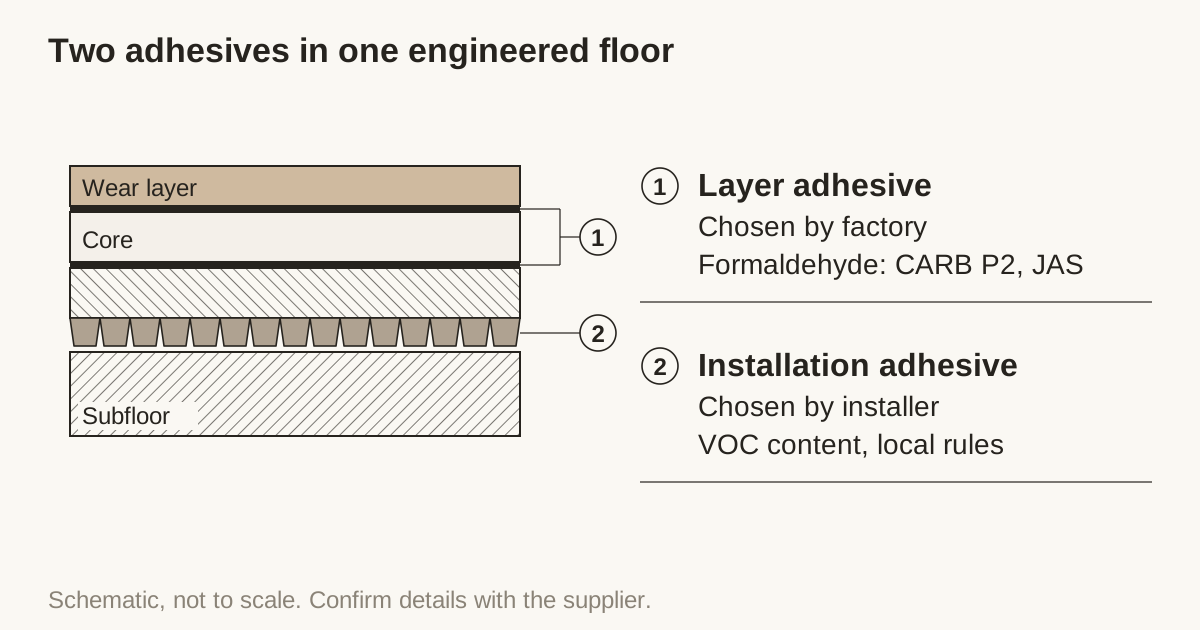
Two kinds of adhesive in one floor
| Adhesive | Where it is used | Who chooses it |
|---|---|---|
| Layer adhesive | Between the wear layer and the core, and between the plies of the core | The manufacturer, in the factory |
| Installation adhesive | Between the finished board and the subfloor, or in the joints of a floating floor | The installer, with the adhesive maker |
A question about emissions needs to say which one it means. A buyer who asks “is the floor low emission” is asking about the layer adhesive, the coating and the composite core. A buyer who asks “is the glue low emission” is probably asking about the installation adhesive, and the factory cannot answer for that one.
Adhesives that bond the layers
A flooring plant bonds the layers under heat and pressure, and the adhesive family is chosen for the construction and the market. Common families are listed below, with the characteristic that matters most to a buyer.
| Family | Typical use | What to know |
|---|---|---|
| Urea-formaldehyde (UF) | Interior plywood and composite panels | Economical and widely used, with the highest formaldehyde potential of the group |
| Melamine-urea-formaldehyde (MUF) | Panels that need better moisture resistance | A melamine fortified version of UF |
| Phenol-formaldehyde (PF) | Panels for damp or exterior use | Very durable bond, dark glue line, low emission once cured |
| Polyvinyl acetate (PVAc) | Joints, edge bonding and some lamination | Water-based, no formaldehyde, softens under heat and sustained load |
| Polyurethane (PUR) | Lamination of face to core | No added formaldehyde, strong bond, needs careful handling in the plant |
| Isocyanate (MDI) based | Composite cores | No added formaldehyde, strong and moisture resistant |
None is good or bad in the abstract. Each is a trade-off between cost, moisture resistance, speed and emissions. A manufacturer chooses on the basis of what it can control and document. We do not publish the adhesive system used in our boards on this page, and what applies to your construction is part of the documentation you can request.
Why formaldehyde is the main emission issue
Some adhesives contain formaldehyde, and panels bonded with them can release small amounts of it into indoor air over time. The amount depends on the resin, the cure, the panel and the conditions. Regulators set limits on the amount a composite wood panel may emit.
For the United States, CARB Phase 2 is the formaldehyde emission standard for composite wood, and the national rule under the federal Toxic Substances Control Act follows the same limits. For Japan, the JAS standard grades panels by formaldehyde emission class. The limits and the test methods differ, so a buyer should ask which one applies to the destination market. We explain what each reference covers in CARB P2, JAS and NWFA.
Two terms from the regulations help a buyer read a document. A resin described as no added formaldehyde means the adhesive is not formaldehyde-based. A panel meeting the standard means its emission was tested against the limit. They are not the same claim, and the second is the more common.
Some of the floors we make use a composite core, and for the U.S. market CARB Phase 2 is the limit that composite wood must meet. Ask for the documentation that covers the construction you are ordering.
The coating also takes part
The adhesive is not the only source of emissions in a finished board. The coating contributes volatile organic compounds, known as VOCs. UV-cured coatings harden under ultraviolet light on the line and are formulated to meet VOC content limits. On our line the coatings are held to 2010 volatile organic compound content limits. See UV-cured finish for hardwood flooring.
Wood itself emits small amounts of natural compounds, and oak is no exception. This is normal and is separate from the adhesive and coating.
Installation adhesives
Glue-down and some floating installations use an adhesive between the board and the subfloor or between the boards. The installer picks the product, with the adhesive maker’s approval for the board and the subfloor.
| Type | Behavior | Points to check |
|---|---|---|
| Moisture-cure polyurethane | Strong, flexible bond, cures with moisture in the air or slab | Compatibility with the slab and any moisture control |
| Silane-modified polymer | Flexible bond, low odor, solvent free | Approved for the board width and the subfloor |
| Water-based | Low odor, slower to cure | Water can swell the board in wide formats, so the maker’s limits apply |
| Solvent-based | Fast tack, traditional use | Higher VOC, local rules may restrict it |
| PVAc joint adhesive | Used in the tongue and groove of a floating floor | Applied by the installer to each joint |
VOC limits for adhesives are set by local air-quality rules, and they differ between states and countries. The installation adhesive is the installer’s choice, and the maker’s data sheet should state the VOC content and the approved uses.
For how the method shapes the choice of build, see flooring installation method and the specification. For concrete subfloors, see engineered oak over concrete.
Why the bond line matters on site
The adhesive between the layers is invisible once the floor is down, but it decides flatness, joint fit and refinishing. A weak bond lets the face move on its own, and the board can lose its shape or the layers can start to lift at an end or an edge. The control of spread, pressure and press time in production is the reason that does not happen. We describe the steps in wear layer bonding and pressing.
How to read a supplier’s answer
Adhesive questions tend to produce long answers that do not match the question. A buyer can keep the conversation useful by separating the claim from the evidence.
A claim sounds like “our adhesive is safe” or “our floor is low emission”. Evidence is a standard, a test and a document: the standard that applies, the laboratory or process that confirmed it, and the document that covers the construction being ordered. A document for a different construction, a different year or a different plant does not cover your order.
Check three things on any document. First, that the construction named is the construction you are buying, including core type and thickness. Second, that the date and the issuing body are shown. Third, that the standard named is the one your market uses. A paper that names a standard from another market answers a different question.
If the answer is not clear, ask the supplier to put it in the quotation. A statement in the quotation can be checked against the shipment, and a remark in a message cannot.
Questions an installer should ask
The installer needs different information from the buyer. Before choosing an installation adhesive, the installer should confirm that the adhesive maker approves the product for the board construction and for the subfloor, that the slab moisture falls inside the maker’s limits, and that the adhesive’s working time suits the size of the area. The installer should also confirm the trowel type, because it sets the spread rate, and the conditions for curing before foot traffic.
These checks belong with the installer and the adhesive maker, not with the flooring factory. A buyer who passes the board data sheet and the subfloor details to both gives the project the best chance of a single, compatible system. Our article on engineered oak over concrete lists the slab checks that go with a glued installation.
What can go wrong when the wrong adhesive meets the wrong board
Several failures trace back to a mismatch.
- Bond failure at the slab. The adhesive lets go of the board or the slab because moisture or contamination was not controlled.
- Telegraphing. A thick or uneven adhesive bed shows through as ridges under the finish, especially under low light.
- Cupping from water-based products. A water-based adhesive in a wide board can add moisture to the underside of the board and cause it to dish.
- Stiff adhesive and movement. A rigid adhesive can restrain a board that needs to move slightly, and it can crack the bond or the joint.
- Odor and emissions in occupied buildings. A high-VOC product in a closed room creates complaints, even if the floor itself is compliant.
Each of these can be avoided by selecting the adhesive for the board and the subfloor together, and by testing on a small area first.
What to request
A buyer can ask for a short set of documents before ordering.
| Document or answer | What it shows |
|---|---|
| Formaldehyde documentation for the construction | Compliance with the market standard |
| A statement of the resin family for each bond line | Whether it is a formaldehyde-based or a no-added-formaldehyde resin |
| VOC data for the coating system | The coating’s content against local limits |
| The installation adhesive guidance | Which products the board is approved for |
| A written statement of who checks the bond | Where the bond is checked in the route |
Not every buyer needs every item. A residential importer may need the formaldehyde papers only, and a commercial specifier may need the full set.
A note on language
Words such as “eco” and “green” are not specifications. Ask for the standard, the test and the document, not the adjective. A claim that cannot be traced to a standard cannot be checked against a sample or a shipment.
Working with Vu Uy Wood
Vu Uy Wood manufactures solid and engineered French White Oak flooring to buyer specification in Song Than 3 Industrial Park, Ho Chi Minh City, and has done so since 2006. Documentation requirements for your market can be written into the RFQ on the Specify page or sent with your drawing. We normally reply within one working day.