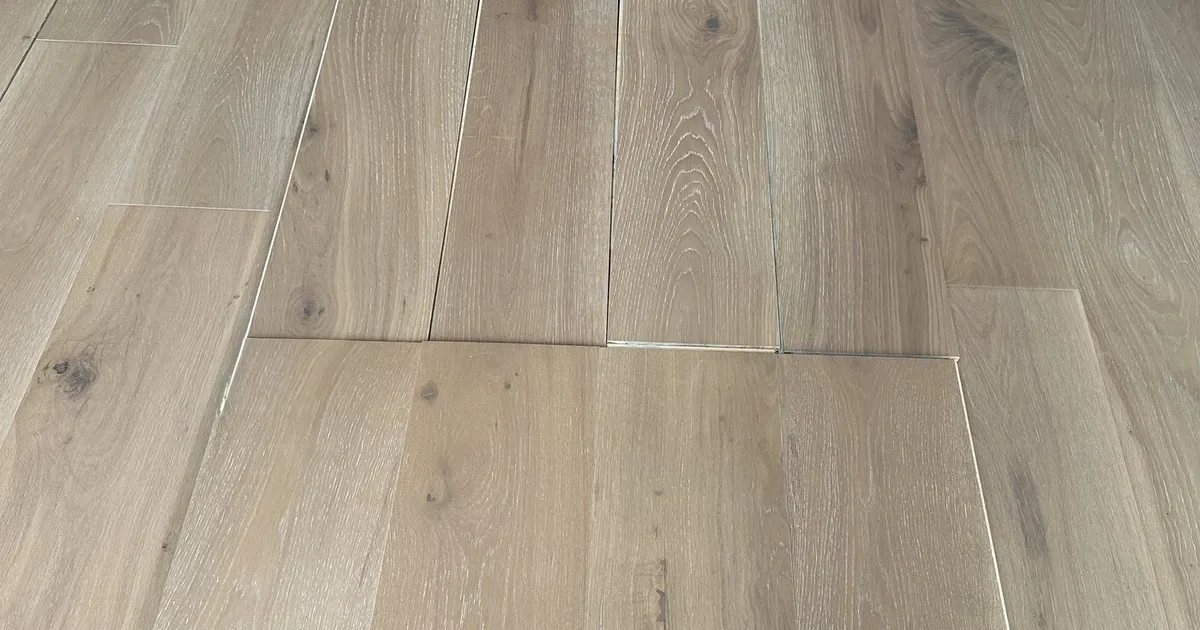
A dimensional tolerance is not a number but a sentence: a target size, the deviation allowed, the method that measures it, the moment it is measured and the sample it is judged against. No single set of numbers applies to every engineered floor, because the European flooring standard EN 14342 sets no dimensional tolerances itself and sends the reader to product standards. This post is part of our guide to engineered oak flooring specifications. It explains what each part of a tolerance line does, where published numbers exist, and how to write the limit for your own order. It describes standards by their published scope, because we did not read the paid texts.
What a tolerance line means
Take a specification line such as “overall thickness 5/8” (15mm), plus or minus [your limit], measured with a caliper at two points on each board, at pre-shipment inspection, against approved sample [reference]”. It carries five parts, and a line that drops one of them is the cause of most disputes.
- Target: the nominal size, in inches and millimeters.
- Deviation: how far a board may differ from the target.
- Method: the instrument and the points measured.
- Moment: at manufacture, at inspection, or after installation.
- Reference: the approved sample, or a named standard and edition.
The moment matters because wood moves. The NWFA/NOFMA standard for factory-finished solid flooring states that machining tolerances are measured at the time of manufacture only, that after flooring leaves the facility moisture content, the cut of the board and site conditions affect the measurements, and that the standard should be held to the actual measurement and not to the allowance.
Which standards carry the numbers
The standards below are the documents a European or international buyer will meet. The first point to take from the table is that the umbrella standard does not carry tolerances.
| Document | Covers | Edition | What it gives a buyer |
|---|---|---|---|
| EN 14342 | Flat-surface wood flooring and parquet: characteristics, conformity evaluation, marking | 2013, listed as current | No tolerance limits; refers to product standards such as EN 13226, EN 13489 and EN 14354 |
| EN 13489 | Multi-layer parquet elements for internal use | 2023, replaced the 2017 edition | Characteristics, requirements and test methods; clauses not read |
| EN 13647 | Measuring geometrical characteristics | 2021, replaced the 2011 edition | Methods for angles, warp, lipping, thickness, top-layer thickness, groove and tongue dimensions; no sampling rules |
| EN 13756 | Terminology | 2018, confirmed 2024 | Defined terms for wood flooring and parquet |
| NWFA/NOFMA factory-finished standard | Solid factory-finished flooring on a 3/4” (19.05mm) basis | Cover March 2011, pages revised April 2018 | A numeric table of machining tolerances (below) |
| NWFA/NOFMA unfinished standard | Solid unfinished flooring | Revised April 2018 | A similar table with wider limits |
Sources: catalog entries and NWFA documents, as listed below. The EN texts are paid documents and were not read. Naming a standard here is not a claim that any floor meets it; a conformity claim needs the supplier’s own documents.
Two readings follow. EN 14342 is about characteristics, conformity and marking, so it does not answer a question about the width of a board. And EN 13647 tells you how to measure, including the thickness of the top layer, but the catalog entry states that sampling is set elsewhere and shows no limits, so the contract must set both.
A published example: solid factory-finished flooring
The public numeric tolerance tables we found for wood flooring are the NWFA/NOFMA standards for solid flooring, and the factory-finished one is the better example of what a tolerance table contains. It is not an engineered-floor standard, it is an industry program’s compliance table, and these are not our tolerances. The values assume a 3/4” (19.05mm) board measured at manufacture at 6 to 10 percent moisture content.
| Item | Published value |
|---|---|
| Width, under 3” (76.20mm) | plus or minus 0.005” (0.13mm) |
| Width, 3” (76.20mm) and over | plus or minus 0.008” (0.20mm) |
| Thickness within one product | plus or minus 0.005” (0.13mm) |
| Tongue thickness, nominal 0.250” (6.35mm) | minus 0.004” (0.10mm) to plus 0.008” (0.20mm) |
| Groove width, nominal 0.250” (6.35mm) | plus 0.012” (0.31mm) |
| Space between tongue and groove | more than 0.003” (0.076mm) and less than 0.012” (0.31mm) |
| Squareness, 3” and over | no more than 5% of product more than 0.005” (0.13mm) out of square per inch of width |
| Overwood, square edge | 0.010” (0.25mm) maximum |
| Overwood, micro-beveled edge | 0.012” (0.31mm) maximum |
| Crook, 3” and over | 0.021” per foot (0.533mm per 305mm), at most 0.105” (2.67mm) per piece |
Source: NWFA/NOFMA International Standards for Factory Finished Solid Wood Flooring (cover revised 03.2011, pages revised 04.2018). The unfinished-flooring standard allows more: width plus or minus 0.010” (0.25mm) and thickness 0.750” (19.05mm) plus or minus 0.015” (0.38mm).
The comparison between the two NWFA tables shows something general: a factory-finished floor is held tighter than an unfinished one. The NWFA documents do not say why, but our profile article gives the likely reason for thickness: variation shows as lippage, and on a prefinished floor it cannot be sanded out on site.
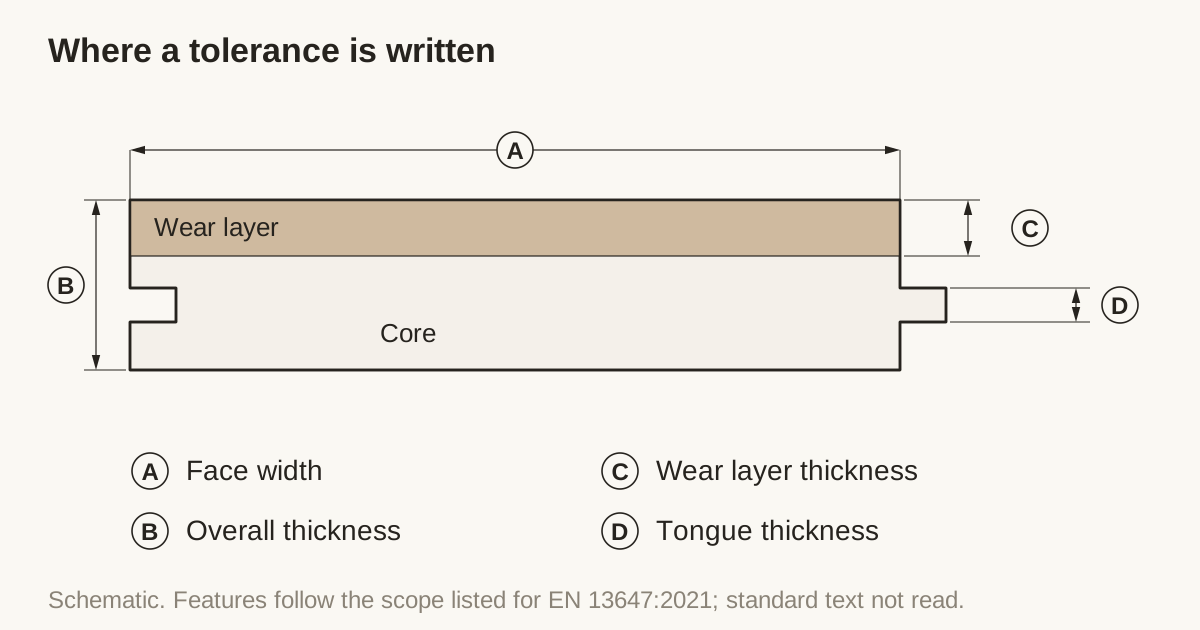
Thickness, wear layer, width and length on an engineered board
On an engineered board the same logic applies to more numbers. Overall thickness and wear layer thickness are separate measurements, and EN 13647 lists the top-layer thickness among the dimensions it measures. On our line the wear layer is cut to the specified thickness and checked across the board before pressing, a wide belt sander calibrates overall thickness across the width, and dimension inspection checks thickness and width against the order sheet. Tongue and groove is machined on all four sides, and a separate inspection checks the profile for consistent fit.
We do not publish tolerance figures on this page. The limits that apply to your order are agreed in the quotation and checked against the approved sample, which is the same position we take on flatness. The reason is the one above: a figure without a method and a moment invites disagreement. The size chart lists the sizes we run, and our article on tongue and groove profile accuracy explains why consistency across the order matters more than any single reading.
How to measure
A tolerance is only as good as the way it is measured, so write the method into the contract:
- Instrument: a caliper or micrometer for thickness and tongue and groove, a steel rule or caliper for width, a straightedge and feeler gauge for flatness and lippage.
- Points: at least two points along the length of each board, with the positions named.
- Condition: boards at the moisture content the order calls for, with the meter type and setting recorded, since different meters read differently on the same board.
- Sample size: the number of cartons opened and how they are chosen, for example drawn at random from different pallets and lots. EN 13647 leaves sampling to product standards or test methods, so the contract has to supply it.
- Who measures: the buyer, a representative or a third-party inspector, using the same method as the factory.
What to write in your specification
Write the tolerance as part of each line and keep both units. A starting set:
- Overall thickness, face width and length, each with a deviation in your own terms.
- Wear layer thickness as its own line, with the method (measured on a cut end).
- Tongue and groove fit: boards join by hand without force and sit level at the face.
- Squareness of the ends, for pattern floors especially.
- Flatness: straightedge across the width, with the acceptable gap.
- The method, sample size and moment for each, and the reference sample.
- What happens to boards outside the limits: sorted, reworked or replaced before loading.
Common misreadings
- “The standard says.” A catalog entry gives scope and edition, not clauses. Cite the document and edition you actually have.
- Solid values applied to engineered floors. The published table above is for solid flooring; use it to learn the shape of a tolerance table, not to set an engineered limit.
- Allowance read as target. The NWFA/NOFMA standard says to hold to the actual measurement, not the acceptable allowance.
- Inches against millimeters. A conversion that rounds differently on two documents can hide a real difference. Write both.
- Naming a standard as proof. A standard names requirements; a conformity claim needs the supplier’s documents.
Frequently asked questions
Does EN 14342 set tolerances for engineered flooring?
No. The catalog entry for EN 14342:2013 states that it does not specify dimensional limits and refers to product standards such as EN 13489 for multi-layer parquet. Tolerances come from those documents or from your own specification, so check which one your market uses.
What is a reasonable thickness tolerance?
We found no public tolerance table for engineered flooring. For solid factory-finished flooring the NWFA/NOFMA standard publishes plus or minus 0.005” (0.13mm) within one product. Treat that as an example, and agree the engineered figure with the supplier against the approved sample.
When are tolerances measured?
At the time stated in the contract. The NWFA/NOFMA standard measures at manufacture and notes that moisture and site conditions change measurements afterward. Name the moment in the specification, and repeat the measurement at pre-shipment inspection with the same method, so both sides read the same board the same way.
How many boards should be measured?
The number and selection belong in the contract. EN 13647 specifies how to measure and leaves sampling to product standards or test methods. A common approach is to draw cartons at random from different pallets and lots, and to record the readings.
Working with Vu Uy Wood
We manufacture made-to-order solid and engineered French White Oak flooring in Song Than 3 Industrial Park, Ho Chi Minh City, and have done so since 2006. Dimension inspection and tongue and groove inspection are separate checkpoints in our production route, and the limits for your order are written into the quotation. The full decision set is in our guide to engineered oak flooring specifications, and the Specify page turns it into a written brief we can quote. We normally reply within one working day.
Sources
- NWFA/NOFMA, International Standards for Factory Finished Solid Wood Flooring: the numeric table, measurement timing, moisture basis.
- NWFA/NOFMA, Standard for Unfinished Solid Flooring: width and thickness limits for unfinished flooring.
- EN 14342:2013 listing, wood flooring and parquet: scope and referenced product standards; the standard text was not read.
- EN 14342:2013 record, status and edition: edition date and status; the standard text was not read.
- EN 13489:2023 listing, multi-layer parquet elements: scope and edition; the standard text was not read.
- EN 13647:2021 listing, geometrical characteristics: measured features and sampling; the standard text was not read.
- EN 13756:2018 listing, wood flooring terminology: scope and edition; the standard text was not read.