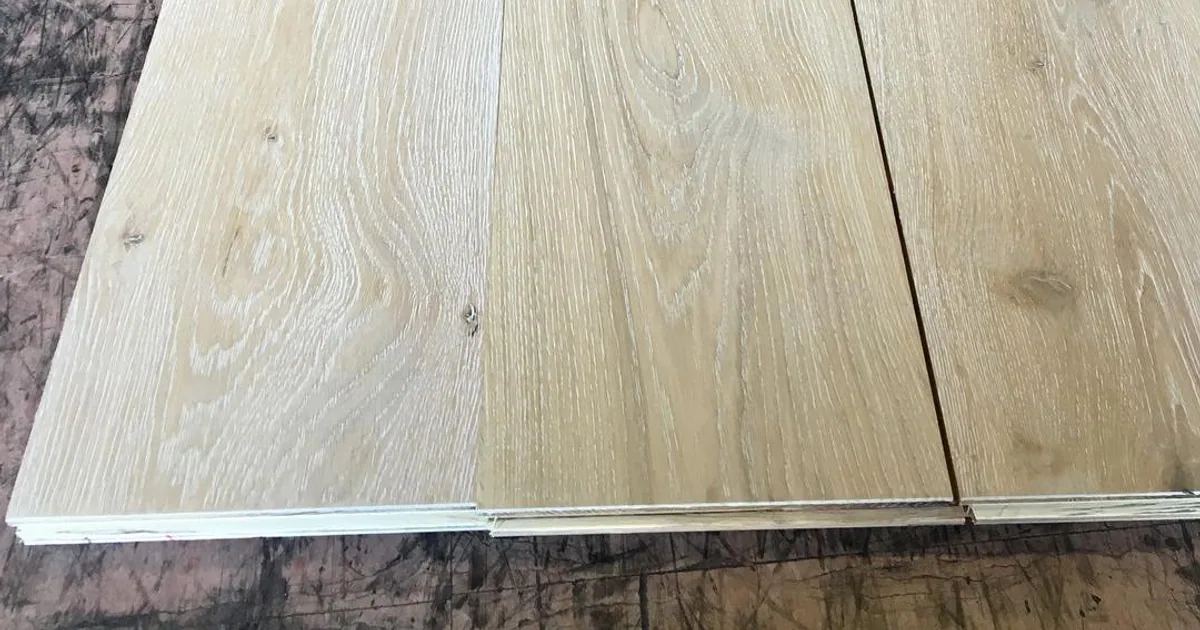
The price of an engineered oak floor moves with the specification, line by line: a thicker wear layer, a wider face, a fixed length, a cleaner grade or a rift and quarter cut each change how much oak a square foot needs. This post is part of our guide to engineered oak flooring specifications, and it sets out which direction each driver pushes, who controls it and what a quotation should show. We publish no prices, and we found no public, neutral figure for how much each driver contributes. What follows is direction, one calculation you can check yourself, and the lines to ask for.
The drivers at a glance
Six drivers sit in the floor itself and three sit in how the order is built. Direction is the part that can be stated honestly; magnitude is confirmed in the quotation for your timber lot and specification.
| Driver | Direction | Magnitude | Controlled by |
|---|---|---|---|
| Wear layer thickness | Thicker costs more | Oak per square foot is proportional to thickness (worked example below) | Maintenance plan |
| Face width | Wider costs more | We found no public figure | Room size |
| Length | Fixed and long cost more than random | We found no public figure | Look |
| Grade | Cleaner costs more | We found no public figure | Look and budget |
| Grain selection | Rift and quarter costs more than plain sawn | We found no public figure | Look |
| Finish route, color, texture | Confirm in the quotation | We found no public figure | Look |
| Number of sizes and colors in one order | Confirm in the quotation | We found no public figure | Buyer |
| Packing and labeling | Confirm in the quotation | We found no public figure | Buyer |
| Trade term and documents | Sets what the price includes | Not a price change, a scope change | Buyer and seller |
Sources: our size chart and grade articles for direction; magnitudes, we found no public figure.
Wear layer: the driver you can calculate
The wear layer is the oak face, and its cost driver is simple geometry: a square foot of floor has 144 square inches of face, so the oak in the wear layer is 144 square inches times its thickness. The NWFA’s glossary defines a board foot as a piece 1 foot long, 12 inches wide and 1 inch thick, which means one square foot of face at one inch thick is exactly one board foot.
Worked example (arithmetic only, no price assumed). Our standard wear layers are 3mm and 6mm sawn, with 0.6mm, 1.2mm, 2mm, 4mm and 5mm made to order. Converting each to inches (25.4mm to the inch) and multiplying by 144 gives the oak per square foot of floor, before sawing kerf, trim and sorting losses.
| Wear layer | Thickness in inches | Oak per sq ft of floor |
|---|---|---|
| 0.6mm | 0.024” | 3.4 cu in |
| 1.2mm | 0.047” | 6.8 cu in |
| 2mm | 0.079” | 11.3 cu in |
| 3mm (standard) | 0.118” | 17.0 cu in |
| 4mm | 0.157” | 22.7 cu in |
| 5mm | 0.197” | 28.3 cu in |
| 6mm (standard) | 0.236” | 34.0 cu in |
Source: arithmetic from the NWFA board foot definition. The result is a volume, not a price.
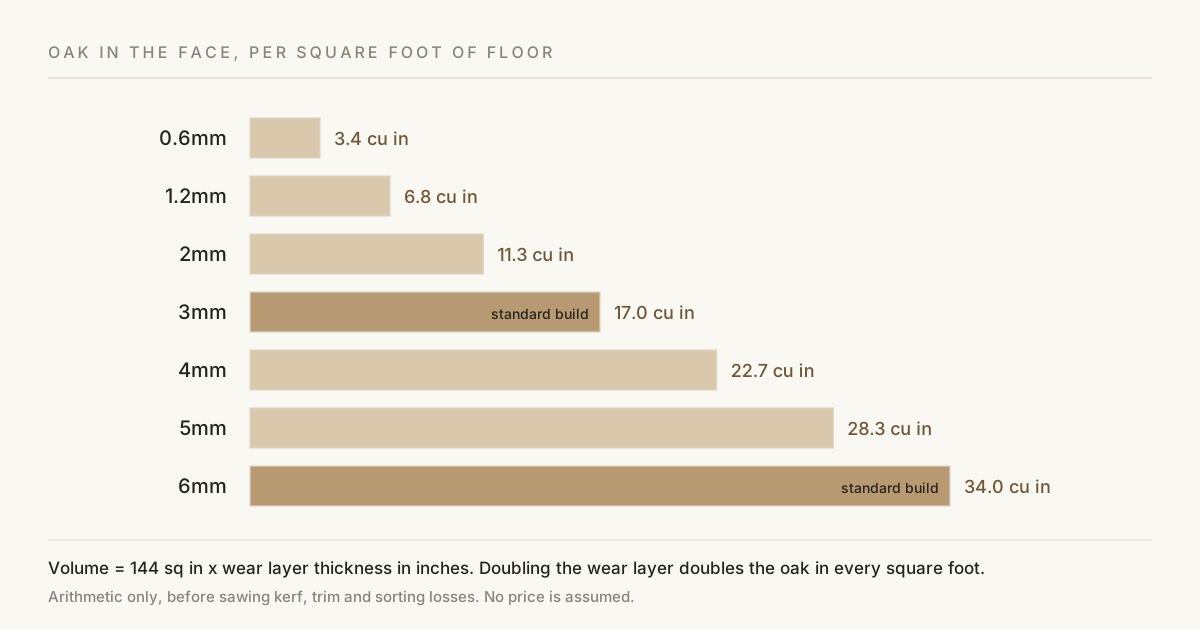
Moving from 3mm to 6mm doubles the oak in every square foot. Sawing turns part of each cut into sawdust, so the timber used is higher than the volume shown, and we found no public yield figure for a sawn face at any thickness. What the table does give you is a fair question for the quotation: ask for two prices that differ only in wear layer, and see whether the difference looks like the extra oak. The other half of the decision is whether the owner will ever sand the floor, because a thick wear layer adds little to a floor that will be recoated and then replaced.
Width and length
A wide board needs wide clear face material, and the wider the face, the fewer pieces of each log qualify, so wider faces generally cost more per square foot. Narrower boards suit smaller rooms and are often more economical. Length works the same way: random length staggers the end joints and uses the timber efficiently, while fixed length and long boards (up to 118”, 3000mm, to order) leave more offcut. A herringbone or chevron floor has no free length at all, because one block length is fixed per order from the drawing.
When budget matters, quote at two widths as well as two grades, so the effect of width shows up in your own numbers. Compare face width, not overall width including the tongue, or the same number covers a different area per board. The size chart lists every width and length we run, and which are made to order.
Grade and grain
Grade controls how much knot and color movement the face carries, and it has a direct effect on yield. Premium has the lowest yield and the highest material cost, Natural is the standard grade, and Rustic has the highest yield and the lowest cost. Grain is a separate line: plain sawn has the highest yield, mixed sits in the middle and rift and quarter has the lowest, because only part of each log can be cut so the face meets the growth rings at the right angle.
The effects stack: each premium choice on grade, width, length and wear layer adds cost to the others, and the size chart’s “Size and price” section shows the same pattern for dimensions. Grade names are not a shared unit: the NWFA/NOFMA factory-finished standard leaves appearance guidelines to each manufacturer, so compare quotes on the written definition of the grade, not its name. Our grade guide gives the four definitions we work to.
Finish, color and pattern
Finish is four lines, not one: system, color, sheen and surface. Clear UV, Color UV and Color and Effect UV are different routes with different process steps, and the cost difference between them is confirmed in the quotation. Supplying the floor unfinished moves the finishing step to the site, so its cost leaves the supplier’s quote and lands in the installer’s. A color developed against your own reference is built and approved on a physical sample before production, and that sample work is part of what you are buying.
Pattern formats are cut to a drawing, with one fixed block length per order. We found no public figure for the extra waste or installation labor in pattern floors, and neither can be stated without the drawing and the installer, so ask the installer for their own rate and compare it with plank on the same area.
Order structure, packing and trade term
More than one format or board size can be produced in one order under the same approved color reference. Each additional size or color is another line on the quotation, so state each width, format and quantity separately and ask how mixed orders are quoted. Check how each quote counts the floor: square feet of coverage per carton or a board count, labeled cartons on wrapped pallets or something less, private-label cartons included or quoted separately, and left and right herringbone blocks quoted as pairs.
The trade term changes what the price includes without changing the floor. The ICC describes Incoterms as rules that clarify the tasks, costs and risks of delivering goods from seller to buyer, so the same floor quoted EXW and FOB covers different work. Compare quotes on one named term and place, and add the documents your market needs, such as core emission paperwork for the U.S. EPA states that composite wood products sold in the U.S. have had to be labeled TSCA Title VI compliant since March 22, 2019 (as of October 2026); our CARB P2 article treats CARB Phase 2 as the baseline while the federal rule is TSCA Title VI, so ask for both statements and confirm what applies to your shipment with your broker.
The lines a quote should carry
Ask for a quotation that lists each of these as its own line, so a price difference can be traced to a specification difference:
- Construction and core type.
- Overall thickness in inches and millimeters.
- Wear layer thickness, sawn, and whether it is a standard build or made to order.
- Face width and the length range or fixed length.
- Grade with its written definition, and grain selection.
- Finish system, color, sheen and surface.
- Format, and block length for pattern floors.
- Quantity per size, in one stated unit.
- Carton, pallet and label scope.
- Trade term, place and documents included.
Our guide to comparing two hardwood flooring quotes shows how to lay two quotes against your own specification line by line.
Frequently asked questions
What drives the price of engineered oak flooring most?
We found no public figure for the share each driver contributes, so we do not rank them by percentage. The drivers that change the oak needed per square foot are wear layer, width, length, grade and grain. Ask for two prices that differ in one line only to see each one in your own quote.
Does a thicker wear layer always cost more?
It puts more oak into every square foot, so the direction is up. Going from 3mm to 6mm doubles the oak in the face before losses. Whether it is worth it depends on the maintenance plan: a floor that will be sanded benefits, while a floor that will be recoated and replaced may not.
Is unfinished flooring cheaper?
It removes the factory finishing step from the supplier’s quote, but the finishing then happens on site and its cost moves to the installer. Compare the two routes on total cost to finished floor, not on the supplier’s line alone, and ask the installer for their rate.
Why do two quotes for “the same floor” differ?
Usually because the lines differ: construction, wear layer, face width, grade definition, finish route, packing scope or trade term. Write your specification first, put both quotes in one table against it and ask each supplier to requote on the same lines.
Working with Vu Uy Wood
We manufacture made-to-order solid and engineered French White Oak flooring in Song Than 3 Industrial Park, Ho Chi Minh City, and have done so since 2006. Every line above is set on the Specify page, which turns your selections into a written brief we can quote, and the full set of decisions is covered in our guide to engineered oak flooring specifications. We normally reply within one working day.
Sources
- NWFA, Wood Flooring Installation Guidelines, revised 2025: board foot definition in the glossary.
- NWFA/NOFMA, International Standards for Factory Finished Solid Wood Flooring: appearance grades are proprietary to each manufacturer.
- ICC, Incoterms 2020 rules: what the trade terms define.
- EPA, Formaldehyde Emission Standards for Composite Wood Products: labeling dates for regulated composite wood products.