
Flatness is the quality buyers notice last in a sample and first on site. A floor that looks perfect under showroom light can show every board edge once the afternoon sun crosses it at a low angle. The two defects behind most of those complaints have simple names: cupping and crowning. This guide explains what they are, what causes them in an engineered floor, how flatness is measured and what a buyer can ask a supplier to confirm before an order is made.
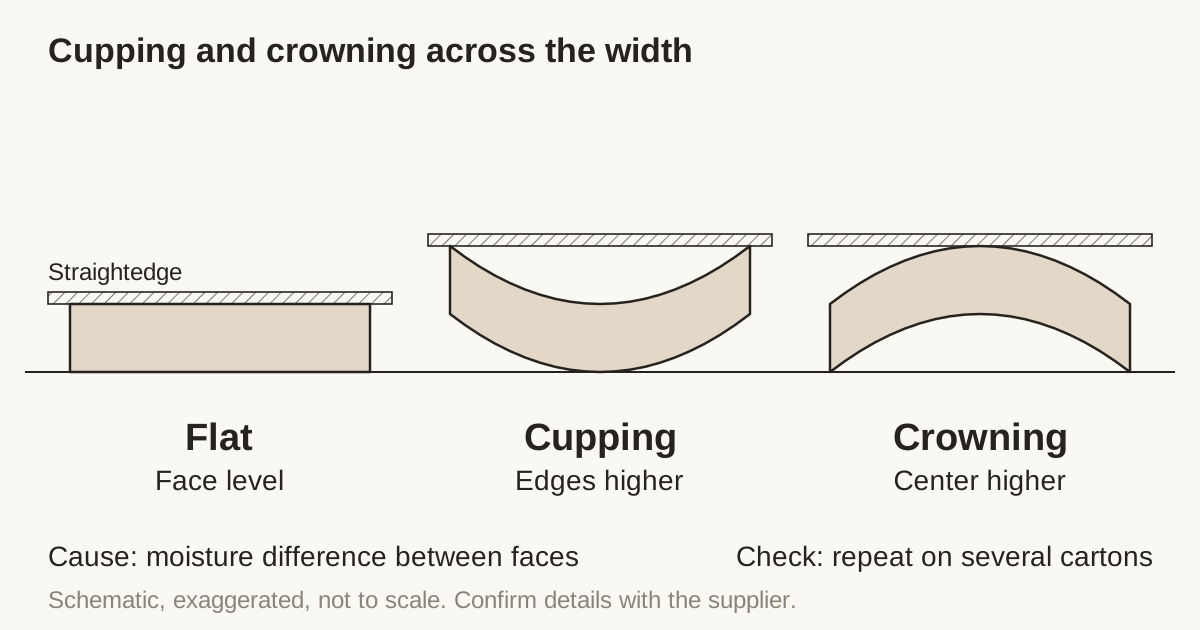
What cupping and crowning are
Both describe a board that is no longer flat across its width.
- Cupping. The long edges of a board sit higher than its center, so the face dishes like a shallow tray. It usually means the bottom of the board is taking on more moisture than the top.
- Crowning. The center of a board sits higher than its edges. It usually means the top has taken on moisture, or the bottom has dried, so the face swells upward. A floor that cupped and was then sanded flat can crown afterwards when the moisture evens out.
A third condition, edge raising or lippage, is a difference in height between neighboring boards. It has other causes, including subfloor flatness and thickness variation, and we deal with it in the article on tongue and groove profile accuracy.
Wood is hygroscopic, so some movement with the seasons is normal. The question is how much, and in which direction.
Why it happens in a floor
Almost every case traces back to a moisture difference between the two faces of the board. Wood swells where it takes moisture and shrinks where it loses it. If one side changes more than the other, the board bends.
| Symptom | Common cause | Where to look first |
|---|---|---|
| Cupping | Moisture rising from below, or a dry room above | Subfloor, slab or crawl space, vapor control |
| Crowning | Wet face, or a floor sanded while still cupped | Spills, cleaning method, sanding schedule |
| Cupping in one area | A local source such as a leak or an unsealed slab edge | The area of the floor, not the whole job |
| Seasonal gaps and mild cupping | Large swings in indoor humidity | Heating, cooling and humidity control |
The common thread is that the cause is rarely the board alone. Site moisture, installation method, heating and cleaning habits all take part, which is why a flatness complaint needs an inspection of the room as well as the product.
How an engineered board resists it
An engineered board is built to limit moisture movement in the face. The oak wear layer sits on a core, and for a 3-layer board there is also a backing layer. The aim is a balanced panel: the layers on each side of the core work against each other so the board stays flat as humidity changes.
- 2-layer. A sawn oak wear layer on a plywood core. The core restrains movement, and the construction is practical where floor height is limited.
- 3-layer. A wear layer over a cross-layered core with a backing layer. The backing layer balances the face and helps wider boards stay flat.
- Solid. One piece of oak through the full thickness. It has no core to restrain it, so it responds more to humidity, especially in wide formats.
The article on 2-layer against 3-layer engineered oak compares the two builds in use, and wear layer bonding and pressing explains why the bond matters to flatness. A weak bond lets the face move on its own, and the board loses its shape.
What the factory controls
Several steps in production affect flatness before a board is packed.
- Drying and moisture checks. Timber is kiln dried and checked against the moisture target for the order, so the wood has little left to give up or take on after pressing. See moisture control in flooring production.
- Pressing. Adhesive spread, press pressure and press time are controlled to give a balanced panel.
- Conditioning. Pressed blanks rest before machining so the panel settles, and a profile is not cut into a board that is still moving.
- Calibration. Sanding brings the board to thickness so it sits evenly in the floor.
What the factory cannot control is the room the boards go into. That is why flatness is a shared responsibility, with the factory responsible for the board and the installer and the owner responsible for the conditions.
How to measure flatness
Measurement is simple and can be done at the factory, at pre-shipment inspection and on site.
- Lay a straightedge across the width of a board, at several positions along its length.
- Look for a gap under the center, which indicates cupping, or a gap under the ends of the straightedge with the center touching, which indicates crowning.
- Measure the gap with a feeler gauge or a ruler, and record the position and the board.
- Repeat on boards from different cartons and lots.
Take the measurement on boards lying free on a flat surface, and again once installed, because a glued floor behaves differently from a loose board. A dry lay of a few rows shows flatness and joint fit at the same time. The article on pre-shipment inspection lists what a buyer or inspector can check on loading day.
Wide boards and long boards
Width is the biggest factor in how visible a small cup becomes. The change in moisture content acts across the grain, so a wide board has more width to move and shows the edge rise more clearly than a narrow one. A long board carries the same effect over a longer run, and light catches it along the whole length.
That does not make wide boards a poor choice. It means the construction, the core and the wear layer should be chosen for the width, and that the site should be ready for it. A wide board on a dry, flat, well-conditioned subfloor in a building with steady humidity behaves well. The same board over a damp slab does not. If your floor mixes widths, say so in the RFQ so each width is quoted on a suitable build.
Agreeing limits in writing
There is no single number that suits every project. Acceptable flatness depends on board width, the sheen, the light in the room and the installation method. A wide board with a high sheen under a long window shows a small cup more than a narrow board with a matte finish does.
What a buyer can do is agree the method and the limit before production, in terms that do not depend on opinion.
- Name the measuring method: a straightedge across the board width.
- Ask the supplier to state its flatness tolerance in writing, and to say what size of gap it accepts.
- Ask whether the tolerance is measured on loose boards at the factory, on installed boards, or both.
- Ask what happens to boards outside tolerance at inspection.
- Check the installer’s and the adhesive maker’s own requirements for the subfloor, since they set the site conditions.
We do not publish a tolerance figure on this page, because a figure without a method invites disagreement. The tolerance that applies to your order is agreed with the quotation and checked against the approved sample.
Flatness is written alongside the other lines in the engineered oak flooring specifications guide.
Reducing the risk on site
- Check subfloor moisture and flatness before the boards arrive, using the method the installer and adhesive maker specify.
- Choose a construction suited to the width. Wider boards generally call for a more stable build, and our guide to plank width covers the trade-off.
- Keep the building at its normal operating humidity range once it is closed in, and do not install into a space that is still drying out.
- Where there is radiant heating, follow the heating maker’s schedule. See engineered oak over radiant heating.
- Over concrete, use the moisture control the installer specifies. See engineered oak over concrete.
- Clean with the method recommended for the finish, because a wet cleaning habit can crown the face.
Other defects, their causes and who pays for each are in engineered flooring defects.
Working with Vu Uy Wood
Vu Uy Wood manufactures solid and engineered French White Oak flooring to buyer specification in Song Than 3 Industrial Park, Ho Chi Minh City, and has done so since 2006. Construction, thickness and width are chosen on the Specify page, and flatness expectations can be written into the quotation and checked against the approved sample. We normally reply within one working day.