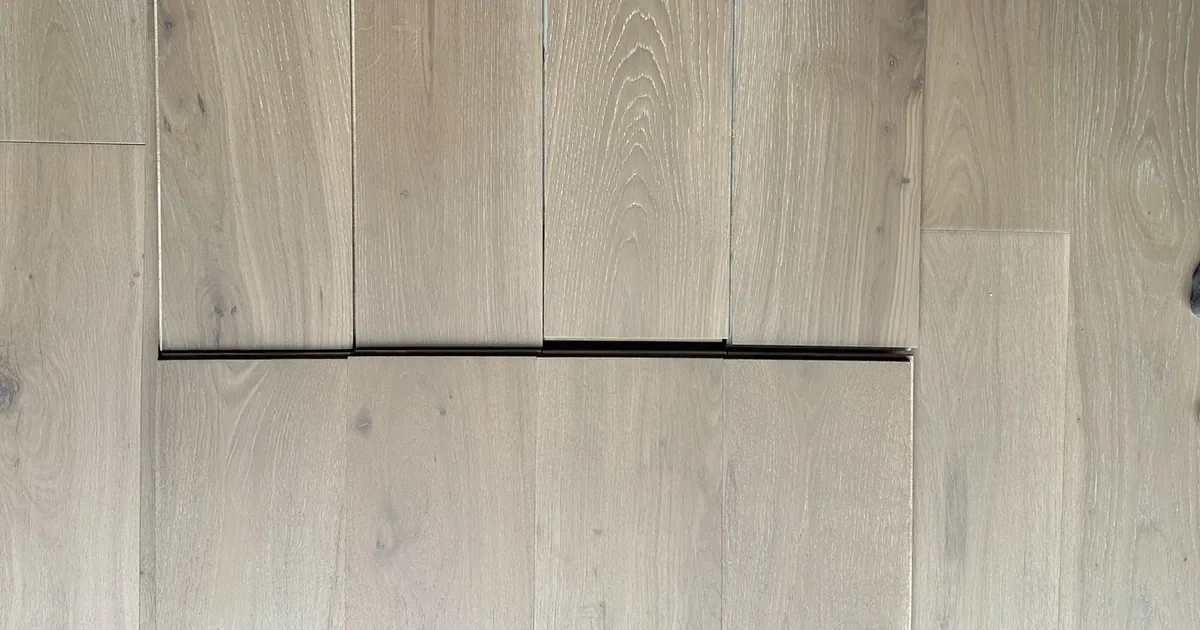
Engineered flooring defects come from three places: the board, the site and the paperwork. The same symptom, a gap or a lifting edge, can have a cause in any of them, and who pays depends on which one it was and on what the contract says. This post is part of our guide to engineered oak flooring specifications. It lists the defects buyers meet most, their usual causes, the limit a specification can name for each, and the evidence that settles a dispute. It is general information, not legal advice.
The defects at a glance
The last two columns are the ones to settle before the order, because they are cheap to write now and expensive to argue about later.
| Defect | Usual causes | Prevention | Limit to write down | Who pays |
|---|---|---|---|---|
| Delamination (face lifting from the core) | Weak bond; moisture imbalance; water on site | Bond controlled and checked; dry site | No open glue line at ends and edges on the approved sample | Depends on cause and contract; site or owner after a water event |
| Face checks (fine cracks in the face) | Knife-cut face under tension; humidity swings (contribution not sourced) | Sawn face; steady indoor humidity | Judged against the approved sample | Depends on cause and on the face specified |
| Gaps between boards | Seasonal humidity swings; boards installed too wet or too dry; loose profile | Site conditions checked; profile held in tolerance | Gap measured by an agreed method | Usually site conditions; depends on cause and contract if the profile is out |
| Cupping and crowning | Moisture difference between the two faces | Slab and subfloor tested; balanced build | Straightedge across the width, agreed gap | Depends on cause: site first, board second |
| Lippage (overwood) | Thickness variation; uneven subfloor; loose profile | Thickness calibrated; flat subfloor | Height difference measured with a straightedge | Shared; the measurement decides |
| Open end joints | Ends not square | End matching on one machine | Squareness agreed in the specification | Depends on cause and contract |
| Color or sheen mismatch | Different lots; light; texture | Master panel; one approved sample | Judged against the approved sample as a group | Depends on cause and contract |
Sources: NWFA Installation Guidelines (2025) for definitions and responsibilities; our own articles. We found no public numeric limit for delamination or face checks in engineered flooring.
Delamination
Delamination means the oak face begins to lift from the core, often first at the ends or edges. The cause is usually in the bond: adhesive spread, press pressure and press time must be controlled for a consistent bond across the panel, and pressed blanks must rest before machining so the panel settles. Moisture matters too. If face and core are at very different moisture contents when pressed, the board can move after it leaves the factory, and a floor that is wetted on site can lift after the water event, whatever the bond.
Test on the sample: look at the board ends and the long edges, where the glue line should be continuous with the face tight to the core, and repeat on boards from several cartons at pre-shipment inspection. We found no public numeric limit for delamination in engineered flooring, and the EN 13489 standard for multi-layer parquet describes characteristics, requirements and test methods (we read its scope only, not its text). So ask the supplier which bond test it uses, and write the limit as a contract line. Our article on wear layer bonding explains the steps.
Face checks
A face check is a fine crack in the oak face. Two things produce them. First, how the face was cut: the NWFA notes that a sliced face can stress the wood fibers, and our sawn, sliced and rotary article describes fine cracks on the side that faced the knife. A sawn face is cut like solid lumber and avoids that. Second, humidity: we found no neutral source for how much it contributes to face checks, so we do not size it here.
We found no neutral number for an acceptable check, so the limit is the approved sample: lay boards from the sample and the production cartons side by side in raking light and agree in writing what the approved range looks like. Ask whether the face is sawn, sliced or peeled.
Gaps and flatness
Some seasonal gap is normal. The NWFA defines compression set as the damage that follows when boards swell enough to crush the cells along their edges, so that cracks open when the floor returns to its normal moisture content. It also defines the expansion gap as the space left at fixed objects so the floor can move. A gap that follows the seasons is worth checking against site humidity first; a gap that is the same in every row is worth checking against the profile and the installation.
Cupping, where the board edges sit higher than the center, and crowning, the reverse, usually trace to a moisture difference between the two faces of the board. The cause is rarely the board alone, which is why a flatness complaint needs an inspection of the room as well as the product. Measure with a straightedge across the width of a board at several positions, on loose boards and again once installed, and agree the acceptable gap before production. We do not publish a flatness figure, because a figure without a method invites disagreement; our guide to cupping and crowning covers the method.
Lippage and end joints
The NWFA defines overwood and underwood as a perceived misalignment, with some pieces raised above their neighbors. On a prefinished floor it cannot be sanded out without damaging the factory finish, so thickness has to be right in the plant. For a published example of what a tolerance looks like, the NWFA/NOFMA standard for factory-finished solid flooring caps overwood at 0.014” (0.36mm) for beveled edges, 0.012” (0.31mm) for micro-beveled edges and 0.010” (0.25mm) for square edges. That standard covers solid flooring and states the values are manufacturer tolerances at the time of manufacture, not installed tolerances, so we cite it as a reference and not as our limit.
Open end joints come from ends that are not square. For solid boards three inches or wider, the same standard allows no more than 5 percent of pieces to be out of square by more than 0.005” (0.13mm) per inch of width. Our boards are end matched on one machine so that end joints stay consistent with the long-side profile; see tongue and groove profile accuracy.
Color and sheen
Color is checked against the approved master panel, and a color match is a visual inspection: the NWFA/NOFMA standard says new flooring may not match showroom sample boards because of the light sensitivity of different species. It also states a gloss level within 5 of the stated level for each product. Judge a group of boards from different cartons beside the master panel in the same light, not board by board.
Who pays
The NWFA’s guidelines describe the usual split. The manufacturer is responsible for a product that performs as marketed and meets the standards that apply. The specifier is responsible for making sure the jobsite can meet the product’s requirements, including climate and subfloor. The installer rechecks site conditions at installation, and the buyer, installer or end user should confirm that appearance and manufacturing quality are acceptable before installing. The guidelines add that installing the floor constitutes acceptance of the material and of the site conditions at that time. After installation the end user keeps temperature and humidity within the manufacturer’s range and follows the maintenance routine.
Read that as a map of evidence, not a verdict. A defect visible in the carton belongs before installation; one that appears afterward is assessed against the site record. Evidence that settles most cases:
- Photos of the boards, the ends and the carton labels, with lot numbers.
- Moisture readings from the boards and the subfloor, with the meter type and setting recorded.
- The installer’s method statement and the subfloor test results.
- The approved sample and the written specification the order was made to.
- A loose-lay record of several boards laid in the room before installation.
Writing the limit into the contract
A limit works only if it names a method, a reference and a moment. Example wording to adapt, with the bracketed items filled in your own terms:
“Flooring is accepted against approved sample [reference] and specification [reference]. At pre-shipment inspection, boards from cartons drawn by the inspector are measured by the method in Annex A. Boards outside the stated limits are sorted out and replaced before loading. Defects visible before installation are reported with photos, carton labels and lot numbers before installation begins. Defects that appear after installation are assessed with the site moisture records, the subfloor test results and the installer’s method statement. The claims period is [period agreed in the contract].”
Two points make this hold up. Tolerances are measured at the time of manufacture and at inspection, because the NWFA/NOFMA standard notes that after flooring leaves the facility, moisture, the cut of the board and site conditions affect the measurements. And the standard named in Annex A should be the one your market uses, with the edition written out, since we read only the scope of the European ones.
Frequently asked questions
Who pays when engineered flooring cups after installation?
It depends on the cause. Cupping usually traces to a moisture difference between the faces of the board, so the inspection covers the subfloor, slab moisture and room humidity as well as the board. The contract, the site record and the approved sample decide the split, so write the measuring method before the order.
Is a small gap between boards a defect?
Not by itself. Wood is hygroscopic and some seasonal movement is normal. The question is how much, where and when. Agree a measuring method and a limit in the specification, and compare gaps with the site humidity record before treating them as a product defect.
When should a defect be reported?
Before installation. The NWFA’s guidelines state that installing the floor constitutes acceptance of the material and the site conditions at that time, and recommend loose-laying several boards in the room first. A defect that is visible in the carton should be raised with photos and lot numbers before the boards go down.
What evidence supports a claim?
Photos of boards, ends and carton labels with lot numbers, moisture readings with the meter type recorded, the installer’s method statement, the subfloor test results and the approved sample. Together they show whether the cause sits in the board, the site or the use of the floor.
Working with Vu Uy Wood
We manufacture made-to-order solid and engineered French White Oak flooring in Song Than 3 Industrial Park, Ho Chi Minh City, and have done so since 2006. Moisture, dimensions, profile fit, color, surface and packing are checked through production, and the limits that apply to your order are written into the quotation and checked against the approved sample. The full set of decisions is in our guide to engineered oak flooring specifications, and the Specify page turns them into a written brief. We normally reply within one working day.
Sources
- NWFA, Wood Flooring Installation Guidelines, revised 2025: definitions (compression set, cupping, crowning, expansion gap, overwood), sawn and sliced faces, party responsibilities, acceptance on installation.
- NWFA/NOFMA, International Standards for Factory Finished Solid Wood Flooring: overwood, squareness, gloss and color match guidelines for solid flooring.
- EN 13489:2023 listing, multi-layer parquet elements: scope only; the standard text was not read.
- EN 13647:2021 listing, geometrical characteristics: scope only; the standard text was not read.