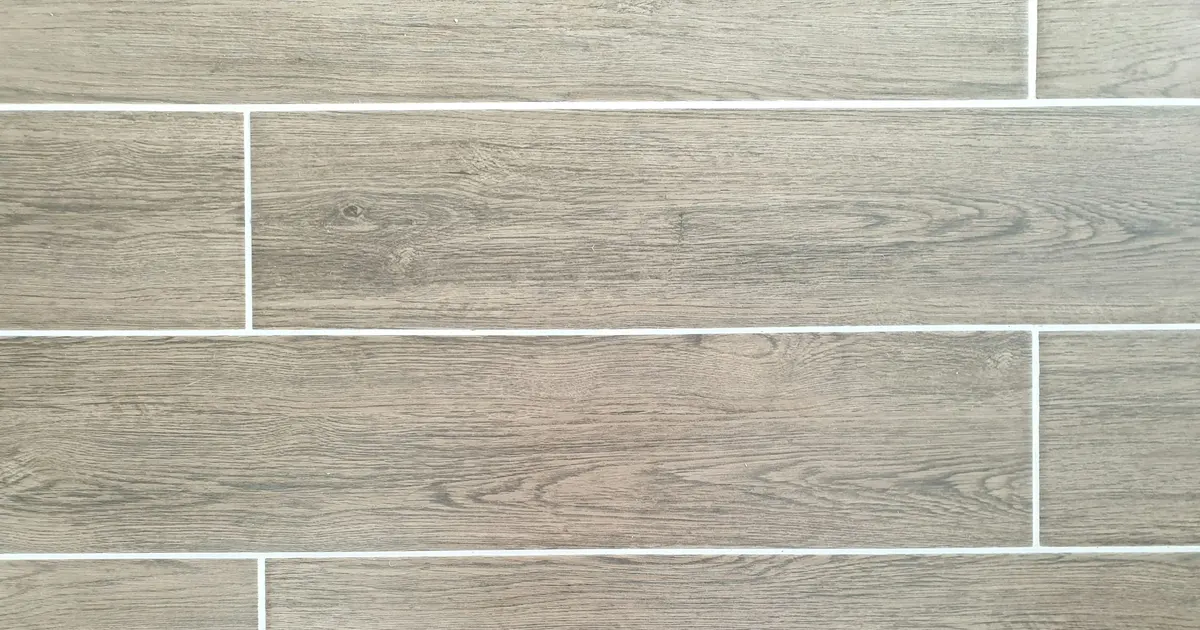
Wood-look porcelain tile has become a common alternative to a timber floor, especially in warm climates, on ground floors and in projects where the same plank look has to run from a living room into a bathroom. It is a very durable material, and in some rooms it is clearly the right choice. In others, engineered oak serves the client better. This article compares the two on the points that decide the question on a real project, and ends with a room-by-room guide.
Two very different materials
Wood-look porcelain tile is a dense, fired ceramic body with a glazed face. The wood image is printed onto the glaze, and the surface is often textured to follow the print. Plank tiles are usually rectified, meaning the edges are ground square after firing, and they are set in mortar with grout joints between them. For general background, see the porcelain tile entry.
Engineered oak has a face of real wood. At Vu Uy Wood that face is sawn French White Oak, bonded to a stable plywood core (2-layer) or laid over a cross-layered core with a backing layer (3-layer). The boards join with a tongue and groove (T&G) profile on all four sides, with no grout.
| Point | Engineered oak | Wood-look porcelain tile |
|---|---|---|
| Visible face | Real oak grain, every board different | Printed image under a glaze |
| Joints | Tight T&G joints, no grout | Grout joints on all four sides |
| Underfoot | Slight give, warm to the touch | Hard and rigid, cool to the touch |
| Standing water | Not suited | Well suited, with suitable grout and setting |
| Repair | Recoat, or sand and refinish within the wear layer | Replace the cracked tile |
| Change of look later | Sand and refinish in a new color | Remove and replace |
| Weight and height | Light, from 3/8” (10mm) to 13/16” (21mm) overall | Heavier, tile plus mortar bed |
Warmth and comfort underfoot
This is often the deciding point for residential clients. Tile is hard and holds the temperature of the slab beneath it, so it feels cool, and in a hot climate that can be welcome. In colder rooms it can feel cold unless it is heated. A dropped glass usually breaks on tile, and long periods of standing are less comfortable on a rigid surface.
Oak feels warmer to the touch and has a slight give that many people notice in kitchens and living rooms. It is also quieter in the room: footsteps on tile have a harder, more echoing sound in rooms with few soft furnishings.
Grout lines and the look of a plank floor
A wood-look tile floor reads as a series of individual planks with a visible joint around each one. Grout color can be matched closely, but the line is still there at every end and side. Long plank tiles also carry a practical limit: tile makers often restrict the offset between rows to reduce lippage, the small height differences between neighboring tiles, which limits the random stagger that a wood floor usually has.
The printed face also repeats. A design is produced from a set number of images, and in a large room the same pattern can be spotted more than once.
An oak floor has no grout. Boards are random length, so end joints fall naturally across the room, and every face is different within its grade. Formats such as herringbone and chevron, made to a drawing, are part of the same product. Our article on random vs fixed length explains how board length shapes the look.
Wet areas
Tile is the clear choice where water stands or is used every day: showers, full bathrooms, laundry rooms, mudrooms, pool surrounds and covered outdoor areas. It does not absorb water in the way wood does, and with the correct setting materials and wet-area membranes under it, it is designed for wet rooms. Slip resistance is rated by the tile maker, often as a dynamic coefficient of friction (DCOF), and should be checked for each wet area.
Engineered oak should not go into rooms with regular standing water. A powder room or a kitchen is a different question, and depends on the client’s expectations and maintenance. Our article on wood flooring in bathrooms discusses where the line falls.
Radiant heating
Tile conducts heat well and is commonly laid over radiant heating. That makes it the easier choice in a bathroom with a heated floor.
Engineered oak can also be used over radiant heating, and engineered construction is the usual starting point because the core restrains movement in the oak face. The heating maker sets the surface temperature limits and the start-up procedure, and the installer and adhesive maker set the rest. See engineered oak over radiant heating for what to specify.
Renovation: height, weight and flatness
In renovation work, practical constraints often decide the floor.
- Height. Tile plus its mortar bed and any membrane builds up more than many renovation floors can accept at doors, stairs and existing thresholds. Our 2-layer construction is a practical choice where overall floor height is limited.
- Weight. Porcelain is heavy, and on upper floors or timber structures the engineer may need to confirm the load.
- Flatness. Large plank tiles need a very flat substrate to avoid lippage. Oak also needs a flat subfloor, and the installer sets the tolerance for both.
- Time on site. Tile needs setting and grouting before it can be used. A prefinished oak floor can be in use sooner, following the adhesive maker’s guidance.
Durability and repair
Porcelain is very hard and resists scratching and staining well, which suits high-traffic areas and commercial entrances. Its weak points are impact and the grout. A heavy object can crack a tile, and replacing one tile in the middle of a floor means cutting it out without damaging its neighbors, then matching it from the same production batch. Keeping spare tiles from the original lot is good practice.
Oak marks more easily than porcelain, but the surface can be renewed. A worn finish can be recoated, and full sanding within the wear layer removes deeper wear or allows a new color. Our standard builds carry 3mm and 6mm sawn wear layers, with other thicknesses made to order.
Choosing by room
| Room | Usually points to | Reason |
|---|---|---|
| Living and dining rooms | Engineered oak | Warmth, real grain, no grout lines |
| Bedrooms | Engineered oak | Comfort and quiet underfoot |
| Kitchens | Either, by client priority | Oak for comfort and continuity, tile for heavy spills |
| Powder rooms | Either | Light water use; oak needs careful maintenance |
| Full bathrooms and showers | Tile | Daily standing water |
| Laundry and mudrooms | Tile | Water, grit and heavy wear |
| Covered outdoor areas | Tile | Exterior conditions |
| Heated bathrooms | Tile | Heat transfer and wet use together |
Where tile meets oak
Many homes use both, often with the same tone so the floor reads continuously. Plan the threshold early: decide the finished heights of each floor, the transition detail and the expansion space the oak needs at the tile edge, which the installer sets. If the oak should match the tile, choose the tile first and develop the oak color against a physical sample, since a printed glaze cannot be adjusted and an oak stain can.
Working with Vu Uy Wood
Vu Uy Wood manufactures made-to-order solid and engineered French White Oak flooring in Song Than 3 Industrial Park, Ho Chi Minh City, and has done so since 2006. We make oak flooring only, with a tongue and groove profile, and we do not make tile. To see how oak colors sit next to other materials, browse the color library, then send the oak specification from the Specify page with a note on the adjoining floors. We normally reply within one working day.