A finisher stains an oak floor with a water-based product and, within hours, brown halos appear around the board ends. Another project lays a floor and finds black marks where an iron fixing met a damp patch. Both are tannin at work. Oak is rich in natural tannins, and those compounds react with water, with iron and with some finishing products. The reaction is well understood and can be managed, but only when it is planned for. This guide explains what tannin does in an oak floor, which situations trigger it and what to put in a specification.
What tannin is and why oak has so much
Tannins are a family of natural polyphenols found in the bark, heartwood and leaves of many trees. Oak carries a high amount in its heartwood, where they help protect the tree from decay and insects. The same property is why oak has long been used for barrels and for dyeing and tanning.
For a flooring buyer, three facts matter.
- Tannins are water soluble. When a board gets wet, tannins can move with the water towards the surface.
- Tannins react with iron. The reaction forms a dark blue-black compound.
- Tannins react with alkaline products. Alkalis darken oak, sometimes dramatically.
None of these is a defect of the wood. They are properties of the species, and they are also part of why oak takes stain and effects so well.
The main triggers
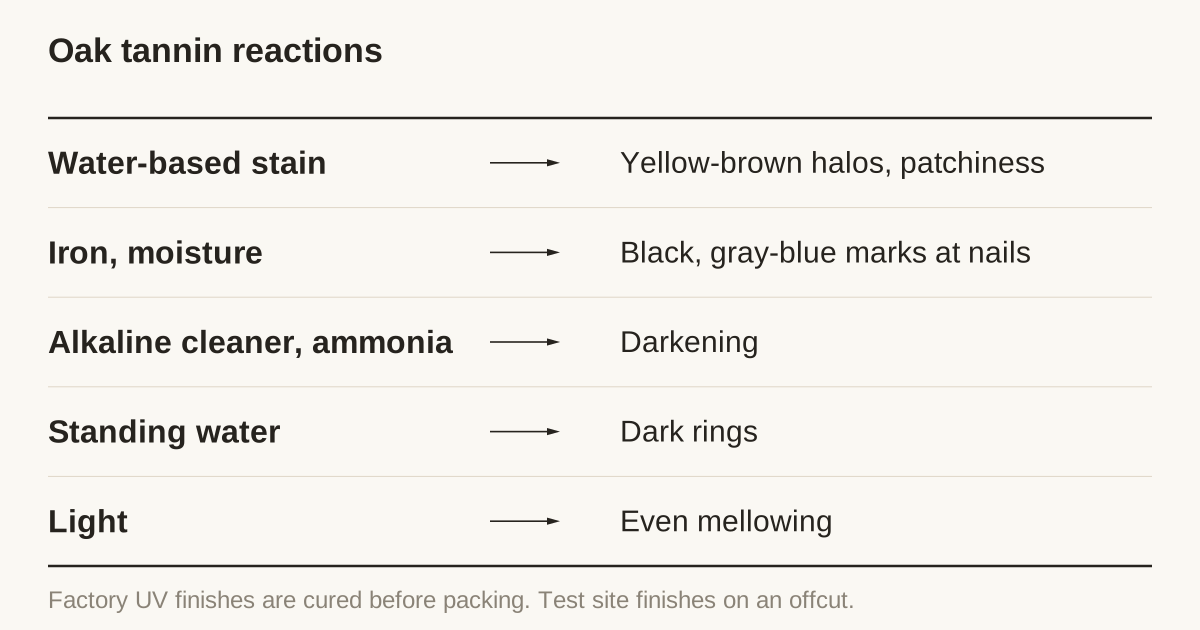
| Trigger | What happens | How it shows |
|---|---|---|
| Water-based stain or finish | Tannin dissolves into the wet film and moves to the surface | Yellow-brown halos, patchiness, darker board ends |
| Iron and moisture | Iron ions meet tannin in a damp surface | Black or gray-blue marks around nails, steel wool and metal legs |
| Alkaline cleaners or ammonia | Alkali reacts with tannin in the wood | Darkening, sometimes uneven |
| Water spills left standing | Tannin leaches and the wood stains | Dark rings and tide marks |
| Light exposure | Oak slowly changes color under light, with or without a coating | An even shift in tone, usually mellowing |
The first trigger is the one that surprises finishers most. Water-based products are common because of low odor and fast drying, and oak is among the species that needs the most care with them.
Why a pre-finished UV floor is a lower risk
A factory-finished floor is stained and coated on a controlled line, and each layer cures before the next one goes on. Stain and topcoat are applied on our UV finishing line, with process settings controlled to support consistency within a lot and across repeat orders. The finish is cured before the board is packed, so the wet-film stage where tannin reaction normally happens is completed in the factory and checked on the approved sample. See UV-cured finish for hardwood flooring.
A cured coating does not make the wood non-reactive. Iron and standing water can still stain a cured floor if they reach bare wood through a gap or a worn edge. But the finishing step, where most tannin problems occur, is not left to the site.
Where the risk sits for unfinished floors
An Unfinished floor is supplied sanded and ready for the finisher. The site then applies stain and topcoat, and the finisher takes on the tannin management.
- Water-based products. If the finisher uses them, a tannin-blocking sealer or a compatible first coat is usually part of the system. Follow the finish maker’s instructions for oak.
- Oil-based or hardwax products. These do not carry water, so they do not draw out tannin in the same way. They have their own drying and compatibility notes.
- Sanding dust. Dust left on the floor can react with water-based coats. Clean the surface thoroughly.
- Steel wool. Fine steel wool leaves iron particles in the grain. In contact with water or a water-based product, it can leave dark specks. Synthetic pads avoid this.
The guide to unfinished against prefinished oak flooring sets out when each route suits a project.
Reactions that are used on purpose
Not every tannin reaction is a problem. Some finishes use it.
- Fumed or smoked oak. Ammonia vapor reacts with tannin to darken oak evenly through the surface layer, and the effect is a deep, warm brown.
- Ebonizing. An iron solution blackens oak by reacting with its tannin, which is why oak is chosen for dark, graphic finishes.
- Effect finishes. Smoke, wash and two-tone looks work on oak because its response to color is varied across the grain.
Our Color and Effect UV route covers smoke, wash and two-tone effects as a factory finish. We do not describe the chemistry of our system, and the way it behaves on your oak is confirmed on a physical sample. See color and effect UV flooring finishes.
How to test for tannin response
A simple test saves a costly redo.
- Make a test patch. Use an offcut from the floor, finished with the exact system the project will use.
- Run the full sequence. Sand, clean, seal if specified, stain and topcoat, and let it cure fully.
- Look for halos, patches and darkening. Check the board ends and the soft earlywood first.
- Try a wet test. Place a damp cloth on a patch and look for color transfer after it dries.
- Test near iron. If steel furniture legs or fixings are part of the design, test a damp patch with a steel contact.
- Record the result. Keep the sample with the project file.
For a factory finish, the approved sample is the test, and it should be made on the same oak and finish system as production. The method is in approving flooring color on a physical sample.
Color change over time
Oak changes color under light. Freshly sanded white oak is pale, and with exposure it usually mellows towards a warmer, slightly deeper tone. The effect depends on the finish, and a clear finish shows it more than a dark stain does. It is a normal property of the timber and not a defect.
Two practical points follow. First, rugs and furniture that cover part of a floor can leave a pale area after a year or two when the exposed floor has mellowed around it, and the difference evens out slowly once the cover is removed. Second, a replacement board put into an old floor will look different at first from the boards around it. Keeping a few spare boards from the same lot, and recording the color reference, helps with repairs later.
Cleaning and maintenance
Tannin makes the choice of cleaner important. Strong alkaline cleaners, ammonia products and some degreasers can darken oak, especially where the finish is worn. Water left standing can stain the board and the joint.
A maintenance plan should say, in writing, which cleaner is approved for the finish, how wet the mop may be and how quickly spills should be wiped. For commercial projects the plan belongs in the handover documents, because the cleaning contractor is rarely the party that specified the floor.
Specification points
- State whether the finish is factory UV or site applied, and name the system.
- For site-applied finishes, name the finish maker and ask for its oak guidance in writing.
- Specify synthetic pads, not steel wool, for site preparation.
- Keep metal fixings and tools off damp bare wood during installation.
- Give the cleaner or maintenance product for the finished floor, and avoid alkaline cleaners unless the finish maker permits them.
- Say whether furniture with metal feet will stand on the floor, and ask for protective pads.
What owners can do
- Wipe spills promptly instead of leaving them to soak.
- Use cleaners made for the finish, and avoid strong alkalis.
- Fit felt or plastic pads under metal furniture legs.
- Use mats at entrances, because water and grit carried in from outside can reach the wood.
When tannin shows up unexpectedly
Most tannin problems appear in the first days after a site finish, but a few arrive later. A leak or a plant pot that sits on the floor can draw tannin to the surface and leave a dark ring. A steel furniture foot on a damp patch can leave a black mark. A mop left standing on its head can leave a halo. In each case the cause is a small amount of water, in contact with bare or lightly protected oak.
The remedy depends on the stain. Light surface marks may clean off with the approved cleaner. Dark iron stains usually need a treatment designed for them, applied by a floor professional. A deep stain may need local sanding and refinishing. Prevention costs far less: pads under feet, saucers under pots and prompt wiping.
Questions to ask
| Question | A clear answer covers |
|---|---|
| Is the finish factory UV or site applied? | Who manages the wet stage |
| Was the sample finished with the production system? | A test that predicts the floor |
| Is a tannin barrier part of the system? | A sealer or compatible first coat |
| What cleaners are approved? | Products that will not darken oak |
| Are metal contacts expected? | Pads and protection |
Working with Vu Uy Wood
Vu Uy Wood manufactures solid and engineered French White Oak flooring to buyer specification in Song Than 3 Industrial Park, Ho Chi Minh City, and has done so since 2006. Finish routes are listed on the Specify page, including Unfinished for projects where the installer applies the final finish. We normally reply within one working day.