Two oak floors can look alike on the day they are installed and behave very differently five years later. The reason is often the finish. An oiled floor and a lacquered floor protect the wood in different ways, so they are cleaned in different ways, wear in different ways and are repaired in different ways. A buyer who understands those differences can choose on what the owner will actually do, not on the look in a catalog. This guide compares the two on care and repair, and shows where each suits a project.
How each finish protects the wood
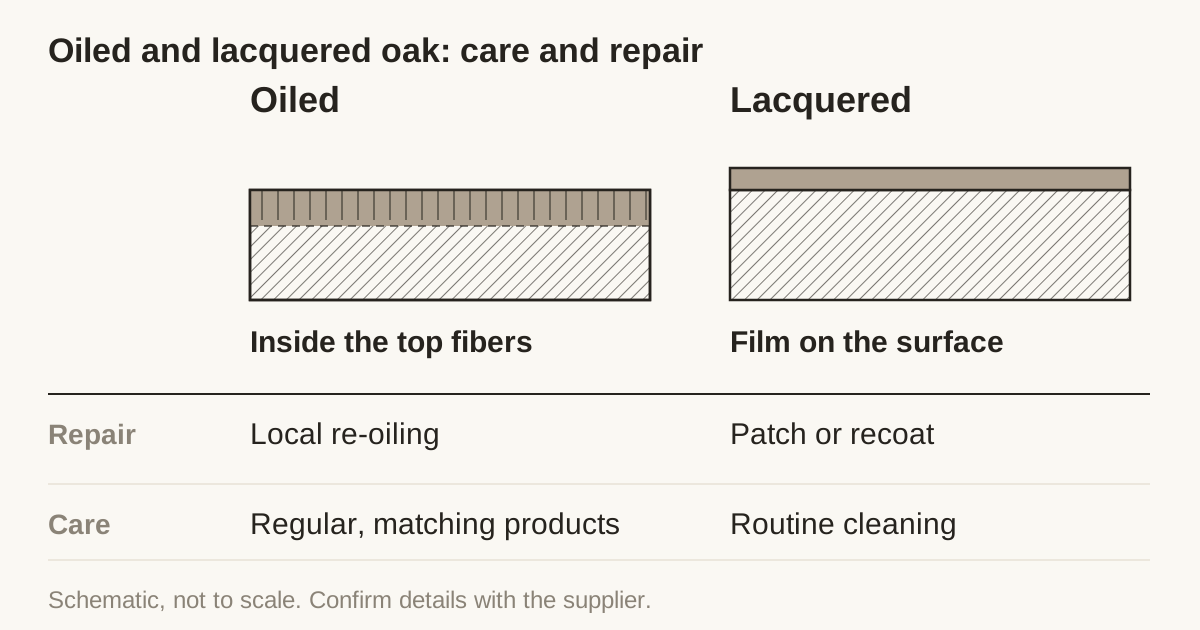
Oil soaks into the surface of the wood. Hardwax oils combine natural oils with waxes, and they harden inside the top fibers of the board. The result is a thin protection that leaves the grain open and the surface feeling like wood. There is little or no film on top.
Lacquer forms a continuous film on the surface. It sits above the wood like a thin clear sheet, and it seals the grain. Modern floor lacquers include water-based and solvent-based products applied on site, and UV-cured coatings applied and cured on a factory line.
The distinction is simple to remember. Oil protects from within the wood. Lacquer protects from on top of it.
Side by side
| Feature | Oiled | Lacquered |
|---|---|---|
| Surface feel | Natural, open grain | Smooth film |
| Look | Matte, soft, slightly warm | From matte to gloss, with a more even surface |
| Stain resistance | Moderate, depends on upkeep | Higher, because the film seals the surface |
| Wear pattern | Wears in traffic paths, which can be renewed | Wears through the film, which needs a recoat |
| Spot repair | Easy, local re-oiling | Harder, a patch can show |
| Full refresh | Clean and re-oil | Abrade and recoat |
| Maintenance | Regular, with matching care products | Lower, routine cleaning |
| First use | Needs curing time on site | Factory UV coating is cured before packing |
Neither is better. They suit different owners.
Care and cleaning
An oiled floor needs a routine that fits the finish. It is cleaned with soap or a cleaner made for oil, with a damp mop, and it is re-oiled from time to time as the protection thins. The owner who follows that routine is rewarded with a floor that improves with age. The owner who neglects it finds the floor becomes more easily marked and stained.
A lacquered floor needs less. Dry sweeping and a lightly damp mop with a cleaner approved for the finish are usually enough. The film resists most household stains, so a spill that is wiped up quickly does not mark. The owner does not have to remember a schedule, which is why lacquered floors are common in places that are managed by a maintenance contractor.
For both, water should not be left on the floor, and strong alkaline cleaners should be avoided, because they can damage the finish and darken oak. See oak tannin and floor finishes.
Repair
This is where the two differ most.
- Oil. A scratch or a worn patch can be treated locally. The area is lightly abraded, cleaned and re-oiled, and the new oil blends with the old. The repair is simple and does not usually leave a visible border.
- Lacquer. A scratch that breaks through the film shows as a pale line, and a repair needs a patch of new lacquer that has to be blended into the surroundings. On a large floor it is often easier to recoat a whole area, or a whole room, than to repair a single mark. A deep scratch may require sanding the board.
For a restaurant, a hotel corridor or a shop, that difference matters. A floor that can be spot-repaired by the staff has an advantage over one that needs a contractor.
Wear and the long view
Both finishes wear. They wear differently.
An oiled floor shows traffic paths as dull areas, and the fix is more oil. A lacquered floor keeps its look for longer, then shows wear as dull or scratched patches, and the fix is a recoat. A lacquer recoat is straightforward while the film is intact and still bonded. Once the film has worn through to the wood, the floor may need sanding back, and the wear layer must have enough thickness for that. Our wear layer guide explains how many sandings a build can take.
Sheen and color
Oil finishes are usually matte or satin and keep the oak looking natural. Lacquers can be made in a wider range of sheens. Our Specify page offers Matte, Extra Matte and Ultra Matte, and the choice changes how texture and color read. See Matte, Extra Matte or Ultra Matte.
Color can be built into either finish. Oil finishes are often tinted or applied over a stain. In a factory UV system the color stain sits under a protective topcoat, which gives a stable, even color across a lot. See clear UV against color UV.
Which finish routes we list
The finish routes on our Specify page are Unfinished, Clear UV, Color UV and Color and Effect UV. The three UV routes are factory finishes cured on the line, and they form a protective film on the surface, so for care and repair they behave in the manner of a lacquer. The Unfinished route supplies the board sanded and ready for a finish applied on site, and that is the usual way to reach an oiled floor.
An oiled factory finish is not one of the listed routes. If your project needs one, say so in the RFQ and we will confirm at quotation what can be made. For a site-applied oil, order Unfinished and ask the finisher to approve the product for oak. The article on unfinished against prefinished flooring explains the trade-offs.
Water, stains and what happens when a spill is missed
A spill that is wiped up at once is harmless on either finish. The difference shows when a spill is missed.
On a lacquered floor, the film holds the liquid on the surface for a while. It can still creep into a joint at the edge, and a stain at the joint is hard to remove, but the face is protected. On an oiled floor, the protection is thinner, and a liquid such as red wine, coffee or oil can soak into the wood before it is noticed. A mark can often be sanded out locally and re-oiled, but it takes work.
In either case, water left on the floor can find the joints, and oak reacts with some liquids because of its tannin content. The routine that protects both finishes is the same: wipe quickly, avoid wet mopping and use approved cleaners.
Cost over the life of the floor
Initial cost and long-term cost run in opposite directions for the two finishes. A factory UV finish is part of the board price and needs little maintenance. An oiled floor is often lower in first cost, and costs more in time and product over its life because it is re-oiled at intervals. A lacquered floor costs more when it needs a recoat, and the cost depends on the size of the area. Compare the two over the period the owner will keep the floor, and include the labor of maintenance. The cheaper floor to buy is not always the cheaper floor to own.
What a refresh looks like
A refresh is the work that restores the floor after years of use. For an oiled floor, it is a deep clean and a new coat of oil, done room by room, and the floor can be back in use quickly. For a lacquered floor, it is a light abrasion of the surface and a new coat of lacquer, which needs the room to be empty and the coating to cure. If the film has worn through, the work includes sanding. In both cases the refresh is planned, priced and scheduled with the owner, and it should be part of the maintenance plan from the start.
Choosing by project
| Project | Likely better fit | Why |
|---|---|---|
| Private home, owner wants a natural feel | Oiled | Easy local repair, soft look |
| Rental or buy-to-let | Lacquered | Low maintenance, stable look |
| Hotel or hospitality | Lacquered, with a plan for recoating | Even look, durable film |
| Retail and showrooms | Lacquered | Consistent finish across a large area |
| Feature room, low traffic | Either | Choose on look |
| Project with a maintenance contractor | Lacquered | Fits a routine schedule |
What to write in the RFQ
- Name the route: factory UV or Unfinished for a site finish.
- For a site finish, name the product and ask its maker for oak guidance.
- State the sheen, because it changes how the finish looks and wears.
- Describe the care routine the owner is expected to follow.
- Say whether spot repair or a full recoat is the plan.
A last check on the sample
Approve the finish on a physical board of the production construction. Sheen, color and surface feel are the three things that photographs misreport. Use the sample to test a repair too: scratch it lightly and try the care product that you plan to specify. The method is described in approving flooring color on a physical sample.
Working with Vu Uy Wood
Vu Uy Wood manufactures solid and engineered French White Oak flooring to buyer specification in Song Than 3 Industrial Park, Ho Chi Minh City, and has done so since 2006. Finish routes and sheens are set on the Specify page, and the finish for a site-applied floor can be discussed with the quotation. We normally reply within one working day.