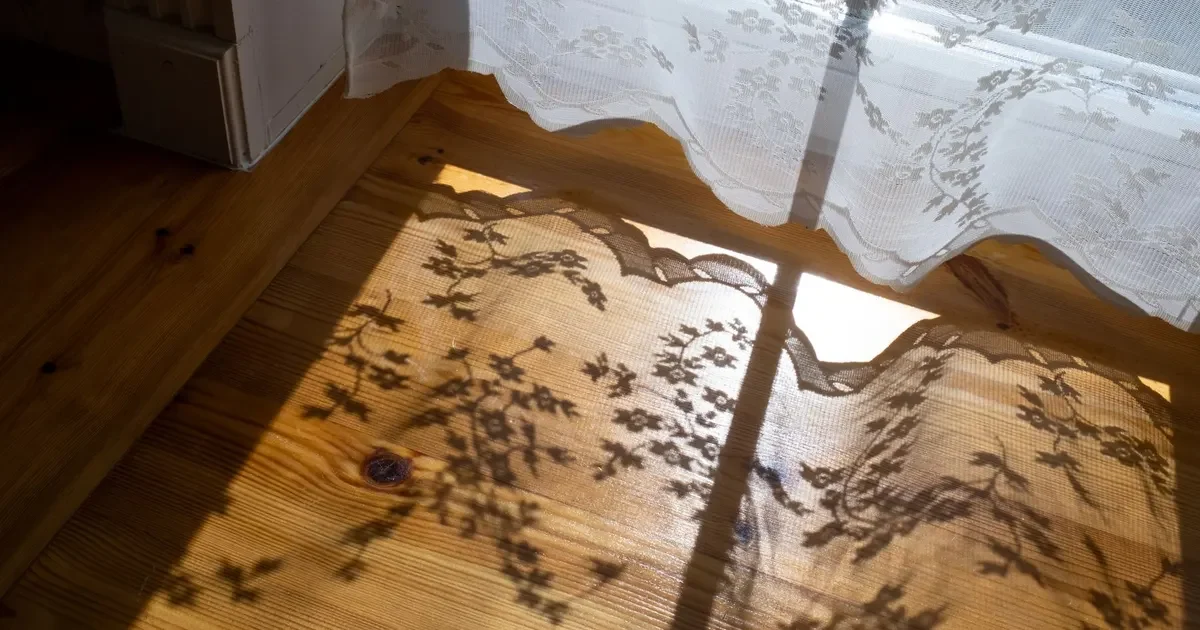
Solid oak flooring is a single piece of timber, and timber is never entirely still. In a heated building in winter, hairline gaps open between boards. In a humid summer, the same joints close and the floor can press against the walls. Both are normal. What makes the difference between a floor that looks natural through the seasons and one that draws complaints is how much movement there is, and how well it was planned for. This guide explains why wood moves, which choices change the amount and what a specification should say.
Why wood moves
Wood takes up moisture from the air and gives it back as the air dries. It settles at a moisture content that matches the surrounding relative humidity, a balance known as the equilibrium moisture content. When humidity rises, the wood swells. When humidity falls, it shrinks.
The movement is not equal in all directions.
- Along the grain, the length of a board, the change is very small and is usually ignored.
- Across the grain, the width and thickness, the change is large enough to see.
- Within the cross-section, wood moves more tangentially, along the growth rings, than radially, across them.
For American white oak, widely published figures from green to oven-dry are about 5.6 percent radially and 10.5 percent tangentially. A floor works over a small part of that range, not all of it, so real movement is only a fraction of those figures. The ratio between the two directions is what matters for a buyer: a plain sawn board, whose face is mostly tangential, moves more across its width than a quarter or rift board, whose face is mostly radial.
What changes the amount of movement
| Choice | Effect on movement |
|---|---|
| Wider board | The same percentage change gives a larger gap or push at each joint |
| Plain sawn cut | More width change than rift or quarter |
| Rift and quarter cut | Less width change and a more stable face |
| Drier building air | Boards shrink, gaps open |
| Humid building air | Boards swell, joints close |
| Radiant heating | Dries the board from below and speeds the change |
| Engineered construction | A cross-layered core restrains the movement of the face |
The amount of humidity swing in the building is as important as any choice made in the factory. A home with steady humidity moves little. A home that is heated hard and left dry moves a lot.
What the arithmetic looks like
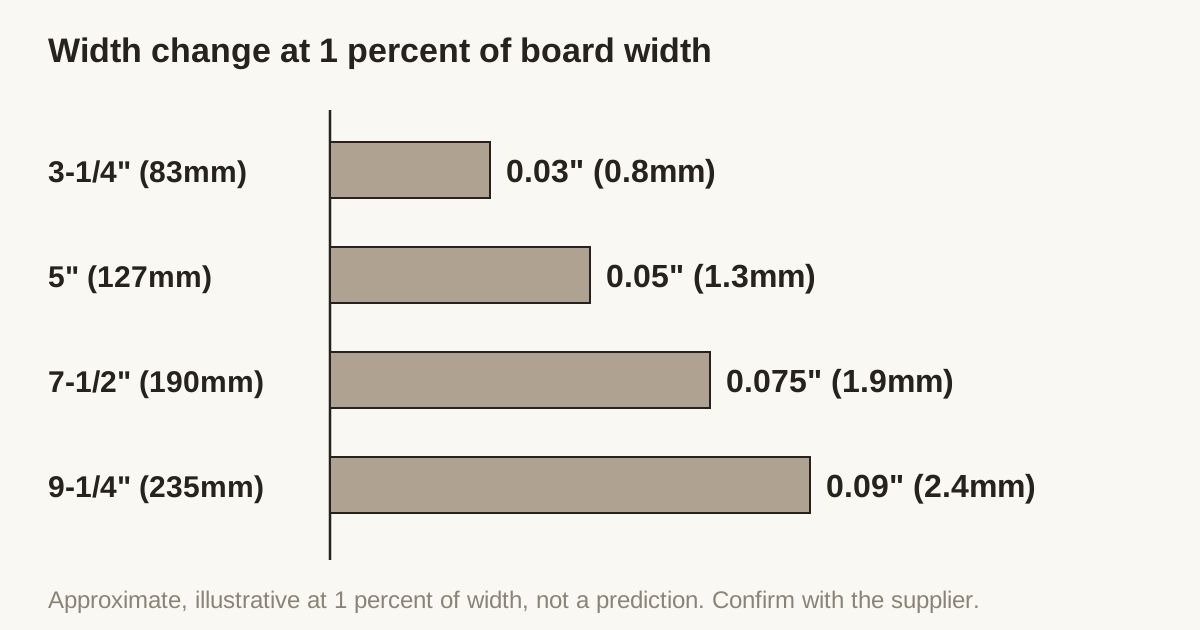
A simple calculation shows why width matters. The table below applies a change of 1 percent of board width, a figure chosen for illustration and not a prediction for any floor.
| Board width | Change at 1 percent of width |
|---|---|
| 3-1/4” (83mm) | about 0.03” (0.8mm) |
| 5” (127mm) | about 0.05” (1.3mm) |
| 7-1/2” (190mm) | about 0.075” (1.9mm) |
| 9-1/4” (235mm) | about 0.09” (2.4mm) |
The pattern is obvious. Each joint of a narrow board takes a small share, and each joint of a wide board takes a larger share. A narrow floor has many joints that each open a little, and a wide floor has fewer joints that each open more. Over a whole room the total is the same, but the look differs. Many fine lines tend to disappear into the grain, and a few wider gaps show.
What gaps and pressure look like
- Winter gaps. In dry months, boards shrink and hairline gaps appear along the joints. They are usually small and close again as humidity returns.
- Summer tightness. In humid months, boards swell and joints close fully. In extreme cases a floor lifts or crowns where it presses on the walls.
- Uneven gaps. Gaps that are larger in one area than another point to a local cause such as a heat source, a damp area or a poor subfloor.
- Cupping. If moisture reaches the board from one side more than the other, it dishes. See cupping and crowning in engineered flooring for how flatness is measured.
Gaps within the normal seasonal range are not a defect. Gaps that are wide, permanent or uneven point to a moisture condition that needs investigating.
What the installer controls
The installer sets the conditions that let a solid floor move without damage.
- Perimeter expansion space. A gap is left at the walls and fixed vertical elements so the floor can swell without pushing. The size is set by the installation guidelines and the installer, and it should be hidden by the skirting or the molding.
- Subfloor condition. A dry, flat subfloor limits cupping. The installer checks it with the method that the board and fixing manufacturers require.
- Fixing method. Nailed, glued or floating installations restrain the floor differently. See how the installation method shapes the specification.
- Building conditions. The building should be at its normal operating humidity before the floor goes in. A building that is still drying out will shift the boards after installation.
What the specification can do
- Choose the width with the movement in mind. A solid floor in a very wide format is a harder job than one in a narrow format. Our plank width guide sets out the trade-off.
- Choose the cut. Rift and quarter sawn faces give less width change. See rift and quarter against plain sawn.
- Choose the construction. An engineered board restrains the face, which is why wide formats are usually engineered. The comparison is in solid against engineered flooring.
- Choose the edge. A micro-bevel outlines each board and makes small gaps much less visible. A square edge shows a gap as a clean line. See square edge against micro-bevel.
- State the humidity range. Give the expected indoor humidity and heating conditions in the RFQ, so the build is quoted for the building.
Reading the climate of the building
The most useful number for a movement discussion is not in the board at all. It is the range of humidity the building will see across the year. A building with air conditioning and humidity control moves little. A building that is naturally ventilated in a humid region will swell in the wet season and shrink when the air dries. A building in a cold region that is heated hard through winter will see the driest conditions of all.
Ask the project team for the expected range, and pass it on with the RFQ. A buyer who gives the destination, the heating type and the use of the building gives the factory the information it needs to suggest a width and a construction. A buyer who gives none receives a quotation based on average assumptions.
Moisture sources inside the building matter as well. A floor above a damp crawl space, a floor near an unsealed slab edge and a floor beneath a leaking pipe all carry local moisture that no choice of board can offset.
Living with the movement
Owners who understand that a solid floor breathes are rarely unhappy. Those who expect a floor with no visible movement are the ones who raise a claim. A short note to the owner at handover helps: hairline gaps in winter are normal, boards will tighten in summer, a humidifier in a dry heated home reduces the range, and cleaning with excess water makes the movement worse.
For owners who want the look of a wide solid board without the movement, an engineered build is the usual answer, and the 2-layer against 3-layer comparison explains how the construction restrains the face.
What not to do
Do not fill seasonal gaps with a rigid filler. The gap will close in summer, the filler will be crushed or pushed up, and the edges of the boards will be damaged. Do not install into a building that is still wet from plaster or screed. Do not seal the perimeter gap with a hard material.
What the factory does
Moisture control starts in the plant. Timber is kiln dried and checked against the moisture target for the order, so boards leave in balance with the conditions they are specified for. Our note on moisture control in flooring production follows the process. After delivery, the building decides the rest, which is why we ask buyers to tell us the destination climate when they request a quote.
A short checklist
| Item | Why it matters |
|---|---|
| Width | Larger widths concentrate movement |
| Cut | Rift and quarter move less across the width |
| Construction | Engineered restrains the face |
| Edge detail | Bevel hides small gaps |
| Destination climate | Sets the target moisture and the range |
| Heating type | Radiant heat dries the floor faster |
| Perimeter gap | Left by the installer at the walls |
Working with Vu Uy Wood
Vu Uy Wood manufactures solid and engineered French White Oak flooring to buyer specification in Song Than 3 Industrial Park, Ho Chi Minh City, and has done so since 2006. Construction, width and edge detail are set on the Specify page, and the destination climate can go into the same request. We normally reply within one working day.