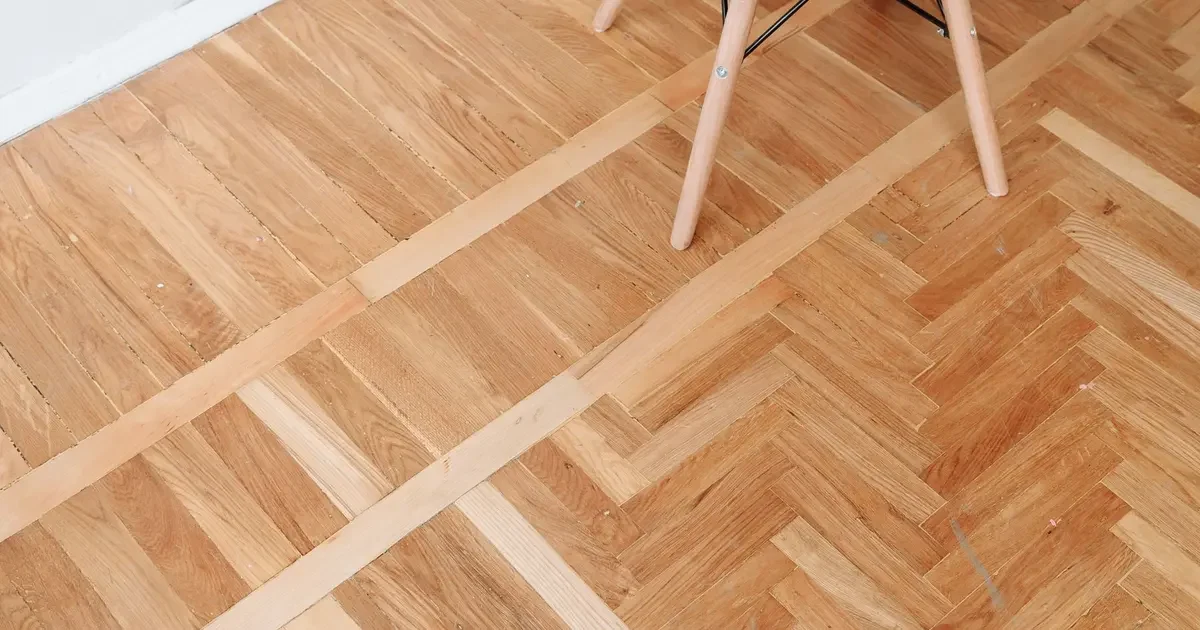
Hardness is the first number many buyers ask for and the one most often misread. A Janka rating is useful, but a floor does not dent or wear according to the rating alone. Furniture, footwear, floor height, the core under the face and the finish on top all take part. This guide explains what the Janka test measures, where white oak sits among common flooring timbers, and how to turn the number into choices that hold up in real rooms.
What the Janka test measures
The Janka test presses a steel ball into a piece of wood. The ball is 0.444 inch (11.28mm) in diameter, and the test records the force needed to embed it to half its diameter. The result is given in pounds-force (lbf), and sometimes in newtons or kilograms-force.
Three points follow from that method.
- It measures resistance to indentation. The number tells you how much force it takes to dent the wood, not how the wood resists scratching or abrasive wear.
- It is measured on solid wood. A test piece of the timber is used, not a finished floor. The coating, the core and the thickness of an engineered board are not part of the result.
- It varies within a species. Density changes from tree to tree and from board to board, so published values are averages with a range around them.
A Janka figure is therefore a statement about the timber. It ranks species against each other on one property.
Where white oak sits
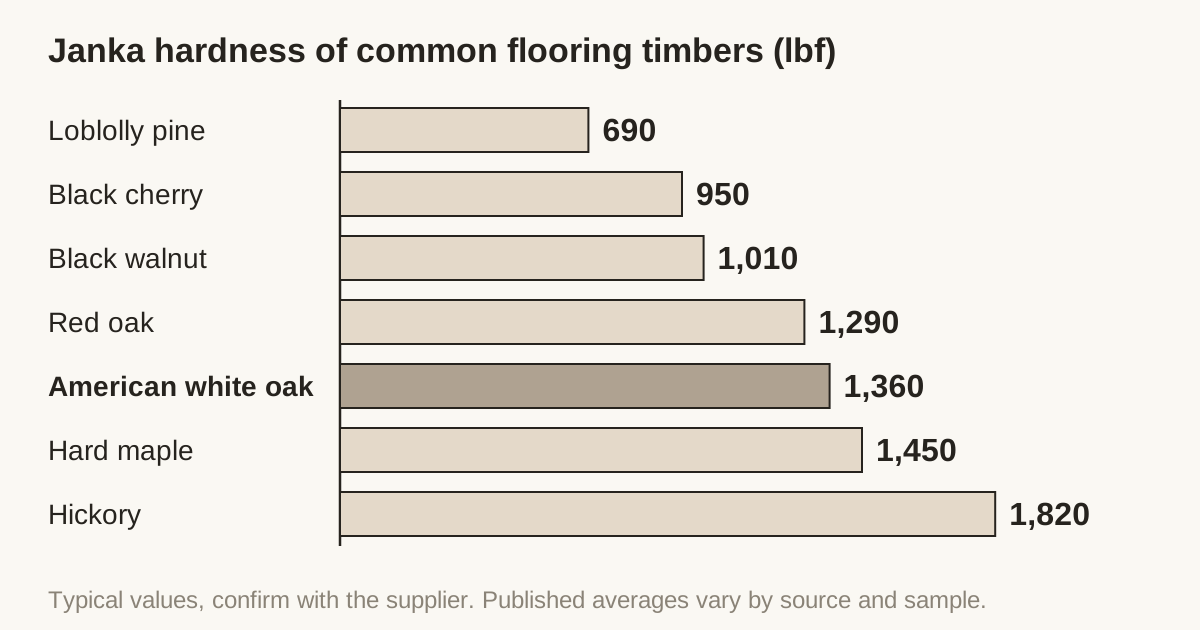
White oak is in the middle to upper range of common flooring timbers. The values below are widely published averages for the timber and vary with the source and the sample.
| Timber | Typical Janka hardness (lbf) |
|---|---|
| Loblolly pine | about 690 |
| Black cherry | about 950 |
| Black walnut | about 1,010 |
| Red oak | about 1,290 |
| American white oak | about 1,360 |
| Hard maple | about 1,450 |
| Hickory | about 1,820 |
Published figures for European white oak, the group that French white oak belongs to, fall in the same general band as American white oak, and the exact value depends on the source and the sample. The practical reading is that oak is hard enough for most residential, hospitality and light commercial floors, without being so hard that it is difficult to machine or sand.
Why the number does not predict a dent
In a room, a dent comes from a concentrated load: a high heel, a chair leg, a dropped tool, a piece of furniture moved without protection. How deep the dent is depends on five things, and the timber’s hardness is only one of them.
| Factor | How it affects a dent |
|---|---|
| Species hardness | Sets the starting resistance of the face |
| Support under the face | A firm core resists a dent better than a soft one |
| Wear layer thickness | A thin face over a soft core can dent beneath the finish |
| Finish | Protects the surface from scuffing but not from deep indentation |
| The load | A narrow, heavy point does far more than a wide, light one |
The second and third points matter most for engineered boards. The face of an engineered board is oak, and its hardness is the hardness of oak. Under a point load, though, the face is supported by the core below. A board with a thin face and a soft core flexes under load and dents more than a board with a thicker face and a firm core, even though the face timber is identical. That is why the build matters alongside the species. Our articles on oak flooring thickness, the wear layer and the 2-layer against 3-layer comparison cover the options.
Dents, scratches and wear are different things
A buyer who wants a tough floor needs to ask about three properties, not one.
- Dent resistance is a function of the timber and the support under it. Janka measures part of it.
- Scratch resistance is a function of the finish and of the texture. Hard topcoats resist scratching better, and a textured or low sheen surface hides scratches better.
- Abrasion resistance is the wear of the finish under foot traffic and grit. It is tested on the coating, as set out in the article on the Taber abrasion test.
A floor can score well on one and poorly on another. A very hard timber with a soft finish scratches easily, and a soft timber with a good finish scuffs less but dents sooner.
Real rooms
| Room | Typical load | What helps most |
|---|---|---|
| Entry and hallway | Footwear, grit, heels | A hard finish, texture, a mat at the door |
| Kitchen | Dropped objects, chair legs | A matte sheen, felt pads, a firm construction |
| Dining room | Chair movement, table legs | Pads on every leg, a texture that hides marks |
| Living room | Furniture, pets | Rugs in high traffic, a textured face |
| Bedroom | Light, localized loads | Little needed beyond pads |
| Retail or hospitality | Heavy traffic, castors, heels | A tested finish, a firm build, a maintenance plan |
Notice how few of these solutions depend on a higher Janka number. Protective pads, mats, texture and sheen change how a floor looks after a year more than a small difference in hardness does.
Texture, sheen and color
Choices on the face change how dents and marks read.
- Texture. A wire brushed or worked surface hides scratches and small dents, because the eye is already reading relief. A smooth surface shows every mark. See wire brushed against smooth oak.
- Sheen. Low sheens hide marks better than gloss. Compare the three on our Specify page in Matte, Extra Matte or Ultra Matte.
- Color. Mid tones hide marks better than very dark or very light ones, where scratches and dust show in contrast.
- Grade. Natural and Rustic faces carry knots and color movement that make small marks less noticeable. A Premium face is quieter and shows more.
Protecting the floor in use
Most dents in a well-built oak floor come from a short list of causes, and most are avoidable.
- Furniture legs. Narrow legs concentrate a heavy load on a small area. Wide felt pads spread it and prevent scratches when furniture moves.
- Heels and cleats. A narrow heel puts a large pressure on a small spot. Entry mats remove grit that would otherwise act as an abrasive.
- Dropped objects. Kitchens and workshops see these. A matte sheen and a textured face make small dents much less visible.
- Moving furniture. Sliding a heavy piece without lifting it cuts the finish and drags grit across the surface.
- Chair castors. Hard castors score a floor. Soft castors or a chair mat protect it in offices and dining areas.
These habits change the result more than a difference of a few hundred pounds-force in a published figure does.
Janka and the choice of species
Janka is a fair guide when you compare species, and a poor guide when you compare finished floors. If a project is choosing between oak and a softer timber, the figure shows that oak resists denting better. If a project is choosing between two oak floors, the figure does not decide the matter, and the construction, wear layer, finish and texture do.
For this reason we keep Janka as one line in a specification and not the headline. A buyer who writes the construction, the wear layer, the texture and the sheen into the RFQ gives the factory far more to work with than one who writes a hardness number alone.
What to ask when someone quotes a Janka number
- Which timber and which source? A value for a different species or a different region is not a value for your floor.
- Is it an average or a single sample? Averages are normal. A single high reading is not a specification.
- Is it the face timber only? For an engineered floor, ask what the core is and how thick the face is.
- What else is claimed? If a supplier uses Janka to imply scratch or wear performance, ask for the test that supports it.
We do not publish a Janka value for a finished Vu Uy Wood board, because Janka is a property of the timber and not of the built floor. If your project has a hardness requirement, state which test and what it applies to, and the answer is confirmed at quotation.
A short specification note
- Name the species, the construction, the overall thickness and the wear layer.
- Name the texture and the sheen, since they decide how marks show.
- State the room type and expected traffic.
- For heavy use, ask for a finish test on your finish system, and for guidance on pads and maintenance.
Working with Vu Uy Wood
Vu Uy Wood manufactures solid and engineered French White Oak flooring to buyer specification in Song Than 3 Industrial Park, Ho Chi Minh City, and has done so since 2006. Construction, thickness and wear layer are chosen on the Specify page, and the room and traffic notes can go into the same brief. We normally reply within one working day.