
A retail floor does two jobs at once. It has to look like part of the brand every hour the shop is open, and it has to survive hundreds of footsteps, trolleys, display moves and cleaning rounds without looking tired. Oak suits that brief because it can be finished in almost any color and repaired in place, but the specification has to be written for the traffic and not for a showroom photograph. This guide explains how a retail floor wears, what to choose for the finish, the wear layer and the format, and how to plan for repair from the start.
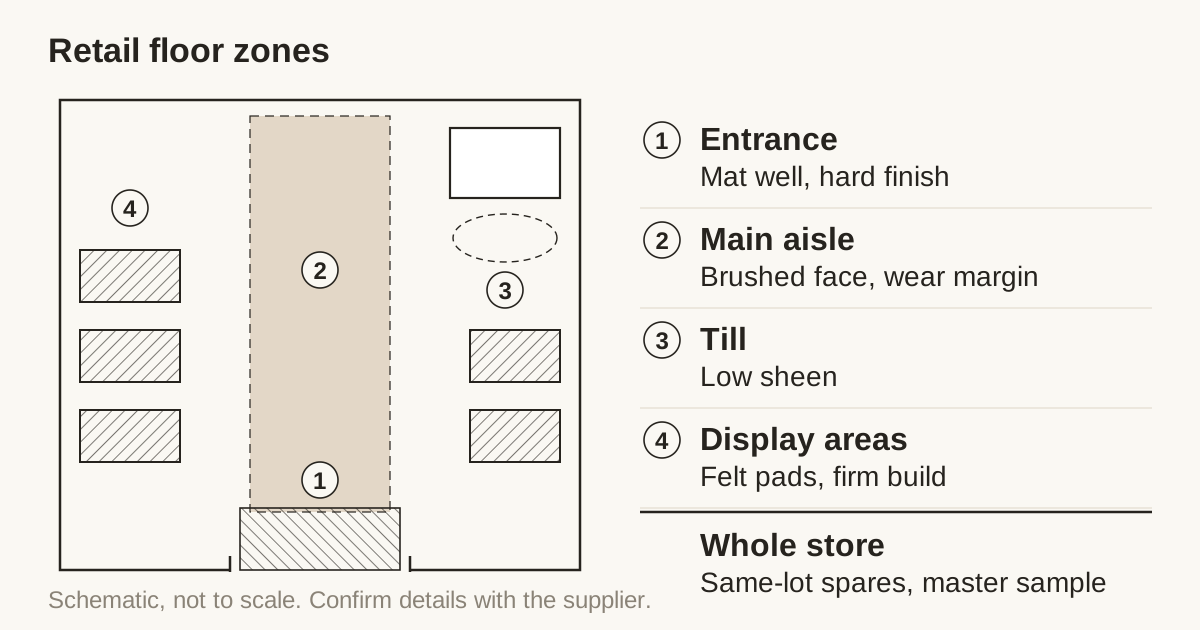
How a shop floor wears
Wear in a store is concentrated. The entrance, the main aisle and the area around the till take most of the traffic, while the corners of the store may see almost none. That pattern drives the specification.
| Zone | What it sees | What it shows first |
|---|---|---|
| Entrance | Grit, water and the heaviest footfall | Scuffing and dulling of the finish |
| Main aisle | Steady footfall, trolleys and display moves | Fine scratches in a line |
| Till and fitting rooms | Standing, turning, bags | Wear around the standing points |
| Display areas | Heavy fixtures set down and moved | Scratches and dents under feet |
| Back of house | Carts, pallets, hard wheels | Gouges and edge damage |
Grit is the largest cause of wear. Sand and dirt carried in on shoes act as an abrasive between sole and finish, and a good entrance mat removes more wear than any coating can resist. Mats and regular cleaning belong in the project plan.
Finish and sheen
A retail floor is looked at from standing height, under spotlights and strong daylight, so sheen and finish matter as much as color.
- Finish system. UV-cured finishes, applied and cured on a factory line, form a protective film that is formulated for hard use. Our article on UV-cured finish for hardwood flooring describes the process, and the Taber abrasion test article explains how abrasion results are read.
- Sheen. Low sheens hide scuffs and reflect less light from downlights. A glossy floor makes every mark visible and creates glare. Matte, Extra Matte and Ultra Matte are the three options on our Specify page. See Matte, Extra Matte or Ultra Matte.
- Texture. A wire brushed face hides fine scratches better than a smooth one. See wire brushed against smooth oak.
- Color. Mid tones hide wear and dust best. Very dark floors show dust and scratches, and very pale floors show dirt in traffic lanes.
Lighting is part of the test. A spotlight raking across the floor will reveal flatness problems and joint lines that room light does not. Approve the sample under the lighting the store will use.
Wear layer and construction
A retail floor may need refinishing during its life, and the wear layer decides how many times that can be done.
The wear layer options on our pages are 1/16” (2mm), 1/8” (3mm), 5/32” (4mm) and 1/4” (6mm) sawn, with other thicknesses made to order. A thicker wear layer gives more refinishing capacity and more margin against dents, and a thinner one suits a short lease or a tight floor height. The guide to the wear layer explains how thickness relates to sanding.
For construction, 2-layer boards suit most commercial floors where the build-up is limited, and 3-layer boards suit wider formats and larger open areas. See 2-layer against 3-layer engineered oak.
Format and width
Large open spaces change how a format reads.
- Wide plank. Wider boards mean fewer joints and a calm floor, and they suit a modern showroom. They also need a stable construction and a flat slab. See the plank width guide.
- Herringbone and chevron. They give a premium look to entrances and feature zones, and cost more to install. See herringbone specification.
- Random length. It hides joints across a large area and makes cutting practical.
- Mixed formats. One order can include plank and herringbone under the same approved color reference, which suits a store with a feature entrance and a plain main floor.
Multi-store programs
A brand that fits out many stores needs the same floor each time. That is a question of repeatability.
- The approved sample becomes the master for every order.
- The finish system, sheen, texture and grade are written once and reused.
- Each repeat order is checked against the master. See hardwood flooring quality control checkpoints.
- A private label or a custom color can be developed against the brand reference. See custom color matching.
Natural oak varies, so a store opened a year later will not match a first store board for board. What the master guarantees is that the finish, color and process are the same, and the grade controls the rest.
Installation and program
Retail fit-out is run to a tight program. The floor is often one of the last trades in, and delays upstream press on it. Two points help.
- Slab and moisture. A new slab should be tested before the boards ship, because a floor installed over a wet slab fails later. See engineered oak over concrete.
- Phasing. If the store opens in zones, the floor can be delivered and installed in stages with each stage drawn from the same approved lot.
Lead time and program are confirmed in the quotation against your dates. We do not state a lead time on this page, because it depends on the specification and the quantity.
Lighting and display
Retail lighting is designed to make goods look good, and it is hard on floors. Track lights and downlights create bright spots that reveal scratches, and a low spotlight angle shows every height difference between boards. Before the finish is chosen, view a sample under the store’s own lighting at the angle the lights will have.
A floor can also compete with the merchandise. Strong grain and color movement draw the eye, and a quiet grade lets the goods lead. Premium and Select grades give a calm floor, and Natural and Rustic give a more expressive one. The choice is a design decision, and it belongs in the specification, not in an assumption that the floor will be neutral.
Cleaning and maintenance in stores
Stores are often cleaned by machines at night. The cleaning plan should name the machine type, the pad or brush, the cleaner and the water use, and it should be checked against the finish. A scrubbing pad that is too hard will dull a low sheen, and a cleaner that is too alkaline can damage the film and darken oak.
Give the cleaning contractor the finish data and the approved products, and ask for a test patch in an inconspicuous area. A floor can lose years of life in a month of wrong cleaning.
Questions to settle before ordering
| Question | Why it matters |
|---|---|
| What is the store’s traffic in the entrance and aisles? | Sets the finish and the wear layer |
| How will fixtures be moved? | Sets the protection plan |
| Who cleans, and with what? | Sets the maintenance plan |
| How long will the lease run? | Sets the wear layer thickness |
| Will the design repeat in other stores? | Sets the master sample and reorder process |
Planning for repair
Every retail floor will be marked, so the repair plan should exist before the first scratch.
- Keep spare boards. Ask for extra boards from the same lot, packed with the order, and store them flat and dry. A replacement board from a later lot may not match.
- Record the system. Keep the color reference, the sheen and the finish system for touch-up.
- Plan recoats. A film finish can usually be recoated while it is intact, and the schedule belongs in the maintenance plan.
- Protect fixtures. Felt pads under display fixtures and soft wheels on trolleys prevent the most common damage.
For a comparison of finish types and how each is repaired, see oiled against lacquered oak flooring.
Entrances and thresholds
The entrance sets the tone for the whole floor, and it is also where the floor is most exposed. A recessed mat well at the door, long enough for several steps, removes most of the grit and water before it reaches the boards. Where the shopfront opens to the street, the first row of boards sits near wet pavements, so the threshold detail and the mat matter more than any choice of finish. Ask the shopfitter to settle the threshold height early, so the transition from the street to the timber is level and safe.
What to write in the specification
| Item | A clear statement |
|---|---|
| Traffic | Zones and expected footfall |
| Construction and wear layer | For example 2-layer with a stated wear layer |
| Finish and sheen | The UV route and the sheen, approved under store lighting |
| Format | Plank, herringbone or mixed, with quantities |
| Slab | Moisture and flatness checked and recorded |
| Spares | Extra boards from the same lot |
| Repeat orders | The master sample and the process to check against it |
Working with Vu Uy Wood
Vu Uy Wood manufactures solid and engineered French White Oak flooring to buyer specification in Song Than 3 Industrial Park, Ho Chi Minh City, and has done so since 2006. Our production page shows the finishing route, and the Specify page turns your store specification into a written brief. We normally reply within one working day.