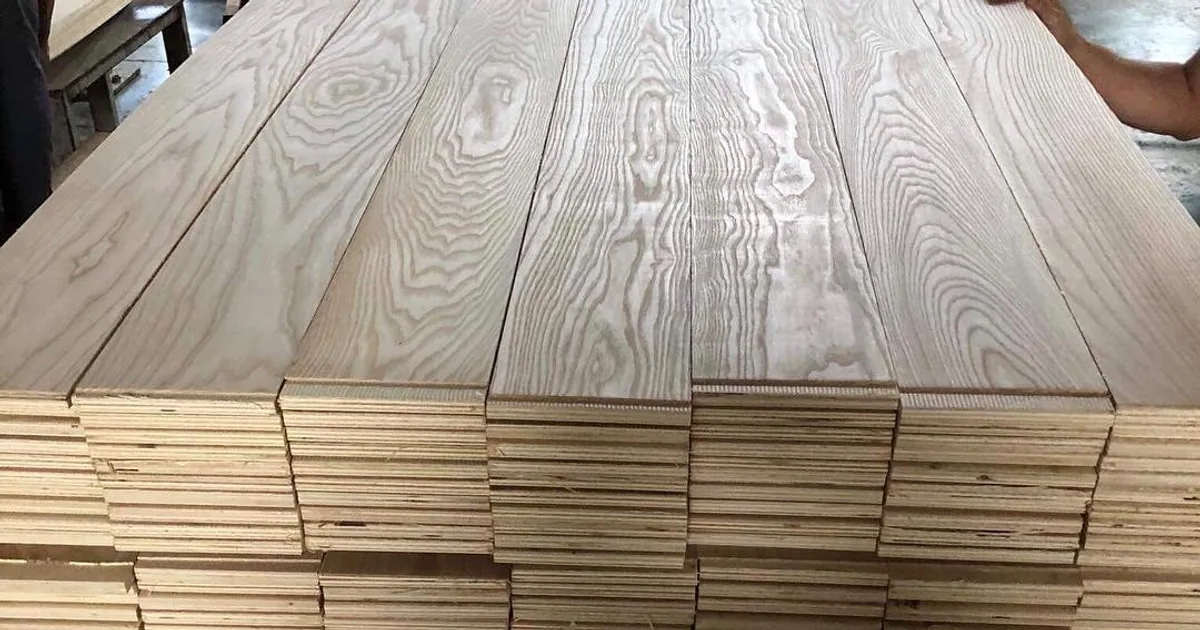
An engineered oak flooring specification is a short list of linked decisions: construction (solid, 2-layer or 3-layer), overall thickness, wear layer, width, length, species and cut, grade, edge profile and finish. Each line changes how the floor looks, how it behaves on site and what it costs, and two quotations are only comparable when every line is written down. This guide is for importers, distributors, builders and specifiers who have to write a floor that a factory can quote. It ends in one document you can send: a specification line per area, plus the RFQ checklist at the end.
We are a factory, not a trader. Vu Uy Wood manufactures solid and engineered French White Oak flooring to buyer specification in Song Than 3 Industrial Park, Ho Chi Minh City, and has done so since 2006. Nothing here is a price list or a stock list: sizes, builds and finishes are made to order and confirmed in the quotation and on an approved sample. Where this guide gives a number, it comes from a named source or from our own Specify page.
Last reviewed: October 2026. Figures carry the date they were checked; confirm regulations and standard editions with your broker or standards body before you rely on them.
- The specification in one table
- Solid or engineered
- Core and bond
- Wear layer
- Overall thickness
- Width and length
- Species and cut
- Grade
- Edges and profile
- Flatness and movement
- What the specification costs
- Checklist: what to send with the RFQ
- Frequently asked questions
- Working with Vu Uy Wood
The specification in one table
Nine lines describe an engineered floor. They are set by different questions, so they are best decided in the order of the table: the building first, the look last.
| Line | What it decides | Options at Vu Uy | Mainly set by |
|---|---|---|---|
| Construction | Stability, floor height, sanding allowance | Solid, 2-layer or 3-layer engineered | Site conditions and format |
| Overall thickness | Finished floor height, fixing method | 3/8” (10mm) to 13/16” (21mm); 5/8” (15mm) and 3/4” (20mm) are standard builds | The building |
| Wear layer | Oak available for sanding, depth of texture | 0.6mm to 6mm sawn; 3mm and 6mm are standard builds | Maintenance plan |
| Width | Scale of the room, choice of construction | 3” (76mm) to 12” (305mm); seven widths in current production | Room size |
| Length | End joints, look, material yield | Random 12” to 86” (300 to 2200mm); fixed length or long boards to 118” (3000mm) to order | Look and budget |
| Species and cut | Base color, grain figure | French White Oak; rift and quarter, plain sawn or mixed | Look |
| Grade | Knots, color movement, yield | Premium, Select, Natural, Rustic | Look and budget |
| Profile | Joint fit and look | Tongue and groove on four sides; square edge on request | Installation method |
| Finish | Color, sheen, surface | Clear UV, Color UV, Color and Effect UV or unfinished; Matte, Extra Matte, Ultra Matte; smooth to wire brushed with cross marks | Look |
Source: our Specify page and the guides linked below. Sizes beyond the standard builds are made to order and confirmed in the quotation.
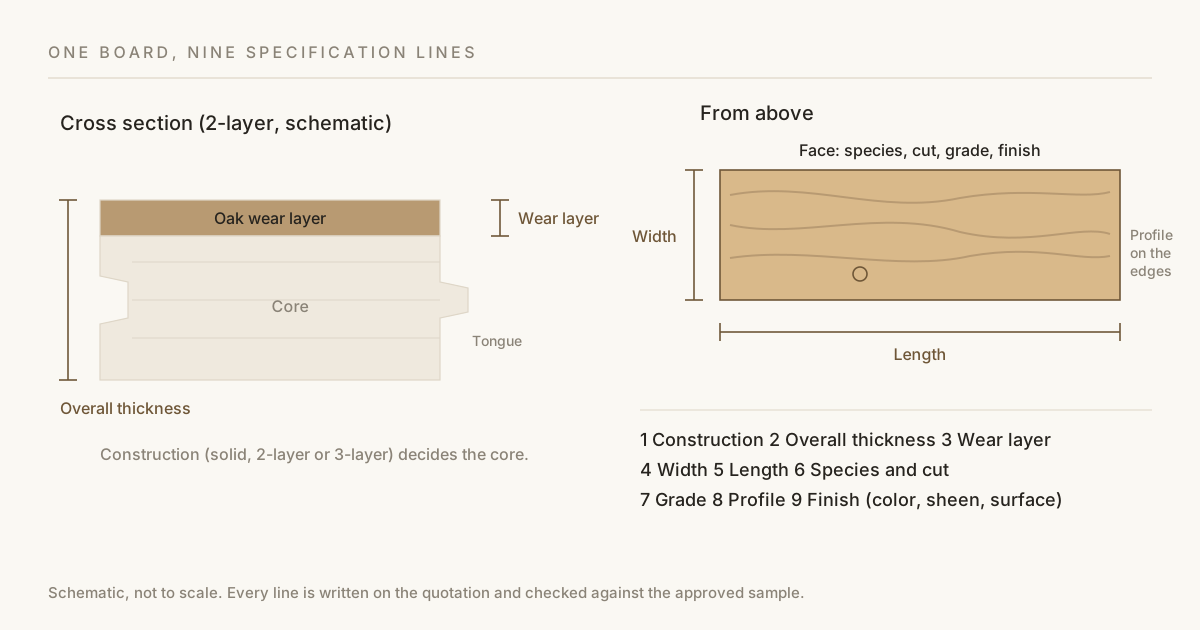
Two rules keep the table honest. First, each line is written as its own item, because a single word such as “engineered” or “natural” hides three or four decisions. Second, the finish is a bundle of four separate lines (system, color, sheen, surface), so it appears in the table once and is split out on the quotation. A European terminology standard, EN 13756, defines terms for wood flooring and parquet; we read its catalog scope only, so the definitions in this guide follow the NWFA and our own articles.
Read more: Engineered Flooring Terms: A Buyer Glossary, Core to Wear Layer
Solid or engineered
The NWFA defines solid wood flooring as a solid piece of wood from top to bottom, and engineered flooring as real wood made from several layers of veneer or a lumber core bonded with adhesives. In engineered flooring the top layer decides the final appearance, whatever the overall thickness. The NWFA also notes that construction varies by manufacturer and by product, which is why a quotation has to name the build and not only the category.
At Vu Uy we make three constructions, all in French White Oak: solid, 2-layer engineered (our main engineered construction) and 3-layer engineered. The choice comes out of the site, and five conditions decide it: the subfloor, the board width, the floor height available, the installation method and how often the floor will be sanded.
| Project condition | Points toward solid | Points toward engineered |
|---|---|---|
| Board width | Narrower boards | Wider boards (3-layer) |
| Floor height | Room for the full thickness | Height is limited (2-layer) |
| Open area | Smaller rooms | Larger open areas (3-layer) |
| Format | Plank in narrower widths | Herringbone and chevron (2-layer is common) |
| Refinishing plan | Repeated sanding is a priority | Recoating, or a thicker wear layer |
| Subfloor | Confirmed suitable by the installer | A wider range of subfloor conditions |
Source: our own decision table; the NWFA definitions are in its 2025 installation guidelines.
No single row decides the question. A narrow-plank floor in a small room over a suitable subfloor, owned for decades, points to solid. A wide-plank floor across an open-plan space points to 3-layer. Most projects sit between, and the useful step is to rank the five conditions for the actual site and let the installer confirm the subfloor before the construction is fixed.
Read more: Solid vs Engineered Hardwood Flooring: Choosing by Project
Core and bond
The core is most of the board. The NWFA describes it as the layer that provides thickness, dimensional stability and the other properties the board needs, and the backing as the layer that gives balance, usually bonded under the core. A balanced construction has materials of similar properties on both sides, so that no layer can pull the board out of shape as indoor humidity changes.
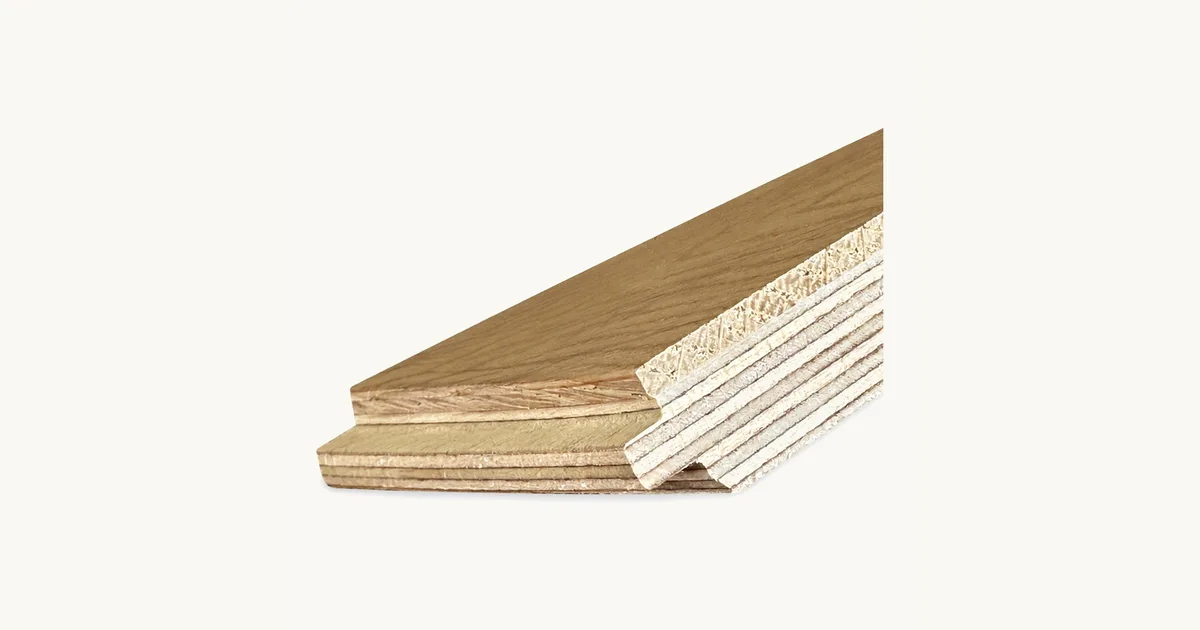
A 2-layer board is a sawn oak wear layer on a plywood core. It is a practical choice where floor height is limited and it is commonly used for herringbone and chevron. A 3-layer board adds a backing layer under a cross-layered core and is designed for greater stability, so it suits wider boards and larger open areas. “Plywood core” is a category, not a specification: ask which construction the quote is based on, how the layers are built up and whether the build is the same on every width in the order.
The bond is the part nobody sees once the floor is down. In our factory the adhesive spread, press pressure and press time are controlled, the bond between layers is checked, and pressed blanks rest before machining so the panel can settle. We do not publish the settings. What a buyer can do is look at the board ends on the sample, where the glue line should be continuous.
Both engineered builds use a plywood core, so formaldehyde paperwork belongs in the request. The U.S. limit table in 40 CFR 770.10 lists 0.05 ppm for hardwood plywood with either a veneer core or a composite core, measured by test method ASTM E1333-14, and EPA states that composite wood products sold in the U.S. have had to be labeled TSCA Title VI compliant since March 22, 2019 (as of October 2026). Our CARB P2 article treats CARB Phase 2 as the baseline; the federal rule is TSCA Title VI, and the NWFA notes that most engineered flooring sold in the U.S. carries a CARB P2 compliance statement, so ask for both statements. Whether a given board counts as a regulated product is a question for the supplier’s documents and your broker.
Read more: 2-Layer vs 3-Layer Engineered Oak: How the Core Changes a Board
Read more: Engineered Flooring Plywood Core: Questions to Ask a Factory
Read more: Wear Layer Bonding: How the Oak Face Is Pressed to the Core
Wear layer
The NWFA’s glossary defines the wear layer as the outermost layer of an engineered floor, the visible side once installed, and its product chapter adds that the top layer is typically called the lamina or lamella. It is the only oak the owner sees, brushes, stains and sands. The wear layer and the overall thickness are two separate numbers, and a quotation that gives only the second has left out the line that most affects long-term value.
How the face is cut matters as much as how thick it is. The NWFA describes three kinds. A sawn face is cut like solid flooring and is available in any cut. A sliced face is knife-cut from lumber, which has thickness limitations and can stress the wood fibers, though it keeps similar natural characteristics. A rotary-peeled face is produced on a lathe and shows a purely tangential grain pattern that repeats over larger sheets. All wear layers we produce are sawn, from 0.6mm to 6mm, with 3mm and 6mm as the standard builds.
| Maintenance plan | Wear layer direction | Why |
|---|---|---|
| Recoating only, or a planned replacement | A thinner wear layer can be reasonable | Little or no oak is removed |
| One full sanding expected | A mid-range wear layer such as 3mm | Some oak is left for one sanding |
| Repeated sanding, long ownership | A thick wear layer such as 6mm, or solid oak | More oak above the core |
Source: our wear layer guide. We state no number of refinishes for any thickness, because each sanding removes a different amount.
For an outside reference point, the NWFA’s voluntary Engineered Wood Flooring Refinishable Program, which is designed to identify products whose wear layers are thick enough to be refinished, sets minimum wear layers of 3.2mm for unfinished products and 2.5mm for factory-finished products, with 2.5mm at the lowest point for sculpted or distressed surfaces. We quote these as a published benchmark only. They are the program’s own eligibility rules (document dated June 2022), not a claim about any floor. A 3mm face is above the 2.5mm factory-finished benchmark and below the 3.2mm unfinished one, so for an unfinished 3mm board the number of sandings is the installer’s call.
Read more: Engineered Flooring Wear Layer Guide: Thickness and Refinishing
Read more: Sawn, Sliced or Rotary-Peeled: How the Oak Wear Layer Is Cut
Overall thickness
Overall thickness is a building question: it sets the finished floor height and so decides how the new floor meets door leaves, thresholds, stair nosings and the finishes in the next room. Whatever sits under the board, such as underlayment or adhesive, adds to it, and the installer counts that. In renovation, measure the available height first.
Our standard builds are 5/8” (15mm) overall with a 3mm sawn wear layer and 3/4” (20mm) overall with a 6mm sawn wear layer. The other thicknesses on the Specify page, 3/8” (10mm), 1/2” (12mm), 9/16” (14mm), 11/16” (18mm) and 13/16” (21mm), are made to order, with the wear layer confirmed on the specification. Pairing matters: a thicker board does not add sanding life unless the wear layer is thicker too.
Installation method has a say as well. Nail-down needs enough material above and below the tongue for the fastener the installer intends to use, and glue-down follows the adhesive maker’s rules. The installer decides the method and confirms that it suits the board, so state the method for each area in the RFQ and raise any floor-height limit before the thickness is fixed.
Read more: Oak Flooring Thickness Guide: Choosing From 3/8 to 13/16 Inch
Width and length
A board size is four numbers: length, width, overall thickness and wear layer. On a quotation they are usually written as one line in that order, for example RL 300-2200 x 190 x 15/3mm: random length from 12” to 86” (300 to 2200mm), face width 7-1/2” (190mm), overall thickness 5/8” (15mm) and a 3mm wear layer. If a quote gives only width and thickness, ask for the wear layer and the construction before comparing prices.
Width sets the scale of the room and narrows the construction choice. Wider boards show more grain and give a calmer floor; narrower boards suit small rooms and are often more economical. The NWFA’s guidelines name the classes: strip is under 3”, plank is 3” to 5” and wide plank is over 5”. Our own wide plank article starts its discussion at 7-1/2” (190mm), so say which line a quote uses when it says “wide”. Seven widths are in current production, from 3-1/4” (83mm) to 9-1/4” (235mm), and widths from 3” (76mm) to 12” (305mm) are made to order.
Length is chosen for look and yield. Random length staggers end joints and uses timber efficiently. Fixed length gives a regular rhythm and uses more timber per square foot, and long boards to 118” (3000mm) are cut to order. For herringbone and chevron the block length sets the geometry, so it is fixed from the drawing.
Read more: Engineered Oak Flooring Size Chart: Width, Length, Thickness
Read more: Hardwood Flooring Plank Width: How to Choose for a Project
Species and cut
Every specification starts with a species. French white oak is the timber we run as the standard, and in the trade the name usually means the two main European white oaks grown in France, Quercus robur and Quercus petraea. White oak and red oak are different groups: white oak is more neutral in color and rich in tannin, while red oak carries a pink to reddish cast and responds less to tannin-driven effects. Name the group on the specification, because it decides how a light stain, a gray or a smoked effect will read.
The cut is a separate line from the species and the grade. The NWFA defines plainsawn boards as cut with the growth rings mostly parallel to the wide face (0 to 45 degrees), riftsawn at 30 to 60 degrees and quartersawn at 45 to 90 degrees. Plainsawn shows arches and wider figure; rift and quarter gives straighter lines, and quarter sawn white oak shows ray fleck. The NWFA also notes that plainsawn flooring is more stable in thickness and less stable in width, and quartersawn the reverse, which matters most for solid boards. In engineered boards the core carries most of the stability, so the cut is mainly an appearance and yield decision.
| Grain | Face | Relative yield from the log | Relative material cost |
|---|---|---|---|
| Plain sawn | Arches, wider figure | Highest | Lowest |
| Mixed | Both side by side | Middle | Middle |
| Rift and quarter | Straight lines, ray fleck on quarter faces | Lowest | Highest |
Source: our rift and quarter article. We found no public yield figure by cut; the actual difference is confirmed in the quotation.
Read more: French White Oak Flooring: What the Timber Brings to a Floor
Read more: White Oak vs Red Oak Flooring: Grain, Color and Stain Response
Read more: Rift and Quarter vs Plain Sawn Oak Flooring: Grain Explained
Grade
Grade is a sorting decision about the face: the size and number of knots, the amount of color variation and whether natural features are present and filled. It does not describe construction, cut, color or texture. We use four grades. Premium is clean and quiet with very few knots and limited color variation, and has the lowest yield. Select has small sound knots and gentle variation. Natural, the standard grade, shows visible knots and natural color movement. Rustic has larger sound knots, stronger variation and filled features, and the highest yield.
The NWFA’s grading rules for solid flooring state that appearance alone determines grade, since all grades are equally strong and serviceable, and that any character allowed in a higher grade is accepted in lower ones. The NWFA/NOFMA factory-finished standard adds the point that matters to a buyer: for factory-finished flooring the appearance guidelines are proprietary to each manufacturer. A grade name is therefore not a shared unit, and one supplier’s Select can sit close to another’s Natural. Ask for the written definition.
Grade is judged on raw wood but seen under the finish. A clear UV topcoat leaves knots and color movement fully visible, while darker stains and effect finishes reduce the contrast between boards. For that reason approve grade, grain, color, texture and sheen together on one finished sample, with more than one board so the range is visible.
Read more: Oak Flooring Grades Explained: Premium, Select, Natural, Rustic
Edges and profile
Our joint is tongue and groove, machined on all four sides, so the ends of each board are profiled as well as the long edges. End matching makes random length practical, because joints can fall wherever the length runs out. A square edge is available on request for a cleaner, more continuous surface, and the edge detail on the face (square, micro-bevel or a colored bevel) is its own line on the specification.
Fit is decided by dimensions held across the whole order, not by one board measured on a bench. Width consistency keeps rows straight, thickness consistency avoids lippage, and a profile that changes between batches means boards from different cartons will not fit each other the same way. The NWFA defines overwood and underwood as a perceived misalignment where some pieces sit above their neighbors, and on a prefinished floor that cannot be sanded out on site.
A tolerance line is how a specification says “how much is too much”. We found no single engineered-floor number that applies everywhere. The European umbrella standard EN 14342 sets no dimensional tolerances and refers to product standards such as EN 13489 for multi-layer parquet, EN 13647 describes how to measure the geometry, and the only public numeric table we found, the NWFA/NOFMA standard, covers solid flooring. We read the catalog scopes of the EN documents, not their texts, so write the limit against the approved sample and the method that measures it.
Read more: Tongue and Groove Flooring: Profile Accuracy on Four Sides
Read more: Engineered Flooring Dimensional Tolerances: What to Specify
Flatness and movement
The NWFA defines cupping as a dished appearance with the board edges higher than the center, and crowning as the opposite. Both usually trace to a moisture difference between the two faces of the board, and the cause is rarely the board alone: site moisture, heating, cleaning habits and the installation method all take part. Wood is hygroscopic, so some seasonal movement is normal, and the question is how much and in which direction.
An engineered board limits that movement through a balanced build, a controlled bond and conditioning before machining. Width is the biggest factor in how visible a small cup becomes, so the construction, the core and the wear layer should be chosen for the width and the site should be ready for it. The NWFA’s guidelines divide responsibility: the manufacturer produces a product that performs as marketed, the specifier makes sure the jobsite can meet the product’s requirements, the installer rechecks conditions at installation, and installing the floor constitutes acceptance of the material and the site conditions at that time. That last point is why a loose-lay check of several boards, before installation, belongs in every order.
Flatness is measured with a straightedge across the width of a board, at several positions, on loose boards and again once installed. We do not publish a flatness figure, because a figure without a method invites disagreement. The tolerance for your order is agreed with the quotation and checked against the approved sample.
Read more: Engineered Flooring Cupping and Crowning: Flatness and Limits
Read more: Engineered Flooring Defects: Causes, Limits and Who Pays
What the specification costs
Every line above moves the price, and most move it in a known direction. We found no public, neutral price survey for engineered oak flooring by wear layer, width or grade (the consumer price guides we looked at disagreed with one another, so we do not quote them), and we do not publish prices here. What can be said is direction, and who controls each driver.
| Driver | Direction | Why | Controlled by |
|---|---|---|---|
| Wear layer thickness | Thicker costs more | More oak in every square foot | Maintenance plan |
| Width | Wider costs more | Wider clear stock, less of each log usable | Room size |
| Fixed or long length | Costs more than random | More offcut per square foot | Look |
| Cleaner grade | Costs more | Knots must fall outside the board | Look and budget |
| Rift and quarter | Costs more than plain sawn | Lowest yield from the log | Look |
| Finish route and color development | Confirm in the quotation | Clear UV, Color UV and Color and Effect UV are different routes with different process steps | Look |
Source: our size chart and grade articles. Magnitudes: we found no public figure; they are confirmed in the quotation.
The practical use of the table is to ask for two prices that differ in one line only, for example Natural against Select at the same width, or mixed grain against rift and quarter at the same grade. The cost drivers article works through a wear layer example with stated assumptions and lists the lines a quote should carry.
Read more: Engineered Oak Flooring Cost Drivers: What Moves the Quote
Checklist: what to send with the RFQ
- Construction: solid, 2-layer or 3-layer, and the core type you expect.
- Overall thickness in inches and millimeters, and any floor-height limit at doors, stairs and thresholds.
- Wear layer thickness, sawn, as its own line.
- Face width, and the length: random range, one fixed length, or block length from your drawing.
- Species group (French White Oak) and the cut: rift and quarter, plain sawn, mixed or open.
- Grade, with the written definition you are working to.
- Profile: tongue and groove on four sides, and the edge detail on the face.
- Finish as four lines: system, color, sheen and surface, with a library color or your own reference.
- Installation method for each area and the subfloor, as confirmed by your installer.
- The documents your market needs, such as core emission paperwork for the U.S.
- Tolerance and flatness method, and how boards outside it are handled at inspection.
- Quantity per size, destination, trade term and the sample you will approve.
A line you leave blank is a question the supplier will ask or, worse, answer for you.
Frequently asked questions
What is the difference between wear layer and overall thickness?
Overall thickness is the full height of the board and sets floor height. The wear layer is the oak face on top, and it is the only part that can be sanded. Two boards with the same overall thickness can carry different wear layers, so a specification states both numbers.
Which construction is best for wide planks?
Wider boards move more across the grain, so 3-layer engineered, which has a cross-layered core and a backing layer, is well suited to wide planks and larger open areas. Solid oak is better kept to narrower widths. The installer should confirm the subfloor and method before the build is fixed.
Is a thicker wear layer always better?
No. A thicker wear layer leaves more oak for sanding, and costs more oak per square foot, so it pays off only if the owner expects to sand. For a fit-out maintained by recoating, a thinner layer can be reasonable. Decide the maintenance plan first, then choose the wear layer.
Do grade names mean the same thing at every factory?
Not reliably. The NWFA/NOFMA factory-finished standard leaves appearance guidelines to each manufacturer, so names such as Select or Natural are not a shared unit. Ask each supplier for the written definition of the grade quoted and approve it on a finished sample.
What do I need to send for an accurate quotation?
Send the nine lines in the table: construction, thickness, wear layer, width, length, species and cut, grade, profile and finish, plus quantity, destination and installation method. The checklist above lists them in order. Where a drawing exists, send it with the specification.
Working with Vu Uy Wood
We manufacture made-to-order solid and engineered French White Oak flooring in Song Than 3 Industrial Park, Ho Chi Minh City, and have done so since 2006. The Specify page walks through construction, thickness, format, width, grade and finish and turns your selections into a written brief we can quote. We normally reply within one working day.
Sources
- NWFA, Wood Flooring Installation Guidelines, revised 2025: definitions, saw cuts, engineered construction, responsibilities, cupping and overwood.
- NWFA, Engineered Wood Flooring Refinishable Program, June 2022: wear layer definition and program thresholds.
- NWFA/NOFMA, International Standards for Factory Finished Solid Wood Flooring: proprietary appearance grades, machining tolerances for solid flooring.
- NWFA/NOFMA, Standard for Unfinished Solid Flooring: grading principles.
- EN 14342:2013 listing, wood flooring and parquet: scope read from the catalog entry; the standard text was not read.
- EN 13489:2023 listing, multi-layer parquet elements: scope only; the standard text was not read.
- EN 13647:2021 listing, geometrical characteristics: scope only; the standard text was not read.
- EN 13756:2018 listing, wood flooring terminology: scope only; the standard text was not read.
- 40 CFR 770.10, formaldehyde emission standards (Cornell LII): limit table and test method.
- EPA, Formaldehyde Emission Standards for Composite Wood Products: labeling dates and scope of regulated products.