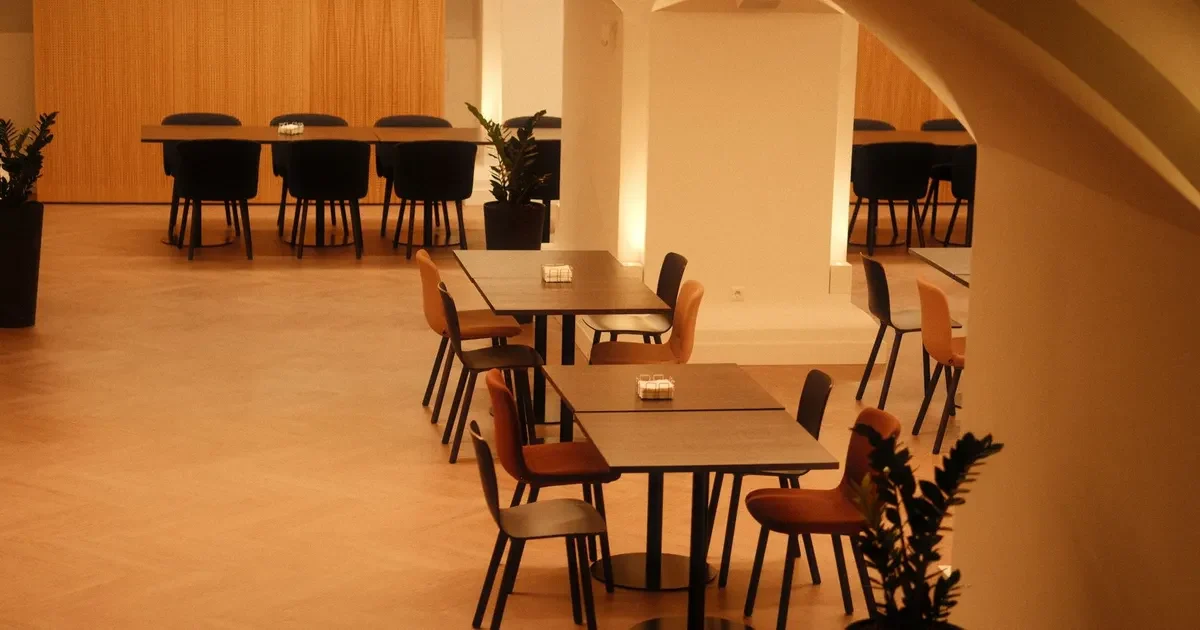
A restaurant floor is cleaned every night, struck by chair legs all day and spilled on at every service. It also sits under warm lighting where guests spend an hour or two looking around. Oak is a popular choice because it warms a room and takes a wide range of finishes. It is also a floor that rewards good specification and punishes a casual one. This guide explains what wears a dining floor, how to choose the finish and edge, and how to plan repairs before the first service.
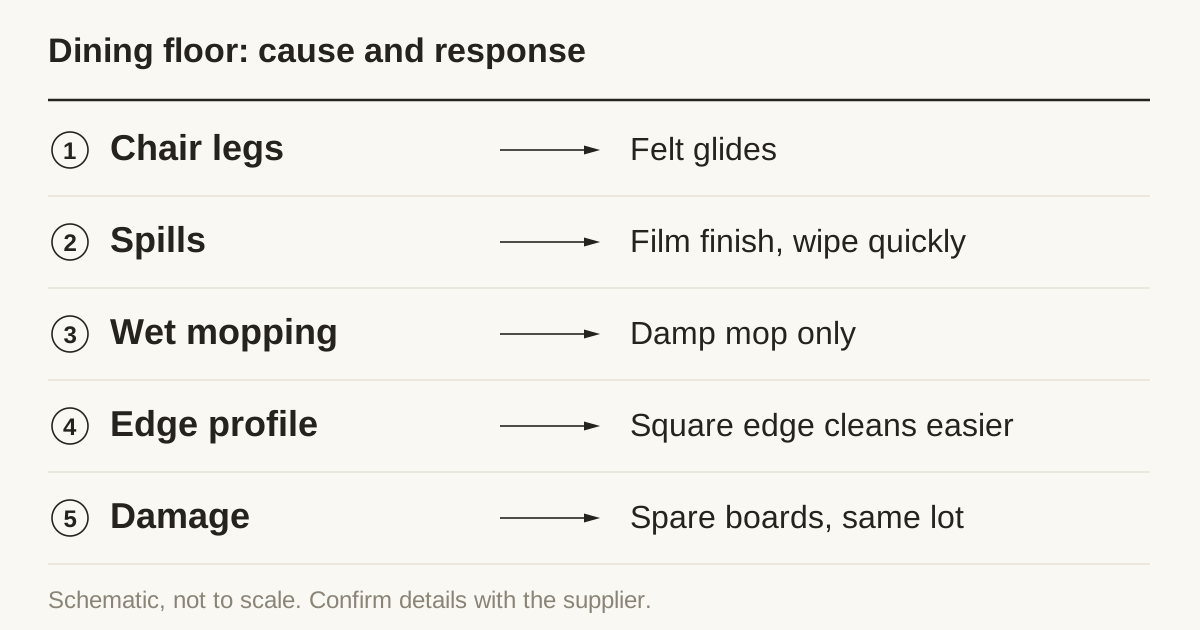
What wears a dining floor
| Cause | Where it happens | What it does |
|---|---|---|
| Chair legs and glides | Under every table | Scratches and fine scuffs in repeated arcs |
| Spills | Tables, bars, service aisles | Staining at joints and edges if not wiped |
| Grease and oils | Near kitchens and pass areas | A film that dulls the finish and holds dirt |
| Wet mopping | Daily closing routine | Water at joints, and cleaner residue |
| Entry water and grit | Door and terrace thresholds | Abrasion and moisture at the first boards |
| Heavy loads | Banquette bases, planters, equipment | Dents and local marks |
The effects are concentrated at a few places. The floor around the entrance and the service route wears fastest, and the floor under the tables sees thousands of small chair movements. The floor in the corners may look new after years.
Finish choices
A dining floor needs a finish that cleans easily and hides small marks.
- A film finish. UV-cured finishes form a protective film on the surface that resists most spills if they are wiped promptly. Factory-cured coatings are formulated for hard use. See UV-cured finish for hardwood flooring.
- Low sheen. Matte, Extra Matte and Ultra Matte show scuffs far less than gloss and give less glare under spotlights. See Matte, Extra Matte or Ultra Matte.
- Texture. A light wire brushed or worked surface masks scratches that would stand out on a smooth floor. A deeply textured floor holds dirt in the relief and takes more cleaning. See wire brushed against smooth oak.
- Color. Mid tones hide marks and crumbs best. A very dark floor shows dust, and a very pale floor shows spills and wheel marks.
An oiled finish is possible, but a busy restaurant seldom has time for the care routine it needs. A comparison is in oiled against lacquered oak flooring.
Water, cleaning and joints
Oak is a natural timber and responds to moisture, so the cleaning routine matters as much as the finish.
- Use a damp mop, not a wet one, and wring it well. Standing water finds the joints.
- Use a cleaner made for the finish. Alkaline degreasers can damage the coating and darken oak. See oak tannin and floor finishes.
- Wipe spills at once. A film finish resists most spills for a short time, not indefinitely.
- Dry the floor after mopping where the cleaning routine allows it.
- Do not use steam on the floor unless the finish maker says it is allowed.
The film is a protective coating. Water resistant is the most that can be said of any timber floor, and only for brief contact.
Edge profile
The edge of the board decides where liquid and dirt go.
- Square edge. There is no groove, so spills do not collect at the joint and cleaning is easier. A square edge shows small height differences between boards, so the subfloor and installation need to be accurate.
- Micro-bevel. It outlines each board, hides small height differences and gives a clear plank look. It also forms a small groove at each joint where crumbs and dust show as fine lines, which is more visible on light floors.
Our guide to square edge and micro-bevel sets out the trade-offs. In a restaurant, the choice usually follows the cleaning routine and the color of the floor.
Grade, format and wear layer
- Grade. Natural and Rustic grades carry knots and color movement, which camouflage small marks. A Premium face is quiet and shows more. See oak flooring grades explained.
- Format. Plank is the simplest to install and replace. Herringbone gives a strong character to a dining room and is more expensive to install and repair.
- Wear layer. The wear layer options on our pages are 1/16” (2mm), 1/8” (3mm), 5/32” (4mm) and 1/4” (6mm) sawn, with other thicknesses made to order. A thicker layer gives refinishing capacity for a venue expected to trade for many years. See the wear layer guide.
Slip and safety
A finish that looks good can feel slippery when wet. Slip resistance is set by the finish, the texture and the way the floor is cleaned. A lower sheen with a light texture usually performs better than a high gloss, but there is no assumption to make. If local codes or the operator’s insurer require a slip test result, state the test method in the RFQ and agree who supplies the result. We do not claim a slip rating for any board on this page.
Entrances, service routes and any area where the floor can be wet need particular attention, and mats are part of the answer.
Repair
Restaurants repair a floor in the hours between services, so the plan must be quick.
- Keep spare boards. Ask for extra boards from the same lot, packed with the order. Keep them flat and dry on site.
- Plan a board replacement. A damaged plank can be cut out and replaced by an installer if spares and the color reference are on hand.
- Plan a recoat. A film finish can be recoated while it is intact. A maintenance schedule keeps the film healthy.
- Protect the floor. Felt glides on every chair, and trays and bins on wheels with soft castors.
- Record the system. Keep the grade, color reference, sheen and finish system.
A floor that can be maintained in place stays in service. A floor that needs a full closure for each repair is a cost.
Light, color and atmosphere
A dining room is lit for mood. Warm, low lighting changes how oak looks, pulling out reds and yellows, and a floor that looks neutral in daylight can look orange in the evening. Candles, pendants and wall lights also create raking light that shows surface irregularities. Approve the sample under the restaurant’s evening lighting as well as in daylight.
Color also affects how the floor ages. A mid tone with a low sheen forgives crumbs, scuffs and water spots. A very dark floor shows dust and pale footprints from cleaning, and a pale floor shows spills and shoe marks. Choose the color for the cleaning routine that will actually be followed.
Noise and comfort
Hard floors are noisy, and a dining room full of chairs and voices can be loud. Timber is warmer in sound than tile or stone, but it still reflects sound. Soft furnishings, wall treatments and ceilings do most of the work in controlling noise. The floor can help through the underlay, the installation method and the use of felt glides under chairs, and a glued floor generally sounds quieter than a floating one.
Common mistakes
- Choosing a finish for a photograph. A glossy, dark floor looks striking in a render and is the hardest to keep looking good.
- Forgetting the cleaning routine. A floor chosen without a cleaning plan is cleaned with whatever is nearest.
- No spares. Replacing a damaged board without spares from the same lot leaves a visible patch.
- Ignoring the thresholds. Terrace doors and entrances bring water and grit directly onto the first boards.
- Leaving out the edge detail. The bevel decides how spills and crumbs behave, and it is easy to forget.
Installation notes
Dining floors are usually installed over a concrete slab in a commercial building, and the same checks apply as elsewhere: flatness, moisture and a method approved for the board. See engineered oak over concrete and how installation method shapes the specification. Terrace doors and open fronts expose the floor to outdoor humidity, so keep the first meter inside the door under watch and protect it with a mat.
What to write in the specification
| Item | A clear statement |
|---|---|
| Zones | Dining, bar, service route, entrance |
| Construction and wear layer | For example 2-layer, with the wear layer stated |
| Finish and sheen | UV route and a low sheen, approved under dining light |
| Edge | Square or micro-bevel, chosen with the cleaning routine |
| Grade and color | Chosen to hide marks, approved on a physical sample |
| Spares | Extra boards from the same lot |
| Cleaning plan | Approved cleaner, mopping method, spill routine |
| Slip requirement | A test method, if required |
Working with Vu Uy Wood
Vu Uy Wood manufactures solid and engineered French White Oak flooring to buyer specification in Song Than 3 Industrial Park, Ho Chi Minh City, and has done so since 2006. The Specify page sets construction, grade, texture and finish, and your cleaning and slip requirements can go into the same request. We normally reply within one working day.