When a project specification asks for the Taber abrasion result of a floor finish, the request is usually a line copied from a coatings standard, and the answer is usually a number with no context. Buyers receive a figure, compare it with another supplier’s figure and conclude one floor is tougher than the other. Sometimes that is right. Often the two numbers were produced under different conditions and cannot be compared at all. This guide explains what the Taber test does, how to read a report and how to ask for results that mean something.
What the test is
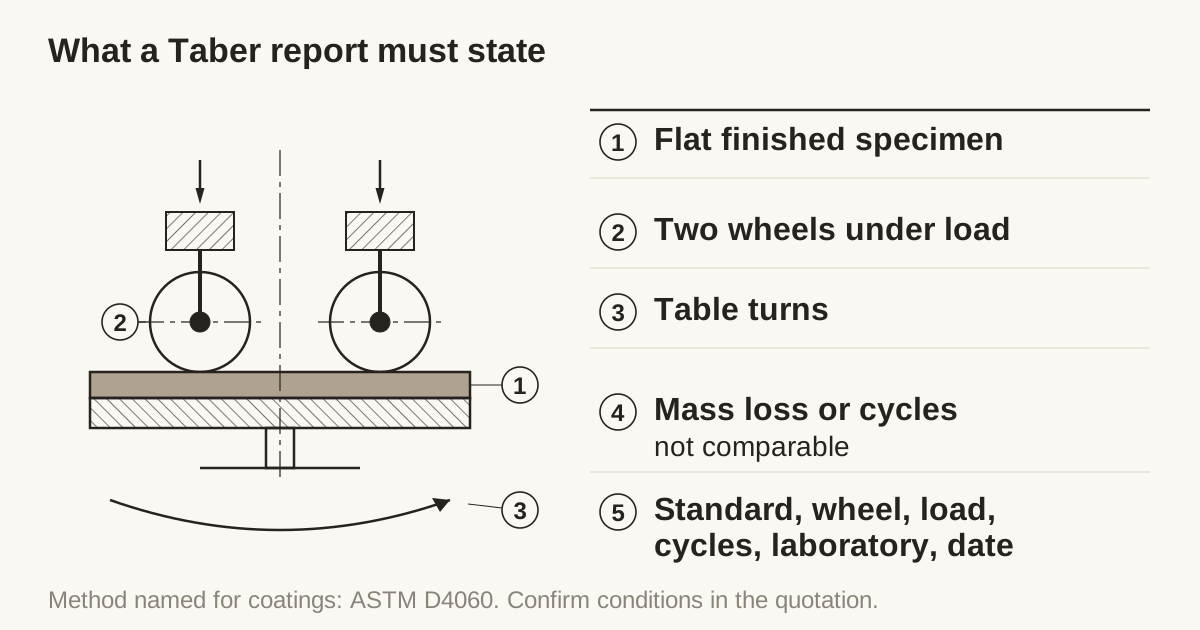
The Taber abraser is a laboratory machine. A flat specimen is fixed to a turntable, and two abrasive wheels rest on its surface under a set load. The table turns, the wheels drag across the specimen, and the surface is worn in a circular track. The test runs for a set number of cycles, or until the coating is worn through to the layer below.
The method most often named for coatings is ASTM D4060, which covers the abrasion resistance of organic coatings using this machine. The standard sets out the equipment and the procedure, and leaves the choice of wheel, load and cycle count to be stated for each test. That last point is the one buyers miss. A result is only meaningful with its conditions attached.
What a result looks like
A Taber result is reported in one of two ways.
- Mass loss. The specimen is weighed before and after a set number of cycles, and the loss is reported in milligrams. Lower loss means the coating resisted the wheels better.
- Cycles to wear-through. The test runs until the coating is worn through in the track, and the result is the number of cycles that took. Higher means more resistant.
Both are reported with the wheel type, the load and, for mass loss, the number of cycles. Common wheels are the milder CS-10 and the more aggressive CS-17, and loads are set in grams. Change any of the three, and the number changes.
| Report field | Why it matters |
|---|---|
| Standard and edition | Fixes the method used |
| Wheel type | More aggressive wheels wear a coating faster |
| Load on each wheel | Heavier loads wear faster |
| Number of cycles | Mass loss depends on the run length |
| Unit of result | Mass loss and cycles cannot be compared |
| Specimen description | Finish system, sheen, color and substrate |
| Laboratory and date | Who ran it and when |
If a report leaves out any of these, it cannot be used to compare floors.
What the test tells you
The Taber test measures how well a coating resists abrasive wear in a controlled setting. That is a real property, and it is relevant to a floor, where grit carried on shoes wears the finish over time.
It is useful for three comparisons.
- One finish system against another, on the same substrate and under the same conditions.
- The same finish at different film weights, to see how much protection extra coating gives.
- A production lot against an approved sample, to confirm that the finish has not drifted.
In each case, the comparison only holds when the test conditions are identical.
What the test does not tell you
A flooring buyer should keep the limits in view.
- It is not a prediction of years in service. Real traffic varies far more than a lab cycle does. A floor in a hallway with outside grit wears faster than one in a bedroom, and no Taber number converts to a lifetime.
- It does not measure scratching. Scratches are cut lines from sharp objects, and the Taber wheels wear the surface rather than cut it. A separate scratch or pencil hardness test addresses that.
- It does not measure denting. A dent is a failure of the wood under the finish, which is a function of species and construction. See white oak Janka hardness.
- It does not measure adhesion or chemicals. A coating can resist abrasion and still lift at an edge or stain from a spill. Those are other tests.
- It does not capture color and sheen effects. A dark, glossy floor shows wear much sooner than a light, matte one, even when the coating wears at the same rate.
For these reasons the abrasion result is one input to a specification and not the whole of it.
What affects the result
Several choices in the finish system change an abrasion result.
- Film weight and number of coats. More coating gives more material to wear through.
- The coating chemistry. UV-cured coatings, which harden under ultraviolet light on the line, are designed for hard-wearing surfaces. Our article on UV-cured finishes explains the process.
- Added hard particles. Some systems include fillers that raise abrasion resistance. Ask what is in the system, and whether it changes the look at low sheens.
- Sheen. Matting agents that lower the gloss can slightly change how a coating wears and how wear shows. Compare results at the sheen you will order. See choosing floor sheen.
- The substrate. A hard, dense face carries a coating better than a soft one, and the stain layer below the topcoat also takes part.
A result for a clear finish on a smooth sample says little about a dark stain with a wire brushed texture, because the topcoat sits at different depths on the surface.
How a test fits a project
Taber results are most useful when written into the process, not asked for at the end.
- Decide whether the project needs it. Retail, hospitality and public areas often do. A private residence rarely does.
- State the standard and the conditions in the RFQ. Name the method, the wheel, the load and the cycles, or ask the supplier to propose conditions and report them.
- Ask for the test on your finish system. That means the same stain, topcoat, sheen and texture, on oak.
- Agree what is passed. A pass or fail line should be written before testing, not afterwards.
- Check a lot against the master. The approved sample becomes the reference for production.
Common misreadings
Three habits cause most of the confusion around abrasion figures.
- Comparing mass loss with cycles. One report gives milligrams lost and another gives cycles to wear-through. The two are different measures and cannot be ranked against each other.
- Comparing different wheels. A result from the more aggressive wheel will look worse than one from the milder wheel on the same coating. Neither is wrong, but they cannot be placed in one table.
- Treating a pass as a guarantee. A coating that meets a requirement in the lab has met that requirement. It has not been promised a service life.
When a supplier sends a figure, the first step is to ask for the full report, not the headline number. A report with the conditions attached can be compared. A number without them is a claim.
Using a test requirement in a tender
A specifier who wants an abrasion requirement in a tender should write it as a method and a limit, for example the standard, the wheel, the load, the cycles and the maximum mass loss, and should allow bidders to submit an equivalent. Writing only a number invites bids that meet it under easier conditions. Writing the method keeps every bid on the same footing and makes the lot check at delivery straightforward. Our article on writing a flooring specification for tenders shows where such a line sits in the document.
What we say about our finishes
Our finish routes are Unfinished, Clear UV, Color UV and Color and Effect UV. Stain and topcoat are applied on our UV finishing line, with process settings controlled to support consistency within a production lot and across repeat orders. We do not publish a Taber figure on this page, because a figure without a method, a wheel and a finish system is not useful. If your project needs an abrasion result, put the standard in the RFQ. Whether a report exists for your finish system, or a test will be run on the approved sample, is confirmed at quotation.
Questions to ask any supplier
| Question | A clear answer covers |
|---|---|
| Which standard, wheel, load and cycles? | Conditions you can repeat |
| Was the specimen the same finish system? | Stain, topcoat, sheen and texture |
| Which laboratory ran it, and when? | An independent record |
| Is the substrate oak? | A relevant face |
| What does production check against? | The approved sample as master |
Working with Vu Uy Wood
Vu Uy Wood manufactures solid and engineered French White Oak flooring to buyer specification in Song Than 3 Industrial Park, Ho Chi Minh City, and has done so since 2006. Finish, sheen and texture are chosen on the Specify page, and any test requirement can be written into the quotation. We normally reply within one working day.