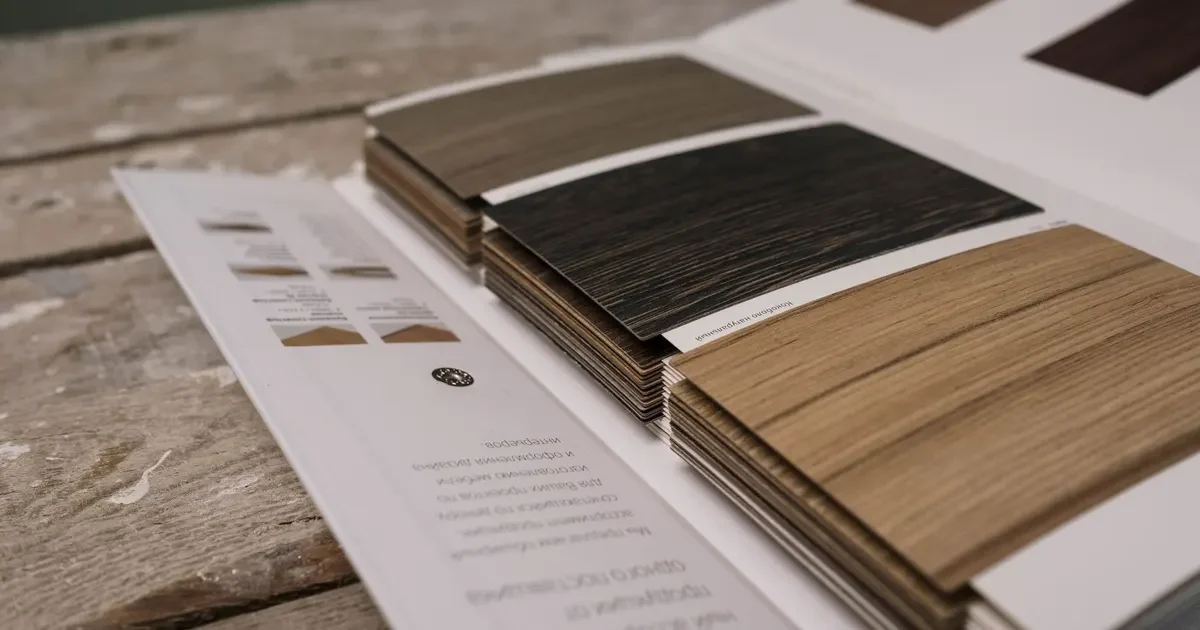
A buyer approves a sample board in a warm mid-brown, and the first carton of the order holds boards that range from lighter and yellower to darker and redder. The stain was the same on every board. Nothing went wrong in the factory. White oak is a natural material, and each board takes color according to its own structure. This guide explains where the variation comes from, which parts a factory can control, which parts it cannot and how to write an approval that reflects the real range.
Where the variation comes from
Stain is a thin liquid that soaks into the wood and carries pigment or dye with it. How much it soaks in, and where, depends on the board.
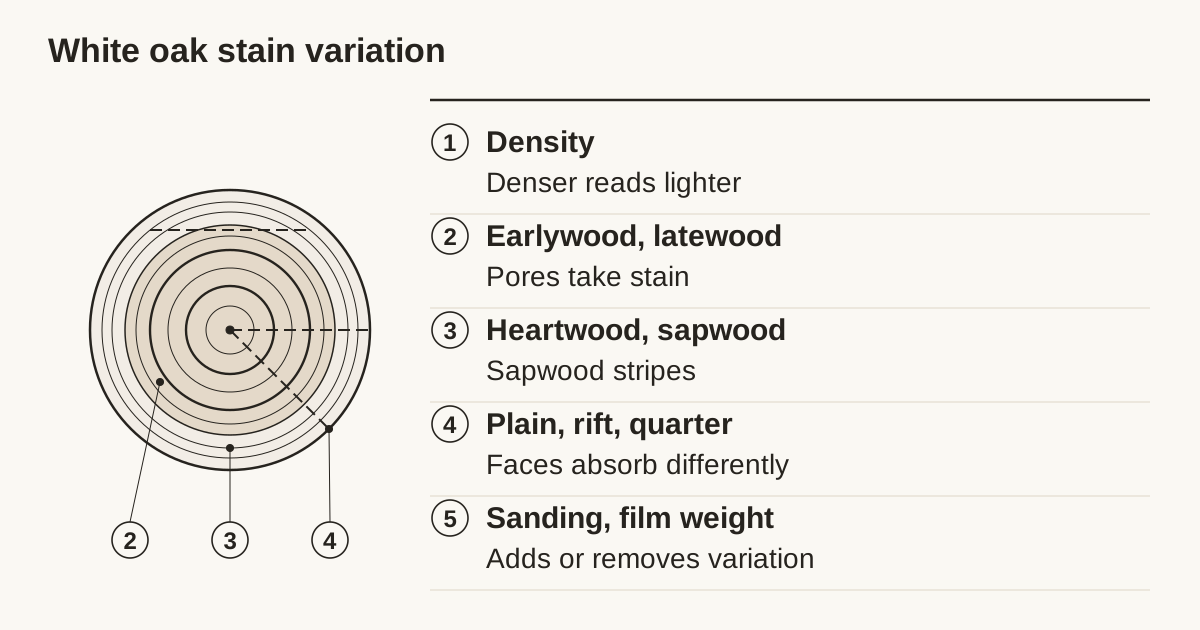
- Density. Denser boards take less stain and read lighter. More open boards take more and read darker. Oak varies in density from tree to tree and from the inner to the outer part of the same log.
- Earlywood and latewood. Oak has porous earlywood and dense latewood in each growth ring. Stain collects in the pores of the earlywood. A board with wide rings and a board with narrow rings have different ratios of the two, and read differently.
- Heartwood and sapwood. Sapwood is paler and takes stain differently from heartwood. A board with a strip of sapwood shows a stripe after staining.
- Tannin content. Oak is rich in tannins, and the amount varies. Tannin can alter the color the stain develops. See oak tannin and floor finishes.
- Grain direction and cut. A plain sawn face, a rift face and a quarter face present the rings at different angles to the surface, and they take stain differently. A rift or quarter face shows ray fleck, which stains darker or lighter than the surrounding wood.
- Surface preparation. Sanding changes how stain is absorbed. A board sanded to a different grit, or burnished by a worn belt, takes less stain.
- Features. Knots, checks, mineral streaks and filled areas absorb stain unevenly. See knot and check filling in oak flooring.
Variation by source
| Source | What you see | Can the factory control it? |
|---|---|---|
| Log to log | Different base color and density | Partly, by sorting before production |
| Board to board | Different tone from the same stain | Partly, through sorting and consistent preparation |
| Along one board | Streaks, patches near knots | Not entirely, it is the grain |
| Cut of oak | Different figure and ray fleck | Yes, by specifying the cut |
| Sanding | Lighter or darker patches | Yes, with calibrated, consistent preparation |
| Film weight | Different depth of color through the topcoat | Yes, with controlled application |
| Lot to lot | Drift between production runs | Yes, by checking against a master |
The pattern is clear. Natural variation is the starting point. Controlled preparation and application keep the process from adding to it.
What the factory controls
A factory that finishes on a line can control a good deal.
- Sorting. Face oak is sorted by grain and color before production, so boards of a similar appearance are finished together.
- Preparation. Stain goes onto a prepared, calibrated surface. Consistent sanding gives consistent absorption, and where a texture is specified, the texture is created before finishing. See how texture changes floor color.
- Application. Stain and topcoat are applied on our UV finishing line, with process settings controlled to support consistency within a production lot and across repeat orders. The stain is applied after sanding, dried and conditioned before it is sealed, and the topcoat is applied at a controlled film weight.
- Inspection. Color is checked against the approved master panel, and surfaces are inspected across the lot. The process is set out in the article on UV-cured finish for hardwood flooring.
What a factory cannot do is make oak uniform. A stained oak floor will always show variation from the wood itself, and that variation is part of why people choose it.
How color choice affects visible variation
Some colors hide variation, and others show it.
| Color direction | How variation shows |
|---|---|
| Natural or very light | Shows strongly, because little pigment covers the wood |
| Mid tones | Moderate, the stain evens the base but not fully |
| Dark browns | Lower, because the pigment masks most differences |
| Gray and greige | Can show undertone shifts between boards |
| Smoke and wash effects | Variation is part of the effect |
If the project needs an even floor, a darker stain and a quieter grade will help. If the project wants a natural, varied floor, a lighter finish and a livelier grade will bring it out. See natural oak look flooring and dark oak flooring for the two ends of the range.
Grade, cut and variation
Grade controls how much natural movement is allowed in the face. Premium has limited color variation. Select has gentle variation. Natural has visible movement. Rustic has stronger variation and filled features. Choosing a stronger grade and expecting an even floor is a mismatch that shows up as a complaint.
Cut changes it as well. Rift and quarter faces are more uniform in grain and typically more uniform in how they take stain. Plain sawn faces carry more figure. Our guide to rift and quarter against plain sawn describes the cuts.
Approving a color with variation in mind
One board approves one board. To approve a floor, a buyer needs a set.
- Ask for several boards, not one, and ask that they show the range of the grade, including the lightest and darkest that will be accepted.
- View them side by side, in daylight and in the room’s lighting, from standing height.
- Mark the limits. Photograph the boards and write down which are the boundaries of acceptable variation.
- Record the system. Note the stain, the topcoat, the sheen, the texture, the grade and the cut.
- Keep the set. The approved set is the master for production and for repeat orders.
The method is covered in more detail in approving flooring color on a physical sample, and for matching an existing floor in match new floor to existing floor.
Variation between lots and between orders
Natural variation does not end with a single order. Oak is cut from different logs in different seasons, and a reorder will draw from a different batch of timber. The sorting and process control keep the finished appearance close, but they cannot make two batches of oak identical.
That is why the approved sample matters so much for repeat orders. The sample becomes the master color standard, and each new lot is checked against the same master. A buyer who keeps a labeled set of approved boards, and who refers to it in every reorder, avoids most of the drift that causes disputes. A buyer who relies on a catalog name or a photograph from the first order does not.
Where a new floor has to match an existing floor, the starting point is different, because the old floor has aged. See match new floor to existing floor for how to handle it.
Finish and light
The same boards look different under different light. A warm light shows yellow and red in oak, and a cool light shows gray and green. Daylight changes through the day. A sample that looks even under one source can show variation under another, so view it under the lighting of the finished space.
Gloss also changes how variation reads. A glossy floor reflects the sky and the room, and the differences between boards stand out as sharp changes. A low sheen scatters the light and softens the changes. If the aim is an even-looking floor, a low sheen is part of the answer. See Matte, Extra Matte or Ultra Matte.
Installing for an even look
Installers take part too. The usual practice is to open several cartons and mix boards as the floor is laid, rather than finishing one carton and starting another. That spreads any lighter or darker boards across the room and avoids patches. A dry lay of a few rows before fixing shows how the colors sit together, and the installer can set aside boards that sit outside the approved range.
What to write in the RFQ
- Name the grade, the cut and the color reference.
- Say how even the floor should look, in plain words, and what is acceptable.
- Ask that the sample be a set of boards that shows the range.
- State the texture and sheen.
- Ask how color is checked in production and against what.
Working with Vu Uy Wood
Vu Uy Wood manufactures solid and engineered French White Oak flooring to buyer specification in Song Than 3 Industrial Park, Ho Chi Minh City, and has done so since 2006. The Colors page shows the 211-color library, and the Specify page sets grade, texture and finish. We normally reply within one working day.