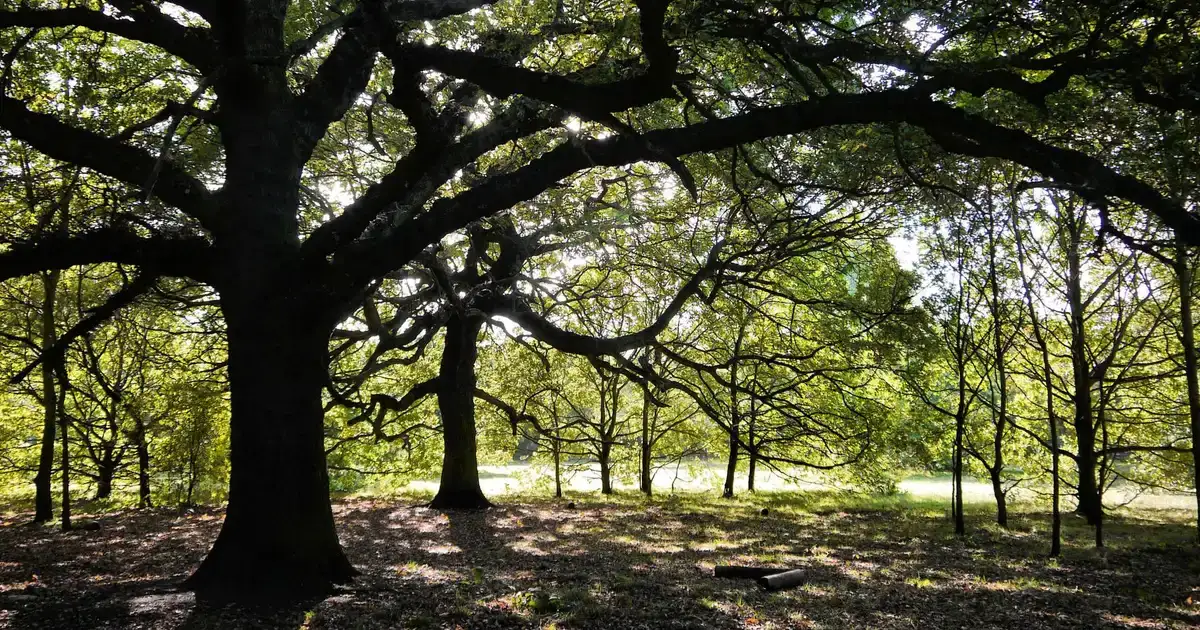
Every specification starts with a species, and for most of our range the species is oak. French white oak is the timber we run as the standard for solid and engineered boards. Buyers often ask why, and the honest answer is a list of practical traits: how the wood looks, how it carries stain and texture, how it wears and how it behaves in a factory. This guide sets out what the timber brings to a floor, so a specifier can judge whether it suits a project and which choices to make around it.
What the name covers
The oaks of the genus Quercus fall into two broad groups, the white oaks and the red oaks. French white oak belongs to the first group. In the trade the name usually refers to the two main European white oak species grown in France, Quercus robur and Quercus petraea, and the timber is sold under the label of its country of origin.
That label matters in two ways. It tells the buyer which wood group the floor belongs to, and it ties the board to a place the factory records. Incoming material is recorded by species, grade and origin, and the face oak is sorted by grain and color before production. Our page on moisture control in flooring production follows the timber from there.
The traits that matter in a floor
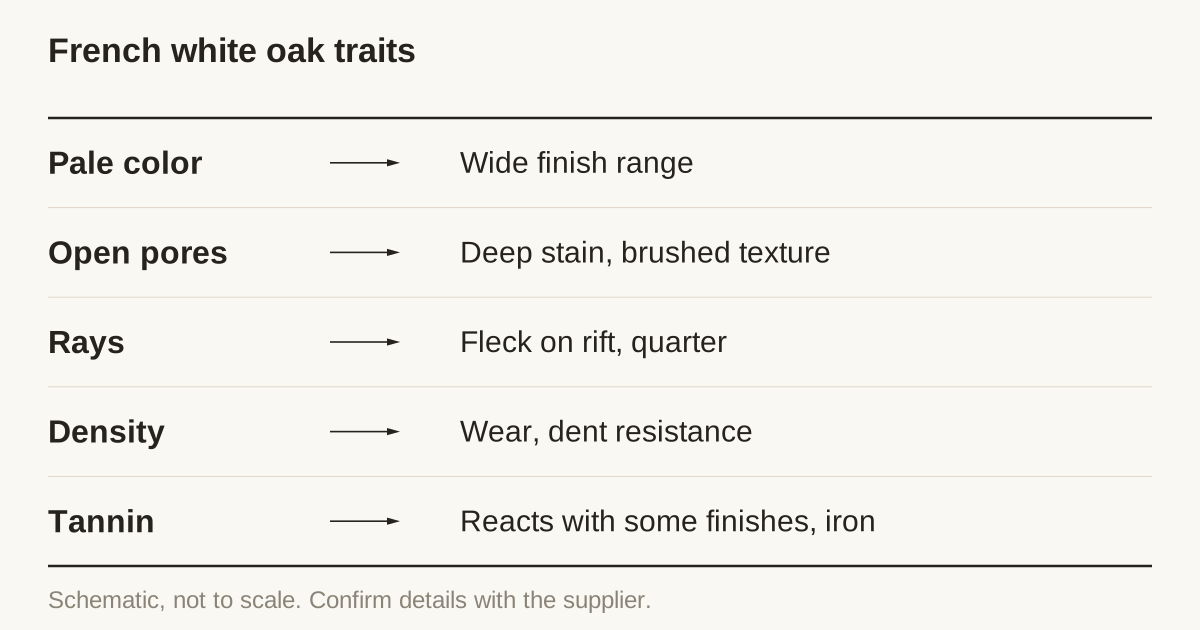
| Trait | What it looks like in the wood | What it means in the floor |
|---|---|---|
| Color | Pale cream to light tan, with a neutral to slightly warm tone | A wide starting range, from natural to dark |
| Grain | Straight to gently figured, with an open texture | Reads calmly in plank, strongly in rift and quarter |
| Pores | Large pores in the earlywood, in distinct rings | Takes stain well and holds brushed texture |
| Rays | Flat bands that cross the growth rings | Show as flecks on rift and quarter faces |
| Density | Hard and dense for a domestic timber | Good wear and dent resistance for most interiors |
| Tannin | Rich in natural tannins | Reacts to some finishes and metals |
Each trait is a strength and a point to manage. A neutral color suits a wide palette, and also shows undertone clearly once stained. An open grain takes color deeply, and also needs a finish chosen with care. We deal with the last of these in the article on oak tannin and finishes.
Color range and the library
Because the base color is pale and fairly neutral, oak accepts a very wide range of finished colors. Our library holds 211 colors, from clear oak to deep smoked browns, grouped into seven collections and eight color families. The clearer the finish, the more the timber itself shows: grain, ray fleck, color movement and knots. The darker the finish, the more the stain leads.
Natural color varies from tree to tree and board to board, even within one grade. Sorting before production narrows the range, and the grade decides how much natural movement stays in the face. See natural oak look flooring for the clear end of the range and dark oak flooring for the other.
Grain and cut
How a log is sawn changes what the board shows. Plain sawn faces show the familiar cathedral figure. Rift and quarter faces show straighter lines, and the rays appear as a subtle fleck. The same timber can make a lively floor or a very quiet one depending on the cut. Our guide to rift and quarter against plain sawn compares them.
Oak is a ring-porous wood, which means the earlywood in each ring is porous and the latewood is dense. That structure is why wire brushing works so well on oak. Brushes remove the softer earlywood and leave the harder latewood standing, and the grain opens into a visible relief. The same structure explains why stain collects in the pores and gives oak its depth of color.
Hardness and wear
White oak sits in the middle to upper range of hardness among common flooring timbers. That is enough for most residential, hospitality and light commercial interiors. Hardness is measured by the Janka test, and we explain what the number tells a buyer in white oak Janka hardness.
Hardness is only part of how a floor wears. The finish takes the daily abrasion, and the construction decides how the board is supported under a dent. A hard wood with a thin wear layer over a soft core can dent more than a hard wood on a firm one. For the options see oak flooring thickness and the wear layer guide.
Stability and construction
Oak is a stable timber for its density, but it still moves with humidity, and wide boards move more than narrow ones. Solid oak shows this more than an engineered board, because an engineered board restrains the face with a cross-layered or plywood core. For how the two constructions compare, see solid against engineered flooring and 2-layer against 3-layer engineered oak.
Finishing behavior
Oak takes most finishes well, which is a large part of why it is a standard choice. A few points matter in practice.
- Stain. The open pores take color deeply and evenly when the surface is prepared consistently. Individual boards still vary, so the approved sample is the reference.
- UV-cured coatings. Stain and topcoat are applied on our UV finishing line, with settings controlled to support consistency across a lot. See UV-cured finishes.
- Effects. Smoke, wash and two-tone finishes work on oak because the timber reacts with and holds color unevenly in useful ways. These are the Color and Effect UV route.
- Oil and site finishes. Oak accepts them as well, which is one reason Unfinished boards are a common order.
Working properties in the factory
Oak is dense and machines cleanly when the cutters are sharp. That helps the profile accuracy of tongue and groove joints, which is machined on all four sides. A dense timber also holds a precise profile after machining, as long as the panel was conditioned beforehand. The tongue and groove article covers the machines.
What French white oak is not
A short list prevents misunderstandings.
- It is not a uniform material. Variation is part of the product.
- It is not immune to dents, scratches or humidity. It resists them better than softer timbers.
- It is not the only choice for every project. A buyer who needs a different species should say so, and the answer is confirmed at quotation.
Documents and origin
Buyers in some markets need documents that follow the timber, and some need the formaldehyde documentation for the composite core. Ask for what your market requires, and see CARB P2, JAS and NWFA for the references we use. Where origin documentation matters, our note on EUDR and engineered oak flooring sets out the questions.
Sorting and grading before production
Timber is not used as it arrives. Face oak is sorted by grain and color, and the sorting is what lets a grade mean something. Boards with clean faces go to the quieter grades, and boards with knots, color movement and features go to the more expressive ones. The wear layer is then cut to the thickness on the specification and checked across the board.
For a buyer, this means the species is only the first filter. Two floors of the same oak can differ widely once grade, cut and finish are applied. The oak flooring grades explained article shows how the four grades are defined, and the RFQ checklist shows where species, cut and grade sit in a request.
Where oak suits a project
Oak suits a wide range of interiors because of its neutral base and its range of finishes. It works in homes, hotels, offices and retail, and it takes plank, herringbone and chevron formats equally well. It is less suited to places where a floor is permanently wet, where no timber is a sound choice. For projects with special conditions, such as radiant heating or a concrete slab, the construction matters more than the species. See engineered oak over radiant heating and engineered oak in hotels.
Choosing around the timber
| Decision | Quiet floor | Lively floor |
|---|---|---|
| Cut | Rift and quarter | Plain sawn |
| Grade | Premium or Select | Natural or Rustic |
| Texture | Smooth or Light Wire Brushed | Wire Brushed or with Cross Marks |
| Finish | Color UV in a mid tone | Clear UV or Color and Effect UV |
The species line is one of nine in the engineered oak flooring specifications guide.
Working with Vu Uy Wood
Vu Uy Wood manufactures solid and engineered French White Oak flooring to buyer specification in Song Than 3 Industrial Park, Ho Chi Minh City, and has done so since 2006. The Colors page shows the 211-color library on oak, and the Specify page builds a written specification around it. We normally reply within one working day.