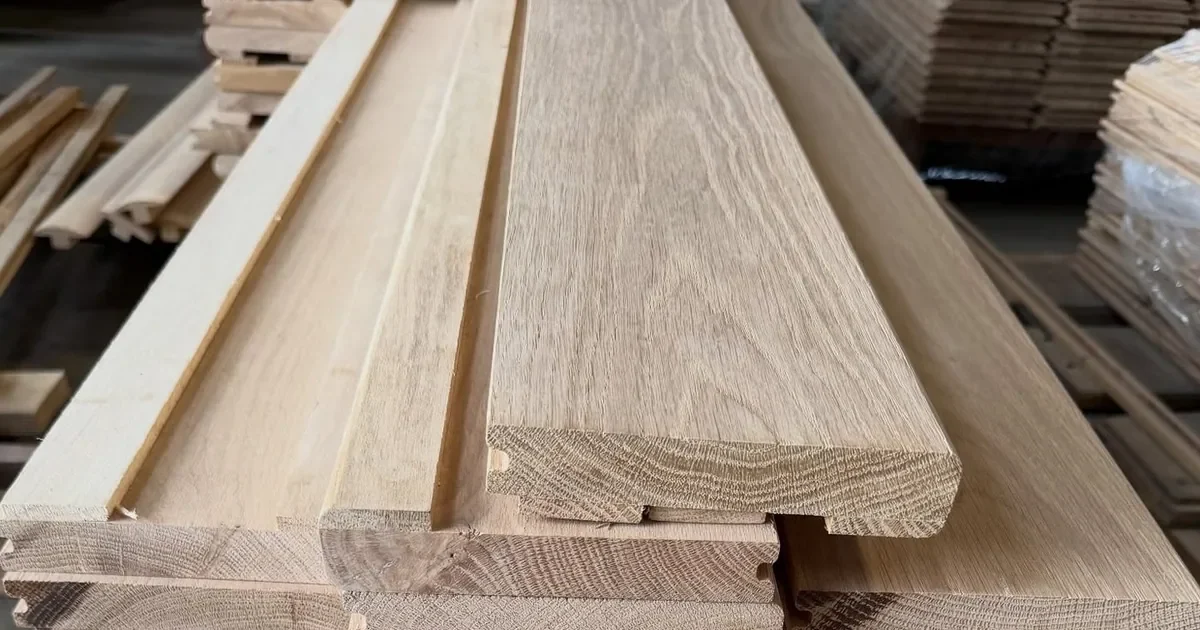
Engineered flooring terms are easier to use once each has one meaning. This glossary defines 34 terms a buyer meets in a quotation, grouped under build, wood, surface, profile and pattern, and paperwork, with a short guide at the end to using them in an RFQ. It is part of our guide to engineered oak flooring specifications. Where a term has a published definition we follow the NWFA’s 2025 installation guidelines and say so. A European terminology standard, EN 13756, also exists; we read its catalog scope only, so we rely on the NWFA definitions. A term that has its own article links to it once.
Build terms
2-layer engineered. A sawn oak wear layer bonded to a stable plywood core. It is our main engineered construction, a practical choice where floor height is limited, and it is commonly used for herringbone and chevron. See 2-layer vs 3-layer engineered oak.
3-layer engineered. An oak wear layer over a cross-layered core with a backing layer underneath, designed for greater dimensional stability. It suits wider boards and larger open areas. The NWFA describes the backing as the layer that provides balance, generally bonded under the core.
Balanced construction. An engineered build with materials of similar properties, such as stiffness and dimensional stability, bonded to both sides of the core, so that no single layer can pull the board out of shape as humidity changes (NWFA).
Bond (glue line). The adhesive layer that makes the face and core act as one panel. In our factory adhesive spread, press pressure and press time are controlled and the bond is checked. A weak bond can show as a lifting face. See wear layer bonding.
Core. The layer that provides thickness and dimensional stability. The NWFA notes that it can be wood, finger blocks or composite material. “Plywood core” is a category, not a specification, so ask for the build. See plywood core questions.
Overall thickness. The full height of the board from face to underside, which sets finished floor height. It is specified together with the wear layer, because two boards of the same overall thickness can carry different wear layers. See the thickness guide.
Solid. One piece of oak through the full thickness, with no core. It has the greatest refinishing allowance of our three constructions and is best suited to narrower boards. See solid vs engineered.
Wear layer. The outermost layer of an engineered board, the visible side once installed, also called the lamina or lamella (NWFA). It is the only part that can be sanded. All ours are sawn, from 0.6mm to 6mm. See the wear layer guide.
Wood terms
French white oak. The timber we run as the standard: white oak from France, usually Quercus robur and Quercus petraea. It belongs to the white oak group, with a neutral base color and an open, ring-porous grain. See French white oak flooring.
Grade. A sorting decision about the face: knots, color variation and natural features. We use Premium, Select, Natural and Rustic. Grade names are not a shared unit between factories, so ask for the written definition. See oak flooring grades.
Janka hardness. A test of how well a wood resists denting. It describes the wood, not the floor, because the finish and the construction also decide how a floor wears. See white oak Janka hardness.
Moisture content. The amount of water in wood, as a percentage of its oven-dry weight (NWFA). Wood is hygroscopic: below the fiber saturation point, usually taken as about 30 percent, it changes size as it takes up or gives off moisture. See moisture control in production.
Plain sawn. Cut with the growth rings mostly parallel to the wide face, 0 to 45 degrees (NWFA). The face shows arches and wider figure, and the cut has the highest yield from the log.
Rift and quarter sawn. Rift is cut with the rings at 30 to 60 degrees to the face and quarter at 45 to 90 degrees (NWFA). The face shows straighter lines, with ray fleck on quarter faces of white oak, and the cut has the lowest yield. See rift and quarter vs plain sawn.
Tannin. A natural compound in oak that reacts with ammonia, iron and alkaline products. That reaction makes smoked and fumed effects possible, and it is why some coatings react with oak. See oak tannin and finishes.
Surface terms
Approved sample. The finished physical sample the buyer signs off, carrying the color, grade, grain, texture and sheen. It becomes the master reference for production, and a screen is not an approval. See approving color on a sample.
Clear UV. Natural oak protected by a clear UV topcoat, with no added stain, for the lightest and most natural expression of the oak. Knots and color variation stay fully visible under a clear topcoat. See Clear UV vs Color UV.
Color and Effect UV. Color stain combined with an additional effect such as smoke, wash or a two-tone reaction, for more depth than a flat stain. The effects work because oak reacts with and holds color unevenly across its grain. See Color and Effect UV finishes.
Color UV. A color stain beneath a protective UV topcoat, our standard route for a colored floor finished in the factory. Stain and topcoat are applied and cured on our UV finishing line, so the approved reference can carry through the production lot. See UV-cured finish.
Sheen. How much light the surface reflects. Our sheens are Matte, Extra Matte and Ultra Matte, and the names differ between makers. The NWFA/NOFMA factory-finished standard states a gloss level within 5 of the stated level. See sheen levels.
Unfinished. Sanded and supplied ready for stain or finish on site, in contrast to factory-finished (also called prefinished) flooring, which is colored and finished at the factory (NWFA). See unfinished vs prefinished.
Wire brushing. Removes the softer wood between the growth rings and leaves the harder grain standing. Our levels run from Light and Medium Wire Brushed to Wire Brushed and Wire Brushed with Cross Marks. See wire-brushing levels.
Profile and pattern terms
Bevel. An edge that is not perpendicular to the face. The NWFA separates square edge, full bevel (typically over 1/16”, 1.6mm), micro bevel (typically up to 1/16”) and eased bevel. See square edge vs micro-bevel.
Chevron. A pattern of blocks with mitered ends at 45 or 30 degrees, forming a continuous point and a more formal rhythm than herringbone. Block width and angle are set from the drawing, with one fixed block length per order. See chevron vs herringbone.
End matched. Boards with a tongue on one end and a groove on the other, so end joints sit in the same plane as the long-side joints. It makes random length practical. See end-matched oak flooring.
Herringbone. A 90-degree pattern of left and right blocks, with one fixed block length per order. Left and right blocks are packed as pairs, so an imbalance stops installation. It is a classic choice for entrances, hallways and feature areas. See the herringbone specification guide.
Overwood (lippage). A perceived misalignment of the surface, with some boards raised above their neighbors (NWFA). It comes from thickness variation, subfloor flatness or profile fit, and on a prefinished floor it cannot be sanded out. See tongue and groove profile accuracy.
Square edge. An edge with no bevel, so boards abut without a broken plane (NWFA). It is available on request for a cleaner, more continuous surface, and the edge detail is stated as its own line on the specification, beside the tongue and groove profile.
Tongue and groove. A tongue milled on one edge and a groove on the opposite edge, so each board fits the next (NWFA). Ours is machined on all four sides, ends included, and it is the joint system for all our flooring.
Paperwork terms
CARB Phase 2. The formaldehyde emission limit for composite wood products. The NWFA notes that most engineered flooring sold in the U.S. carries a CARB P2 compliance statement; EPA’s federal rule, TSCA Title VI, has required labels since March 22, 2019. Ask for both statements. See CARB P2, JAS and NWFA.
EXW and FOB. Two Incoterms, trade terms that define the tasks, costs and risks of delivery between seller and buyer (ICC). The same floor quoted under each covers different work. See EXW vs FOB.
Packing list. The document listing cartons, pallets, SKUs and production lots in a shipment, checked against the order before loading. Carton labels show the SKU and lot, and for herringbone the left and right blocks are listed in matching quantities. See export packing.
Pre-shipment inspection. A check of finished, packed goods before loading, carried out by the buyer, a representative or a third-party inspector. It measures the order against the approved sample and the written specification, not against memory. See pre-shipment inspection.
RFQ. Request for quotation: the written specification, quantity and destination sent to a supplier so each line can be quoted separately. A line left blank is a question the supplier will ask or answer for you. See the RFQ checklist.
Using these terms in an RFQ
Write each line with one term and one value, in both units, so the quotation can answer each line separately. A specification sentence built from the terms above reads: “Engineered, 2-layer, 3/4” (20mm) overall, 6mm sawn wear layer, French White Oak, rift and quarter, Natural grade, 7-1/2” (190mm) face width, random length, tongue and groove on four sides, Color UV, Extra Matte, Light Wire Brushed, approved sample [reference].”
Three habits keep the vocabulary honest:
- Keep grade, grain and finish as separate lines, and approve them together on one finished sample.
- Ask each supplier for the written definition of any term on the quote that is not on your list.
- Name the standard and the edition when you cite one, as the NWFA’s wide plank class (over 5”) and our own wide plank article (from 7-1/2”, 190mm) show that a word can carry two lines.
Frequently asked questions
Are wear layer, lamina and lamella the same thing?
Yes. The NWFA defines the wear layer as the outermost layer of an engineered floor, the visible side once installed, and notes that the top layer is typically called the lamina or lamella. In a quotation, ask for its thickness separately from the overall thickness, and ask whether it is sawn.
Is plain sawn the same as flat sawn?
They describe the same cut. The NWFA calls a cut with the growth rings mostly parallel to the wide face plainsawn in hardwoods and flatsawn in softwoods. In oak flooring the term plain sawn is the usual one, and it is a separate line from grade, so write the cut next to the grade on the specification.
What does end matched mean?
Each board has a tongue on one end and a groove on the other, so end joints fit together in the same plane as the long-side joints. It lets random-length boards be laid with joints falling wherever the length runs out.
Working with Vu Uy Wood
We manufacture made-to-order solid and engineered French White Oak flooring in Song Than 3 Industrial Park, Ho Chi Minh City, and have done so since 2006. The Specify page applies these terms step by step and turns your selections into a written brief we can quote, and the full set of decisions is in our guide to engineered oak flooring specifications. We normally reply within one working day.
Sources
- NWFA, Wood Flooring Installation Guidelines, revised 2025: glossary and product chapter definitions.
- NWFA, Engineered Wood Flooring Refinishable Program, June 2022: wear layer, core and backing definitions.
- NWFA/NOFMA, International Standards for Factory Finished Solid Wood Flooring: gloss level guideline.
- EN 13756:2018 listing, wood flooring terminology: scope only; the standard text was not read.
- ICC, Incoterms 2020 rules: what trade terms define.
- EPA, Formaldehyde Emission Standards for Composite Wood Products: TSCA Title VI labeling date.